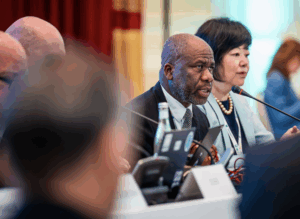
Todd Blanche thought he could walk into a standard House Appropriations Committee budget hearing and stick to a scripted defense of the Justice Department’s 2027 fiscal blueprint. He was wrong. When you are the Acting Attorney General and you recently greenlit a $1.8 billion taxpayer fund that could hand cold hard cash to January 6 rioters, nobody cares about your spreadsheet line items. They want answers.
Blanche's appearance before House lawmakers on June 2, 2026, became an interrogation. He didn't come to talk about the budget. He came to perform damage control for an administration that is rapidly retreating on one of its most controversial legal maneuvers yet.
The Slush Fund Nobody Wants to Defend
The core of the outrage stems from what the administration brands the "Anti-Weaponization Fund." To the Department of Justice, it is an appropriate remedy for individuals allegedly targeted by political prosecutions during the Biden administration. To critics—including a growing number of furious Capitol Hill Republicans—it looks like a multi-billion dollar political slush fund.
Lawmakers wasted no time grilling Blanche on the mechanics of this operation. Who gets the cash? Blanche has spent the last month trying to have it both ways. During a brutal Senate budget hearing in May, he stubbornly refused to rule out that those convicted of violence on January 6 could get payouts. He told interviewers that anyone who feels persecuted by the justice system is free to apply.
But the political temperature in Washington has changed dramatically over the last 48 hours. On Monday, word leaked that the administration is seriously reconsidering the fund. Even worse for Blanche, a Virginia federal court just issued a temporary restraining order blocking the entire setup for at least two weeks.
Behind closed doors, the bravado is completely gone. Texas Senator Ted Cruz recently revealed on his podcast that Blanche faced a near-rebellion from GOP senators in a private meeting, with lawmakers shouting at the nation's top law enforcement official. According to Cruz, a cornered Blanche was "adamant" that no one who assaulted police at the Capitol would see a dime. But out in the open committee room, his vague public statements haven't reassured a soul.
The Collusive IRS Deal and the Super Pardon
If the $1.8 billion payout fund wasn't enough of a lightning rod, Blanche spent his testimony dodging bullets over the shocking legal mechanics that created it. The fund didn't come from a congressional appropriation. It was born out of a quiet, highly unusual settlement of Donald Trump’s private lawsuit against the Internal Revenue Service over leaked tax returns.
Basically, Trump dropped his lawsuit. In exchange, Blanche signed the DOJ onto an agreement that "forever bars" the federal government from auditing the tax returns of Trump family members or their businesses.
House Democrats, led by Judiciary Committee Ranking Member Jamie Raskin, have labeled this the "Todd Blanche Super Pardon." It is an accurate description. A one-page addendum snuck into the settlement purports to grant blanket, permanent immunity to the Trump family and their corporate entities for any federal civil, criminal, or administrative violations—known or unknown.
Federal judges are already pushing back. Miami Judge Kathleen Williams reopened the IRS lawsuit, openly questioning whether Blanche and Trump committed a "fraud on the court." Williams noted the obvious conflict of interest: Trump is effectively the plaintiff and, as head of the executive branch, controls the defendant. The court wants to know if the two parties colluded to completely avoid judicial scrutiny. Blanche's signature is the only one on that audit exemption. He can't pass the buck here.
Capitol Hill Reacts
The fallout from this strategy has paralyzed Congress. This isn't just a partisan food fight. House and Senate Republicans are terrified of the optics of funding cash payouts for individuals who beat police officers with flagpoles.
The legislative gridlock is real. Senate Republicans left town last month without passing vital funding for immigration enforcement agencies. Why? Because rank-and-file conservatives refuse to vote for the Homeland Security spending bill until the White House strips the Anti-Weaponization Fund of its teeth or scraps it entirely. Blanche entered the House hearing room with almost no allies left on the dais.
Where the Justice Department Goes From Here
The Acting Attorney General’s smooth-talking defense lawyer routine is hitting a wall of constitutional reality. You can't settle a private tax dispute by inventing a $1.8 billion program out of thin air without Congress, and you certainly can't barter away the IRS's legal authority to audit a specific family forever.
Watch the courts closely over the next ten days. Trump's legal team must respond to Judge Williams' collusion inquiry by June 12. At the same time, the temporary injunction in Virginia forces the DOJ to freeze the fund entirely. If the administration wants to salvage its broader legislative agenda and keep the government funded, Blanche will likely have to formally kill the Anti-Weaponization Fund before the month is out. Expect the DOJ to quietly scale back the scope of the settlement, strip the January 6 language entirely, and attempt to decouple the Trump family's tax immunity from the public treasury.