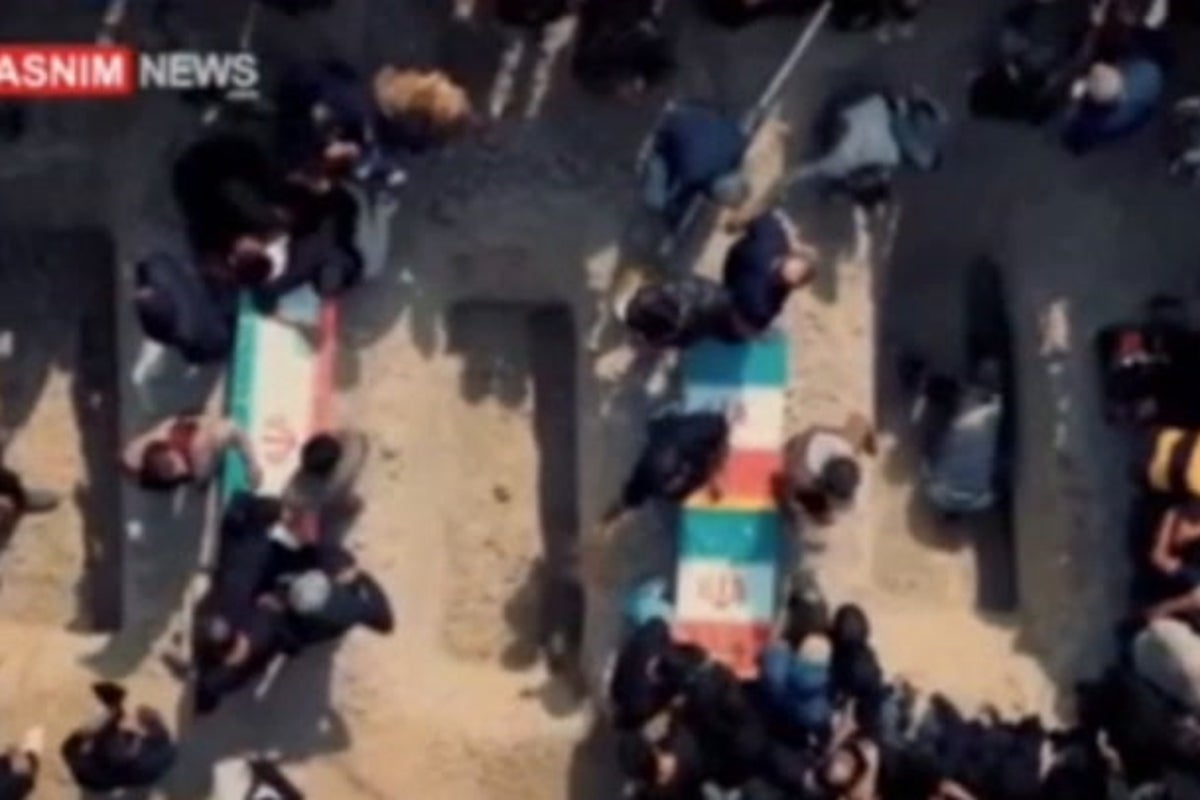
War has a way of turning the most mundane Saturday morning into a permanent scar. In the southern Iranian city of Minab, that scar is now a mass grave holding 165 people, most of them young girls who were just settling into their first lessons of the day. While military strategists talk about "surgical strikes" and "operational objectives," the reality on the ground in Hormozgan province is far messier. It's a scene of blood-stained backpacks and pink sandals covered in concrete dust.
The strike on the Shajareh Tayyebeh girls' elementary school on February 28, 2026, isn't just another statistic in the escalating war between Iran, Israel, and the United States. It's a flashpoint that has galvanized a grieving nation and raised uncomfortable questions about how modern "precision" warfare is actually conducted. When thousands of mourners filled the streets of Minab this Tuesday, they weren't just burying children; they were burying any hope of a quick or clean resolution to this conflict.
The Morning the Sky Fell
Saturday is a regular school day in Iran. At approximately 10:45 a.m., as classes were likely transitioning between periods, a missile tore through the Shajareh Tayyebeh school. The impact didn't just break windows; it collapsed half the structure, trapping students and staff under tons of reinforced concrete.
Iranian state media and local officials, including the Vice Governor of Hormozgan, Ahmad Nafisi, have been direct in their accusations, pointing to a joint U.S.-Israeli air raid. The numbers are staggering. While initial reports fluctuated, the final toll settled at 165 dead and 95 wounded. Most of these victims were girls aged 7 to 12.
Think about that for a second. An entire generation of young girls in one neighborhood, gone in a single afternoon.
Proximity is Not a Shield
The core of the controversy—and the likely reason for the strike—lies in geography. The school sits roughly 780 feet from the Shahid Absalan clinic, which is under the IRGC navy’s medical command. It's also near the Seyyed Al-Shohada barracks.
In the cold logic of target acquisition, "near" is often "close enough." U.S. and Israeli officials have been quick to distance themselves. Rear Admiral Daniel Hagari and Pentagon spokespeople like Pat Ryder have stated they are "investigating" or have "no connection" to the strike. They point to the proximity of IRGC facilities, suggesting that if a strike did occur, the school was either collateral damage or that the Iranian regime is using civilian "shields."
But open-source investigations, including satellite imagery analysis, show the school has operated as a distinct civilian facility since at least 2016. It has its own entrance, playgrounds, and those bright, hand-painted murals of crayons and apples that now sit behind yellow police tape. Using the presence of a nearby military base to justify the destruction of a primary school is a legal and moral stretch that even the most seasoned analysts find hard to swallow.
A Nation in Mourning
The funeral in Minab was a sea of black chadors and Iranian flags. It wasn't just a local event; it was a state-sanctioned outpouring of grief and rage. Thousands of people lined the streets as trucks carried coffins draped in the national colors.
You don't need to be a geopolitical expert to see how this plays into the hands of the Iranian leadership. President Masoud Pezeshkian didn't mince words, stating that "attacks on schools target a nation’s future." For a regime often at odds with its own youth, this tragedy has provided a rare moment of national unity. Even those who have spent years protesting the government are finding it hard to stay silent when their children are the ones being pulled from the rubble.
International Reaction and the Law of War
UNESCO and Nobel laureate Malala Yousafzai have condemned the bombing as a "grave violation of humanitarian law." Under the Geneva Conventions, schools are protected civilian objects. Even if a military target is nearby, the principle of proportionality must apply.
- Distinction: Combatants must always distinguish between civilians and military targets.
- Proportionality: The expected civilian harm cannot be excessive in relation to the concrete military advantage.
- Precaution: Every effort must be made to minimize civilian casualties.
Looking at the wreckage in Minab, it's difficult to argue that any of these three pillars remained standing. If the goal was to take out a barracks, hitting a school with 170 children inside is, at best, a catastrophic intelligence failure and, at worst, a war crime.
The Long Road from the Rubble
The search for survivors ended on March 1, but the political and social fallout is just beginning. Iran has already launched retaliatory drone strikes across the region, targeting U.S. installations and allied Gulf states. The cycle of "eye for an eye" is spinning faster than anyone can track.
For the people of Minab, the geopolitics are secondary. They’re dealing with empty desks and a silence in the hallways that won't be filled anytime soon. Human rights organizations like Hengaw and various teachers' associations are trying to document the names of every child lost, even as internet blackouts make independent verification nearly impossible.
If you want to understand where this war is headed, don't look at the maps in the Pentagon or the headlines in Tehran. Look at the images of the Shahid Absalan clinic and the Shajareh Tayyebeh school side by side. One is a legitimate military interest; the other is a graveyard for schoolchildren. Until the "precision" of modern warfare can actually tell the difference, the "collateral damage" will continue to be the only thing the world remembers.
Keep an eye on the official investigation reports from CENTCOM and the IDF over the next week. Their willingness—or refusal—to acknowledge the specifics of the Minab strike will tell you everything you need to know about how the 2026 conflict will be fought. For now, the best way to support the families is to ensure their names aren't lost in the noise of the broader war.

.jpg)

