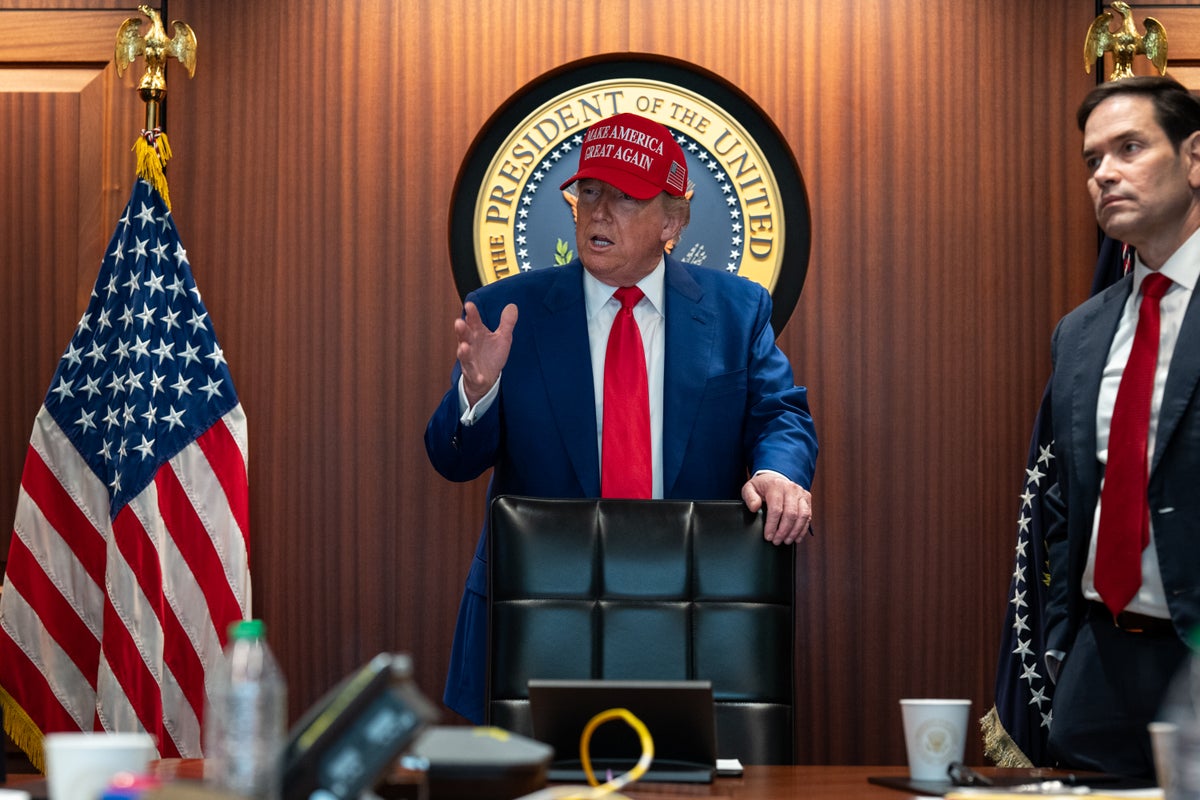
Donald Trump didn't just stumble into a war with Iran. He didn't simply "leverage" a geopolitical crisis or "foster" a new strategy. He walked right into a pre-existing American psychological trap. If you've been watching the news lately—the drone strikes, the blockaded Strait of Hormuz, the skyrocketing gas prices—you've probably felt that familiar, heavy dread. But there's something else beneath the surface, isn't there? A weird, jagged energy that feels less like fear and more like a collective urge to just watch it all burn.
It's not just about oil or nuclear centrifuges. It’s about a specific American itch that Trump knows exactly how to scratch.
The Cowboy Myth and the Need for a Villain
America has always had a thing for the lone avenger. We love the guy who rides into a corrupt town, ignores the rules, and cleans house with a six-shooter. Trump’s rhetoric on Iran—calling for "regime change from the skies" while claiming the war is already "won"—fits this archetype perfectly. It’s the ultimate shortcut. Why deal with messy diplomacy when you can just kick the door down?
Psychologists call this a "collective narcissistic injury." For decades, we were told we were the "shining city on a hill." Then the world changed. The economy shifted. Other countries started rising. When a nation feels its status slipping, it doesn't usually look for a therapist. It looks for a scapegoat. Iran, with its decades of history as the "Great Satan" in the American imagination, is the perfect candidate.
We aren't just fighting a country; we’re trying to kill our own sense of decline.
Destruction is a Distraction
Let’s be real about the timing. You’ve seen the polls. By late 2025, Trump’s approval was sagging. People were talking about the "Epstein files" again. Inflation was eating everyone’s lunch. Then, suddenly, we’re striking Iranian missile sites.
There’s a reason 40% of Americans in recent surveys believe this conflict is a distraction from domestic scandals. War provides a "moral clarity" that peace never can. In a war, the world is binary. Good vs. Evil. Us vs. Them. It’s much easier to focus on a burning oil tanker in the Persian Gulf than on why you can't afford a house in the suburbs.
The Cost of the "Cakeism" Strategy
Trump’s foreign policy is built on "cakeism"—the idea that you can have your cake and eat it too. He tells his base we’re going to "whack the bad guys" but promises we won't get bogged down in "stupid wars."
It’s a lie.
You can't blockade one of the world's most vital energy arteries and expect cheap gas. Nearly 90% of Americans now admit this conflict is driving up prices at the pump. We want the catharsis of the explosion without the bill that follows.
- Over 13 U.S. service members have died since February 2026.
- The Pentagon is asking for $200 billion in new funding.
- 70% of shipping traffic through the Strait of Hormuz has vanished.
The "appetite for destruction" is fun until the waiter brings the check.
Why We Can't Look Away
There’s a dark thrill in seeing a "strongman" ignore the international community. When Sir Keir Starmer and other European leaders call for diplomacy, and Trump basically tells them to mind their own business, a certain segment of the American public feels a rush of pride. It feels like agency. It feels like we’re finally "doing something."
But look at the data. Even among the MAGA base, support is fracturing. Opposition to the war has jumped 10 points in the last month. People are realizing that "winning" a war in 2026 isn't like a movie. There's no credits roll. There's just more debt, more dead kids, and more expensive gas.
The Mirror Iran Holds Up
We think we’re changing Iran, but the war is actually changing us. It’s exposing the fact that a huge chunk of our political identity is now tied to grievance. We don't have a vision for the future, so we settle for a spectacular present.
If you want to understand why we’re here, stop looking at maps of Tehran. Look at the mirror. We’re a country that would rather see a massive fireball on the evening news than have a difficult conversation about our own fading influence.
The next step isn't just a ceasefire in the Persian Gulf. It’s a reality check at home. Start by looking at the actual numbers: $200 billion for a war with no clear end date versus the cost of fixing the bridge in your own town. Demand a timeline. Demand to know why "winning" looks so much like losing. If we don't curb this appetite for destruction now, it won't be Iran that ends up in ruins—it'll be the American dream we claim to be protecting.