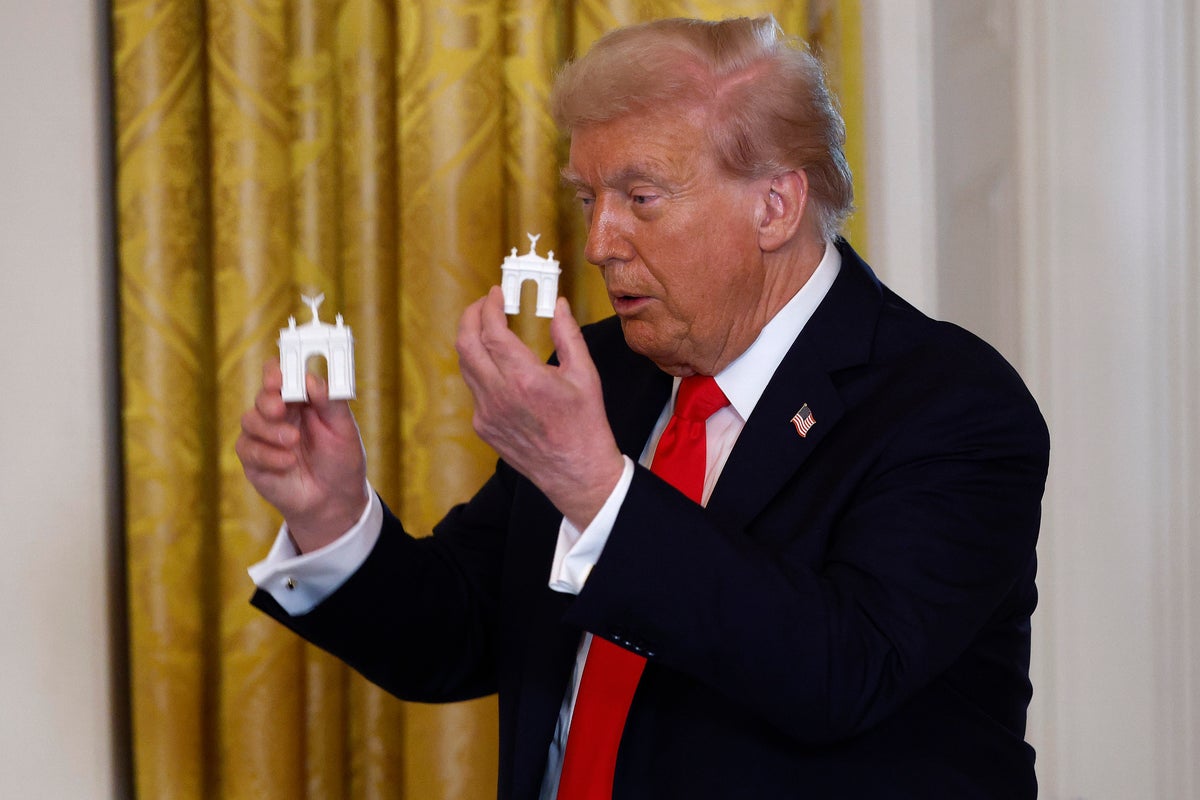
Donald Trump isn't exactly known for thinking small. If you've been following the latest architectural drama in D.C., you know he's already pushing for a massive 250-foot "Independence Arch" to celebrate America's 250th birthday. But the real story isn't just about one oversized monument. His latest picks for the Commission of Fine Arts (CFA) are now signaling that one arch might not be enough. We’re looking at a vision for three.
Rodney Mims Cook Jr., the man Trump recently tapped to chair the commission, hasn't been shy about his ambitions. Cook is a traditionalist who views the current "monumental core" of Washington as unfinished. He's argued that for the city's grand design to actually feel complete—and to truly mirror the imperial aesthetic of world capitals like Paris or Rome—D.C. needs a trio of arches.
This isn't just about "beautification" in the way most people think of it. It's a fundamental move to rewrite the skyline of the capital.
The Vision Behind the Trio of Arches
The proposed "primary" arch is already causing enough of a stir. Planned for a spot near the Lincoln Memorial and Arlington National Cemetery, it's designed to dwarf everything around it. At 250 feet, it would stand more than twice as tall as the Lincoln Memorial. It's got the works: gilded eagles, four lions at the base, and a statue on top that looks like a mashup of Lady Liberty and a Roman goddess.
But Cook’s argument for three arches goes deeper into the history of D.C.’s urban planning. He points to the McMillan Plan of 1902, which tried to bring the city back to the grand, neoclassical roots laid out by Pierre L’Enfant. The logic is that arches shouldn't just be standalone objects; they should serve as "gateways" that frame the city's most important axes.
If you look at the geography, the proposal isn't random. One arch handles the bridge from Virginia. The others would likely be positioned to "anchor" different entrances to the Mall, creating a visual enclosure that the city currently lacks. For some, it’s a return to classical glory. For others, it’s an expensive, gilded intrusion on a landscape that’s supposed to be about democracy, not triumphs.
Why the Commission of Fine Arts Matters Right Now
Most people have never heard of the Commission of Fine Arts, but it’s basically the HOA for the entire federal government in D.C. They have the power to approve or nix any design, statue, or building within the city's core. Trump has spent the last few months aggressively remaking this panel.
He didn't just pick Cook. He also appointed James McCrery—the very architect who was originally working on the $400 million White House ballroom project. It’s a bold move. Essentially, the people who designed the vision are now the ones sitting on the board that has to approve it.
The New Players on the Board:
- Rodney Mims Cook Jr. (Chairman): A massive proponent of the "Classical" style. He’s the driving force behind the idea that D.C. needs more than one arch.
- James McCrery: A traditionalist architect who knows the "Trump style" inside and out.
- Roger Kimball: A conservative art critic who has long railed against modern, abstract architecture in public spaces.
With this lineup, the "modernist" era of D.C. architecture is effectively on life support. This group doesn't want glass boxes or abstract slabs. They want granite, marble, and gold. They want structures that look like they could have been built in 100 AD.
The Massive Backlash and Legal Hurdles
You don't just drop a 25-story gilded arch next to the Lincoln Memorial without a fight. The pushback has been immediate and fierce. A group of veterans and historians has already filed suit to stop the project. Their main beef? The sightline.
If you stand at the Lincoln Memorial and look toward Arlington House, you’re looking at one of the most sacred views in American history. It’s meant to symbolize the healing of the nation after the Civil War. Critics say plopping a massive triumphal arch right in the middle of that view is architectural vandalism.
Then there's the height. D.C. has very strict rules about how tall buildings can be. While federal projects sometimes find ways around local zoning, the sheer scale of a 250-foot structure makes it hard to ignore. It would be nearly half the height of the Washington Monument.
Is This Actually Going to Happen?
The "three arches" plan is currently more of a philosophical goal than a construction-ready blueprint, but the first arch is moving fast. The CFA recently voted to approve the "concept design" for the Independence Arch. That’s a huge step. It means they’ve cleared the hurdle of whether the arch should exist and are now just arguing over the details—like whether the gilded eagles on top are too much.
Trump's goal is to have the first arch finished by July 2026, just in time for the Sestercentennial. It’s a tight timeline for a project of this scale. Typically, something like this would take a decade of environmental impact studies and public hearings. But with a commission filled with loyalists, the usual red tape is being cut with a very large pair of scissors.
The real question isn't just about the arches, but about what they represent. Are we a nation that builds monuments to "Triumph," or a nation that prefers the quiet dignity of the existing Mall?
If you're planning a trip to the capital in the next two years, don't expect the skyline to look the same. If the commission gets its way, the era of the "uncluttered" Mall is over. You're going to see a lot more gold, a lot more marble, and at least one—possibly three—massive gateways that you won't be able to miss from five miles away.
Keep an eye on the next CFA meeting in May. That's when we'll see if the "three arches" idea moves from a chairman's dream to an official proposal. If it does, the legal battles are only going to get crazier.
Watch the court filings for the "Save the Sightline" lawsuit. That's the only thing that actually has the power to stop the bulldozers at this point. If that suit fails, the "gilded age" of D.C. architecture is officially here.