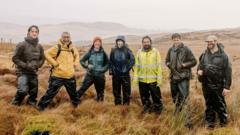
The shovel hits the dirt with a satisfying thud. It is a crisp morning in a Scottish glen, the kind of air that tastes like cold iron and wet wool. You are standing there, boot pressed firmly onto the spade’s shoulder, ready to plant a sapling. It is a noble act. You are fighting climate change. You are building a legacy. You are, quite literally, rooting for the future.
But beneath your boots, a silent war is being lost.
We have spent decades thinking that a forest is just a collection of trees. We measure success in stem counts and hectares covered. We look at a hillside of green needles and think, "Job done." Yet, across the globe, these meticulously planned woodland creation projects are failing at an alarming rate. They look like forests, but they are biological ghost towns. The trees are stunted. Their needles are yellowing. They are standing in the dirt, but they are not connected to the land.
The reason is invisible. It is a thread thinner than a human hair, and it is the only thing standing between a thriving ecosystem and a graveyard of expensive timber.
The Great Disconnect
Imagine trying to run a modern city without a single fiber-optic cable, phone line, or electrical grid. You have the buildings. You have the people. But nobody can talk to each other. Resources can’t be shared. A fire in one district goes unnoticed by the station two blocks away until the whole neighborhood is ash.
That is exactly what a tree feels like when it is planted into "dead" soil.
Traditional woodland creation often treats soil like a structural medium—basically just brown Styrofoam that holds the tree upright. We clear-fell old sites, churn up the earth with heavy machinery, and perhaps douse it with fertilizer. In doing so, we shred the mycorrhizal fungi. These are the "fungal roots" that have co-evolved with trees for over 400 million years.
Scientists are finally realizing that a tree is not an individual. It is a hub in a massive, subterranean neural network. These fungi extend the reach of a tree’s roots by up to a thousand times. They mine the rocks for phosphorus and nitrogen, delivering those nutrients to the tree in exchange for the liquid carbon (sugar) the tree produces via photosynthesis.
When we plant a sapling into soil stripped of its specific fungal partners, we are essentially dropping a newborn infant into a desert and expecting it to find its own water.
A Tale of Two Saplings
Consider a hypothetical forester named Elara. She has two plots of land.
On Plot A, she follows the old manual. She clears the scrub, tilling the earth until it’s uniform. She plants 2,000 Sitka spruce. They look great for six months. But then, a drought hits. Because these trees have no fungal network to reach deep into the soil pores for residual moisture, they stress. They shut down. By year three, 40% are dead. The survivors are weak, making them easy prey for bark beetles.
On Plot B, Elara tries something different, informed by the latest fungal research. She doesn't just plant trees; she inoculates the site. She uses soil "plugs" from a nearby ancient woodland, rich in native spores. Or perhaps she uses a tailored fungal slurry developed in a lab to match her specific tree species.
The difference isn't immediate. In fact, Plot B might look slower at first. But beneath the surface, a partnership is forming. The fungi are weaving into the root tips. They are building a "Wood Wide Web." When the same drought hits Plot B, the older, more established trees in the perimeter—or even the fungi themselves—shuttle water to the struggling saplings.
The forest survives because it is a community.
The Math of the Macroscopic
The stakes are not just aesthetic. They are mathematical.
Recent studies into fungal-supported woodland creation suggest that trees with a healthy mycorrhizal base can sequester carbon significantly faster than those without. We are talking about a massive leap in efficiency. If we are relying on "woodland creation" to hit net-zero targets, we cannot afford to wait 50 years for a forest to figure out how to talk to its neighbors.
The carbon isn't just in the trunks and the leaves. In a healthy forest, a staggering amount of carbon is pumped underground into the fungal biomass. It stays there. It becomes part of the earth. When we ignore the fungi, we are effectively leaving half of our carbon-scrubbing potential on the table.
But the research is tricky. You can’t just throw any mushroom at any tree. It is a highly specific "lock and key" mechanism. A Scots Pine requires a different fungal partner than an Oak. Some fungi are "generalists," while others are "specialists" that only appear once a forest reaches a certain age.
This is the frontier of modern forestry. We are moving away from the era of the chainsaw and into the era of the microscope.
The Ghost in the Machine
There is a certain humility in this realization. For a long time, humans thought we were the primary actors in the story of the forest. We thought we "made" the forest.
The truth is more humbling: the fungi are the architects. They were here before the trees, and they will likely be here after us. They manage the flow of information. They decide which trees get the nutrients and which are left to wither. They even facilitate "chemical signaling." If a deer starts munching on a leaf on the west side of a grove, the fungi can transmit a distress signal through the roots, prompting trees on the east side to flood their leaves with bitter tannins before the deer even arrives.
It is a slow-motion intelligence.
When we ignore this, our "forests" are just rows of silent, lonely pillars. They are fragile. They are quiet. If you’ve ever walked through a commercial plantation and noticed how eerie and silent it is compared to an ancient wood, you have felt the absence of this network. No birds, no insects, no rustle of a complex understory. Just the sound of wind through dead-end branches.
Healing the Wound
So, how do we fix it?
The research currently being conducted in the UK and across Europe is looking at "Microbial Priming." This involves mapping the fungal DNA of healthy, ancient forests and trying to replicate that "biological fingerprint" in new sites.
It also means changing how we treat the land. It means less tilling, which slices through the fungal hyphae like a knife through a nervous system. It means leaving "mother trees"—older, established trees that act as anchors for the fungal network—even when a site is being harvested or replanted.
We are learning to be less like decorators and more like matchmakers.
It is a shift in perspective that requires us to look down instead of up. We are obsessed with the canopy—the grand, soaring reaches of the timber. But the destiny of that canopy is decided in the dark, in the damp, and in the microscopic.
Next time you see a headline about a million trees being planted, don't just look at the number. Ask about the soil. Ask if those trees have been given the tools to speak to one another. Because a tree without its fungal shadow is just a piece of wood waiting to fall.
The forest is not the trees. The forest is the connection between them. We are finally learning how to weave that web back together, one spore at a time.
The spade goes back into the shed. The boots are kicked off by the door. Outside, in the rain, the sapling stands alone. But if we have done our job right, it isn't actually alone. Beneath the soil, a tiny, white thread is reaching out, searching for a hand to hold in the dark.
And finally, it finds one.