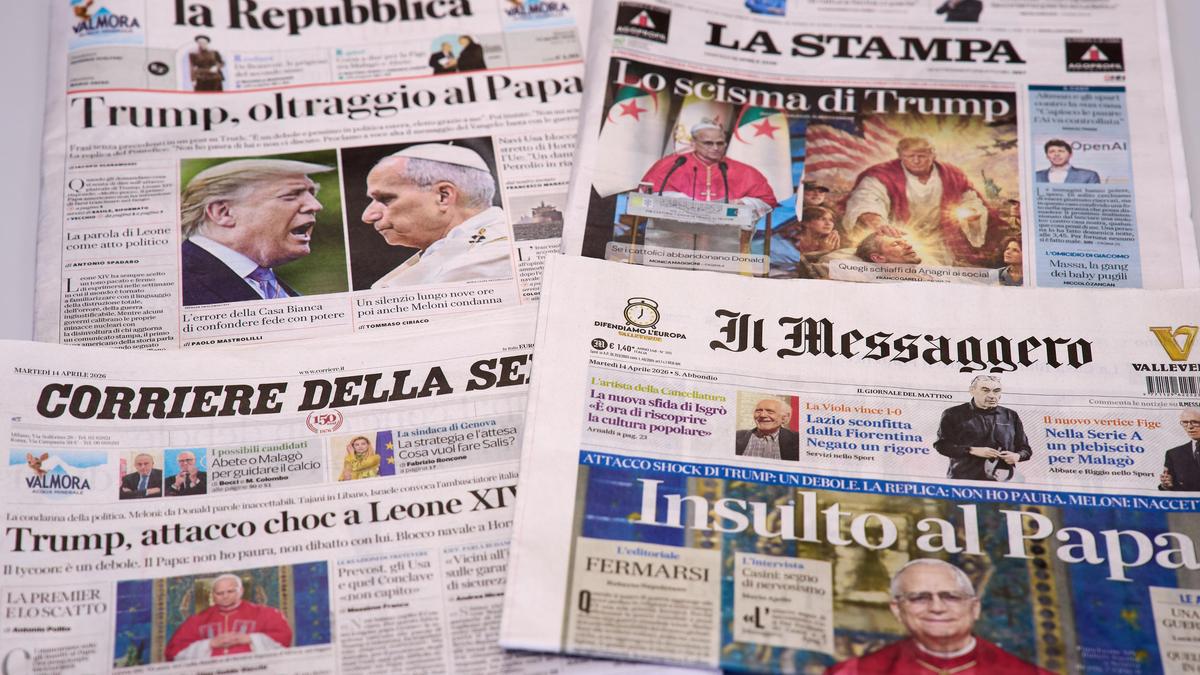
The collision was inevitable, but the ferocity is unprecedented. For the first time in over a century, the Roman Catholic Church and the executive branch of the United States are locked in a struggle that transcends mere policy disagreements. It is a fundamental dispute over who holds the moral mandate to define the American identity.
When Donald Trump took to social media this week to brand Pope Leo XIV "weak" and "terrible for foreign policy," he wasn't just venting at a world leader. He was firing a salvo in a brewing theological and geopolitical insurgency. The Chicago-born Leo XIV, formerly Robert Prevost, is the first American to sit on the Chair of Saint Peter. His elevation in 2025 was widely seen as a strategic move by the College of Cardinals to bridge the gap between the Vatican and the world’s most powerful, yet increasingly polarized, democracy. Instead, it has created a lightning rod for a new "Americanist" crisis.
The Chicago Pope vs the Mar a Lago President
The immediate catalyst for this rupture is the escalating conflict in the Middle East. As the Trump administration justifies "overwhelming violence" in Iran through a lens of American messianism, Leo XIV has pivoted toward a searing critique of what he calls the "delusion of omnipotence." This isn't just the usual Vatican call for peace; it is a direct challenge to the nationalist theology that has become the backbone of the current White House.
Trump’s response—asserting that Leo XIV "wouldn't be in the Vatican" if not for him—reveals a transactional view of the papacy that the Church finds abhorrent. By framing the Pope as a political appointee who owes him loyalty, Trump has effectively declared that the Gospel must be subordinate to the "America First" agenda. This is the heart of the battle. It is not about taxes or border fences; it is about whether a religious institution with a billion followers must bow to the sovereign will of a single nation-state.
The 1891 Blueprint
To understand why this is happening now, we have to look back to 1891. Pope Leo XIII—the namesake chosen by the current pontiff—issued Rerum Novarum, a document that fundamentally changed how the Church viewed the modern world. It was a "third way" that rejected both the greed of unchecked capitalism and the atheism of socialism.
Leo XIII was the first to grapple with the "American problem." He admired the energy of the young republic but feared its radical individualism. In 1899, he issued a warning against "Americanism," a heresy where the faithful believe they can "tone down" difficult Church teachings to better suit the national culture.
Today, we see a mirror image of that struggle. The Trump administration’s supporters often treat their political identity as their primary religion, with Catholic social teaching serving as an optional buffet. When Vice President JD Vance tells the Vatican to "stick to matters of morality," he is echoing a centuries-old attempt to domesticate the Church—to keep it in the sacristy and out of the streets where the real power is wielded.
The Nuclear Divide
The rhetoric turned radioactive when Trump suggested the Pope was "OK with Iran having a nuclear weapon." This is a classic move from the populist playbook: transform a complex moral argument into a binary security threat. Leo XIV’s position is grounded in the "Just War" tradition, which has become increasingly skeptical of any military action in the age of total destruction.
While the White House uses religious language to sanctify war, the Pope is stripping that sanctification away. He is telling American Catholics that they cannot serve two masters. You cannot pray for "mercy" on Sunday and "annihilation" on Monday. This creates an impossible tension for the millions of Catholics who comprise the swing vote in the American Rust Belt.
Why the Church Can't Back Down
For the Vatican, this isn't just about Trump. It’s about a global trend where national leaders—from Orbán in Hungary to the populist movements in Latin America—are attempting to co-opt the Church's moral authority for tribal ends. If Leo XIV allows himself to be intimidated by a U.S. President, he loses his authority to speak to the rest of the world.
The American bishops, usually a fractured group, have found a rare moment of unity in defending the Pope. They recognize that if the President can successfully frame the Vicar of Christ as a "Radical Left" politician, the Church’s ability to act as a moral arbiter in American life is finished.
The End of the Ceasefire
The "ceasefire" between the Vatican and the Trump administration was always a fragile illusion. It relied on both sides avoiding the big questions of sovereignty and sacrifice. Those questions are now front and center.
The President believes he was elected in a "landslide" to execute a specific vision of American power. The Pope believes he was elected by the Holy Spirit to protect human dignity from that very same power when it oversteps its bounds. These two visions are no longer compatible.
This isn't a policy debate. It's a divorce. And as the rhetoric moves from the halls of the Vatican to the campaign rallies of the American heartland, the question is no longer whether the Church and the State can get along. The question is which one the American Catholic will follow when the orders from Rome and the orders from Washington finally, and irreversibly, collide.
The era of the "patriotic" Catholic who can effortlessly balance the flag and the cross has ended. In its place is a stark, uncomfortable choice that neither the President nor the Pope seems willing to help them avoid.