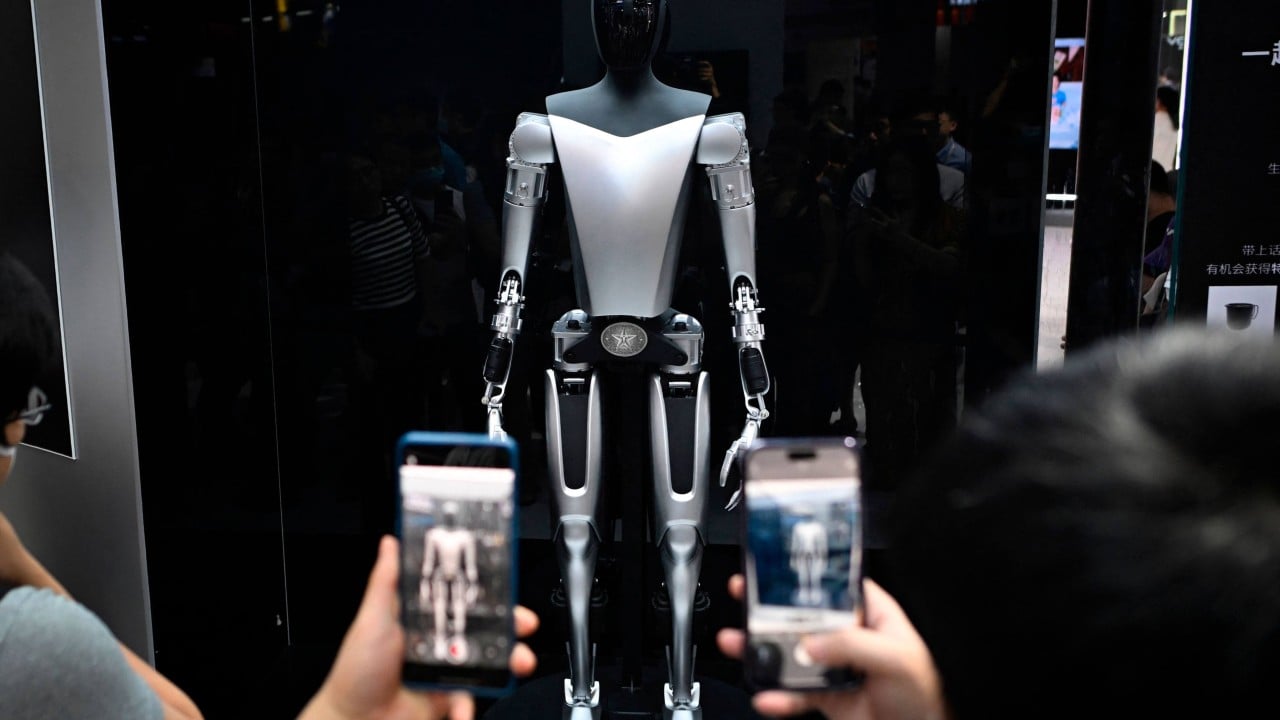
The transition from high-volume automotive manufacturing to humanoid robotics production at Giga Shanghai represents more than a product pivot; it is an exercise in maximizing the yield of existing supply chain densities. While public discourse focuses on the novelty of the Optimus bot, the structural reality is that the humanoid form factor is a derivative application of Tesla’s established electric vehicle (EV) architecture. The proximity to high-precision component suppliers in the Yangtze River Delta creates a unique geographic advantage that reduces the cost-to-scale ratio, a metric that remains the primary bottleneck for general-purpose robotics.
The Convergence of Automotive and Robotic Architectures
The manufacturing of a humanoid robot requires three fundamental subsystems: structural actuation, energy density management, and autonomous compute. Giga Shanghai’s existing infrastructure for the Model 3 and Model Y lines already solves the most difficult portions of this triad.
Power Electronics and Battery Density
A humanoid robot operates under extreme spatial constraints. Unlike an EV, where the battery pack can be distributed across a flat floorpan, a robot requires a centralized, high-output energy source that does not compromise the center of gravity. Giga Shanghai’s experience in integrating 4680-style cells and managing thermal dissipation in compact environments is directly transferable. The robot’s battery pack functions as a structural member, a concept refined through the development of the structural battery pack in automotive lines. This reduces redundant mass, which directly increases the robot’s operational window between charge cycles.
Actuator Complexity vs. Scale
The human body contains over 200 degrees of freedom, but for industrial and domestic utility, a humanoid must master approximately 28 to 40. The manufacturing challenge lies in the mass production of custom actuators—the motors and gearboxes that facilitate movement. These components are currently the highest cost-driver in robotics. Giga Shanghai sits at the center of a "four-hour delivery circle" of suppliers specializing in rare-earth magnets, precision gears, and sensors. By leveraging the same procurement pipelines used for EV drive units, Tesla can drive down the bill of materials (BOM) through sheer volume—a strategy that competitors lacking internal manufacturing capacity cannot replicate.
The Logistics of Localized Industrial Clusters
Giga Shanghai’s success is predicated on the "Delta Effect." The concentration of Tier 1 and Tier 2 suppliers in the surrounding provinces allows for a just-in-time inventory system that minimizes capital tied up in logistics.
- Precision Machining Dominance: The region leads in the production of harmonic drives and cycloidal reducers. These are critical for the smooth, high-torque movements required for robotic limbs. In a traditional robotics company, these parts are sourced at low volumes with high margins. Tesla’s presence allows for the commoditization of these high-precision components.
- Rapid Prototyping Cycles: The feedback loop between engineering and the factory floor in Shanghai is shortened by the local presence of tooling and die-casting experts. When a design change is made to an actuator housing, the lead time for a new mold or CNC program is measured in days, not weeks.
- Labor Efficiency in Assembly: While the robot is intended to automate labor, the initial assembly of the robots themselves requires high-skill technician oversight. Shanghai offers a massive pool of manufacturing engineers who have spent the last five years optimizing the most efficient automotive plant in the world.
The Cost Function of Humanoid Viability
For a humanoid robot to achieve market penetration, its total cost of ownership (TCO) must be lower than the cost of human labor for the same tasks. This is not merely about the purchase price; it is a function of durability, energy consumption, and maintenance.
- Production Cost: Target manufacturing costs for Optimus are estimated to be under $20,000. Achieving this requires a level of vertical integration where the software (AI) and hardware (actuators/sensors) are designed in tandem.
- Maintenance Cycles: Using automotive-grade testing protocols, Tesla can subject robotic joints to the same rigorous stress tests used for suspension components. This ensures a mean time between failures (MTBF) that exceeds current industry standards for collaborative robots (cobots).
The structural bottleneck for humanoid robots is the "Hand Problem." Replicating the human hand’s dexterity requires a density of sensors and motors that currently defies mass production. However, Giga Shanghai’s advantage lies in its ability to standardize these complex assemblies. By treating the robotic hand as a modular sub-assembly—similar to a car’s infotainment system—Tesla can iterate on the hand’s design without halting the production of the main chassis.
Compute and the Training Pipeline
The intelligence of the robot—the "brain"—relies on the FSD (Full Self-Driving) computer. The hardware currently being installed in vehicles at Giga Shanghai is the same hardware that will power the robots. This creates a massive economy of scale for silicon procurement.
The real-world data gathered by the millions of Tesla vehicles on the road provides the foundation for the robot’s vision system. When a car learns to identify a pedestrian or a curb, that spatial intelligence is shared with the robot via a unified neural network architecture. The robot does not need to be taught how to see; it inherits a vision system that has already been "trained" by billions of miles of driving data. The manufacturing plant then becomes the first "gym" for these robots. Before Optimus is sold to external customers, it will be deployed within Giga Shanghai to perform repetitive tasks such as moving parts between workstations or inspecting paint quality. This creates a closed-loop system where the factory produces the labor that further optimizes the factory.
The Strategic Shift from Mobility to Utility
The move toward robotics signals a fundamental shift in the definition of "transportation." If a car is a robot that transports people, a humanoid is a robot that transports objects or performs labor. The underlying technology stack is identical.
The primary risk in this transition is not technical, but regulatory and supply-chain-centric. Dependence on rare-earth elements for high-performance motors remains a vulnerability. Furthermore, the export of high-level AI hardware is subject to shifting geopolitical constraints. Tesla’s strategy of localizing both the supply chain and the manufacturing in China mitigates some of these risks by ensuring that the robots are built where the components are born.
The economic endgame is the decoupling of labor from human population growth. By utilizing Giga Shanghai as a template for robotic mass production, the marginal cost of labor begins to track toward the cost of electricity. This transition will likely occur in three distinct phases:
- Internal Integration: Robots replacing human operators in hazardous or highly repetitive roles within Tesla's own factories.
- B2B Deployment: Specialized versions of the robot sold to logistics and warehousing firms where the environment is structured and predictable.
- General Utility: The deployment of robots into unstructured environments, including retail and domestic settings, once the AI has reached a sufficient level of edge-case competency.
The infrastructure at Giga Shanghai is currently being mapped to support this trajectory. The expansion of the facility is not just about building more cars; it is about creating a flexible manufacturing substrate capable of switching between vehicle assembly and robotic fabrication as demand dictates. This flexibility is the ultimate competitive moat.
The prioritization of humanoid production within Giga Shanghai’s ecosystem suggests that the facility will serve as the global lead plant for Optimus. The decision to leverage the existing China-based supply chain is a pragmatic acknowledgment that the hardware for the next generation of AI will be won or lost on the factory floor, not just in the software lab. Companies that cannot bridge the gap between digital intelligence and physical execution will find themselves relegated to niche software roles, while the entity that controls the means of robotic production dictates the new floor for global economic productivity.