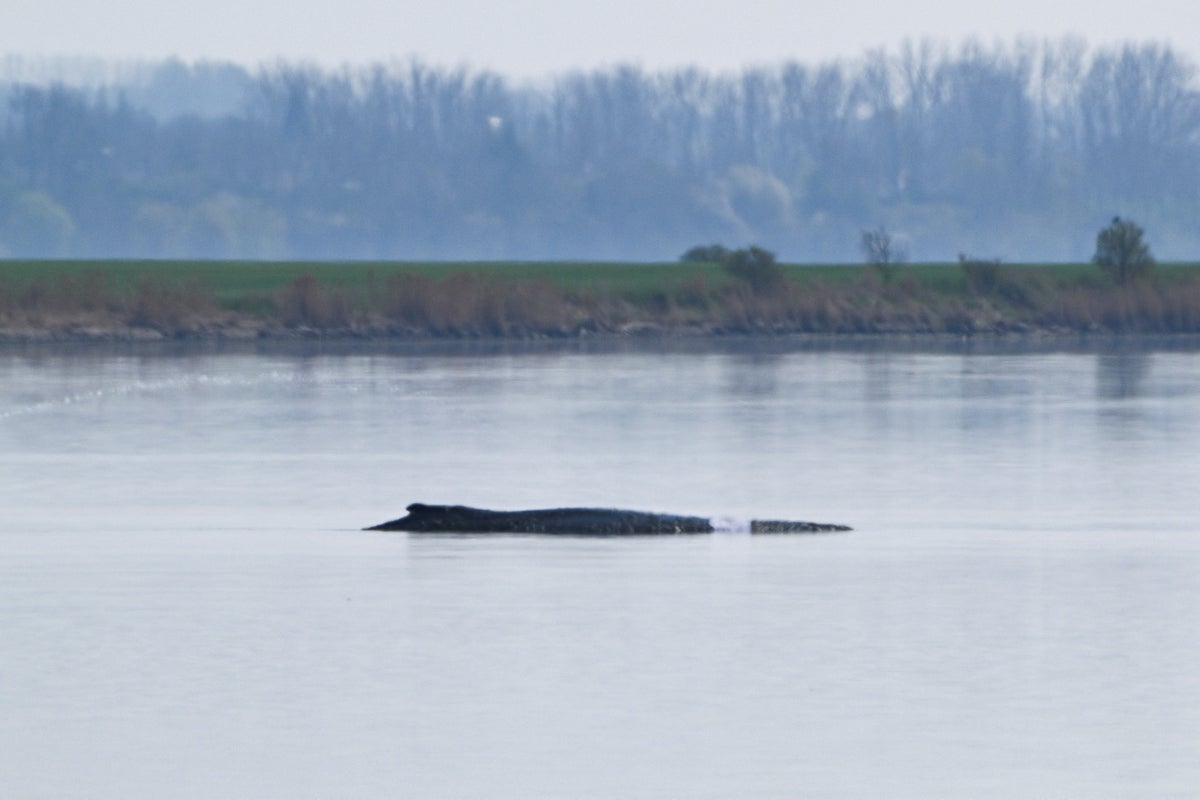
The North Atlantic is not a place for the fragile. It is a gray, churning expanse that hums with a low-frequency power, a graveyard for anything that loses its rhythm. When Timmy—a juvenile humpback whale whose ribs now trace jagged lines against his skin—washed onto the sandbars of the bay, the rhythm stopped. For him, the ocean had become a wall. For the humans standing on the shoreline, the world had suddenly shrunk to the size of a single, labored blowhole.
Seawater doesn't just feel cold when you’ve been standing in it for six hours. It feels like a physical weight. It feels like an invasion. Sarah, a local marine biologist who has spent fifteen years tracking migration patterns, knows this cold better than her own heartbeat. She stands waist-deep in the surf, her hands pressed against the slick, rubbery skin of the whale. He is thirty feet of muscle and bone, currently being crushed by his own mass because he no longer has the buoyancy of the deep to hold him together.
Gravity is the enemy here.
In the open water, a humpback is a masterpiece of fluid dynamics. On a sandbar at low tide, that same animal becomes a structural tragedy. Timmy’s internal organs are slowly failing under the pressure of his three-ton frame. Every time he exhales, a misty spray of salt and mucus hits Sarah’s face. It smells of old fish and fermented sea, the scent of a life that is literally drying out in the wind.
The problem with most rescue missions is that they are designed by people who think logic can override the physics of the tide. The initial plan was simple: wait for the high tide and tow him out. But the tide didn't come high enough. The moon was indifferent. Timmy remained wedged in a depression of silt, his flukes occasionally beating the water in a desperate, rhythmic thud that vibrated in the chests of everyone standing on the beach.
The Engineering of a Miracle
By the second night, the dry facts of the situation had turned into a desperate engineering puzzle. You cannot simply pull a whale. If you tie a rope to a humpback’s tail and pull with a tugboat, you will likely dislocate his spine or sever the caudal peduncle. You are trying to move a house made of jelly and glass across a floor of sandpaper.
The rescuers had to pivot. They began to construct what can only be described as a liquid cradle.
The new plan involves a sophisticated array of industrial-grade inflatable pontoons and a custom-stitched nylon sling that looks more like something used to move heavy machinery than a piece of veterinary equipment. But the machinery is secondary to the math. To save Timmy, they have to manipulate the very earth beneath him.
Volunteers spent the pre-dawn hours digging trenches—not to drain the water away, but to channel the incoming tide directly under his belly. They are creating a localized flood, a tiny, artificial ocean designed to trick physics just long enough to get the sling into place.
It is grueling, back-breaking work. Shoveling wet sand is a fool’s errand; the ocean fills the hole as fast as you can dig it. Yet, there is a silence on the beach that feels sacred. No one is talking about "environmental impact" or "conservation metrics." They are talking about the way the whale’s eye, the size of a grapefruit, follows them as they move. It is an ancient, dark eye, seemingly full of an intelligence that doesn't belong in the mud.
The Invisible Stakes of the Shoreline
Why do we do this?
Critics often point to the cost. Thousands of dollars in fuel, equipment, and man-hours are being poured into a single animal that might just beach itself again three miles down the coast. From a cold, statistical perspective, Timmy is a rounding error in the grand scale of marine mortality.
But humans are not statistical creatures. We are narrative creatures.
When we see a whale on the beach, we see a mirror. We see a magnificent thing out of its element, struggling against a force it cannot control. In a world that often feels chaotic and indifferent, the act of standing in freezing water to keep a whale’s skin moist is an act of rebellion. It is a way of saying that the individual matters. It is a way of reclaiming a small piece of our own humanity by acknowledging our kinship with something that breathes the same air but lives in a different world.
The "elaborate plan" the headlines mention isn't just about the sling or the pontoons. It’s about the logistics of empathy.
It involves a relay of pumps to keep water flowing over the whale's dorsal fin to prevent overheating—yes, a whale can overheat in fifty-degree weather because its blubber is such an efficient insulator. It involves a vet standing by with a syringe the size of a forearm, ready to administer fluids and antibiotics to fight the pneumonia that almost always sets in when a whale’s lungs are compressed by the shore.
The Weight of the Final Push
The window of opportunity is narrow. The next high tide is a "king tide," pushed by a specific alignment of the sun and moon. It is the only moment the water will be deep enough to support the pontoons.
If the sling isn't positioned perfectly, the whale could roll. If he rolls, he drowns. A whale is a mammal; if his blowhole is submerged while he is pinned to the floor, he will suffocate in the very medium that is supposed to be his home.
Sarah watches the water line. It creeps up her boots, then her thighs. The team moves into position. The tugboat, anchored a quarter-mile out, begins to tension the line. This is the moment where the "human element" becomes a matter of raw, physical strength.
They are shouting now, their voices barely audible over the roar of the surf. They have to slide the nylon mesh under Timmy’s pectoral fins. The whale feels the shift. He panics. A single thrash of his tail could break a man’s ribs, but no one moves back. They lean in. They use their bodies as wedges against the sand.
"Easy, big guy," Sarah whispers, though her voice is lost to the wind. She has a hand on his flank, feeling the tremors running through his muscles. She can feel his heart beating—a slow, heavy throb that seems to sync with the crashing of the waves.
The pontoons begin to hiss as they are inflated by portable compressors. Slowly, agonizingly, the gray mass of the whale begins to lift. The trenches they dug become conduits, the water rushing in to fill the vacuum under his belly. For the first time in forty-eight hours, Timmy is not a weight. He is a vessel.
The Unseen Result
Success in these moments isn't a parade. It isn't a press conference with a ribbon cutting.
Success is a disappearance.
The most beautiful thing a whale can do is leave. As the sling is released and the pontoons are deflated, there is a breathless second where Timmy just hangs there in the water, suspended between the shore and the deep. He doesn't know he’s been the subject of a "new elaborate plan." He doesn't know about the thousands of people who watched his struggle via grainy livestream.
He only knows the pressure is gone.
He gives one final, powerful kick. The water erupts in a white plume. He doesn't look back. He shouldn't. The humans are left on the shore, dripping wet, shivering, and suddenly very small. Their arms ache. Their skin is blue-tinged from the cold.
They watch the dark shape of his fluke break the surface one last time, a black silhouette against the rising sun, before he vanishes into the vast, unforgiving gray. The sandbar is empty. The tide begins to recede, erasing the trenches and the footprints, leaving the beach exactly as it was before the world tilted.
We are left with the silence, and the salt, and the sudden, sharp realization of how much effort it takes to keep a heart beating in the cold.