The humidity in New Delhi during a diplomatic summit doesn't just sit in the air. It clings to your skin like wool, heavy and unyielding, making the crisp, air-conditioned sanctuaries of government buildings feel less like offices and more like pressurized oxygen tanks. Inside the Hyderabad House, the marble floors are buffed to a mirror shine, reflecting the heavy mahogany tables where the fate of global commerce is routinely bartered away.
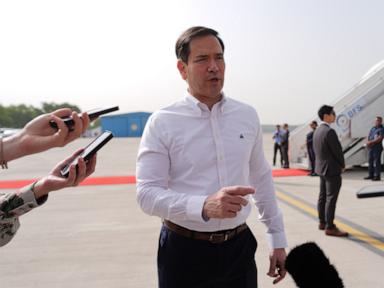
When Marco Rubio stepped off the plane as the American Secretary of State, the tarmac heat likely hit him like a physical wall. But the political temperature waiting inside was even higher.
Diplomacy is often covered as a series of sterile press releases, a collection of acronyms—like the Quad—and boilerplate statements about "shared values." That is a lie. Diplomacy is a high-stakes poker game played by exhausted human beings who are running on black coffee, fighting jet lag, and trying to read the micro-expressions of their counterparts across a crowded table.
Behind the polite smiles and the synchronized flashes of press cameras lay a friction that has been building for years. The United States and India are often called natural allies, two massive democracies anchoring opposite sides of the globe. But right now, the gears of that alliance are grinding against a harsh economic reality.
The Quiet Friction of the General Store
To understand why a diplomatic visit to India matters to someone sitting in Ohio or Bangalore, you have to look past the military hardware and focus on the shop floor.
Imagine a neighborhood where two dominant shop owners decide they need to team up to keep a aggressive new competitor from taking over the block. They agree on the big picture. They hold joint neighborhood watch meetings. But when it comes to deciding who gets to sell what, and at what price, the friendship gets complicated.
For years, India enjoyed a special status under the U.S. Generalized System of Preferences (GSP), which allowed billions of dollars of Indian goods to enter the American market duty-free. It was a catalyst for small textile factories in Gujarat and tech startups in Hyderabad. Then, the trapdoor snapped shut. The U.S. revoked that status, citing a lack of reciprocal access to Indian markets.
Consider the perspective of an Indian medical device manufacturer in Chennai. For a decade, they built their business model on selling affordable components to American hospitals. Suddenly, a 10% tariff lands on their ledger. Margins vanish. Workers face layoffs.
On the flip side, consider a dairy farmer in Wisconsin. They look at India’s massive, surging middle class—millions of new consumers entering the market every year—and they want in. But they find themselves blocked by a wall of protective tariffs designed to shield India’s own fragile agricultural sector.
This is the knot Rubio traveled to untangle. The American position is straightforward: if we are going to be strategic brothers-in-arms, our markets must reflect that brotherhood. The Indian response is equally entrenched: a developing nation of 1.4 billion people cannot sacrifice its own farmers and local industries on the altar of American corporate access.
The Ghost in the Room
You cannot talk about Washington and New Delhi without talking about Beijing. It is the invisible gravity pulling these two vastly different nations into the same orbit.
The Quad—the Quadrilateral Security Dialogue comprising the U.S., India, Japan, and Australia—is frequently described in policy papers as a framework for an open and free Indo-Pacific. Stripped of the jargon, it is a maritime perimeter wall designed to contain Chinese expansionism in the South China Sea and across the Indian Ocean.
For India, this isn't an abstract geopolitical theory. It is a matter of borders.
A few years ago, Indian and Chinese soldiers engaged in lethal, hand-to-hand combat in the freezing, oxygen-deprived heights of the Galwan Valley. No guns were fired, per a long-standing agreement to prevent escalation, but men died using stones and clubs wrapped in barbed wire.
When an Indian diplomat sits across from an American Secretary of State, the memory of those cold Himalayan ridges is always present. They need American satellite intelligence, American naval cooperation, and American military tech.
But independence is woven into the DNA of India's foreign policy. For decades, New Delhi championed the Non-Aligned Movement, refusing to become a satellite state for either Washington or Moscow. Even now, as Russian oil flows into Indian refineries despite Western sanctions, India maintains that its primary duty is to its own people's survival, not to Western geopolitical mandates.
Rubio’s challenge wasn't just to negotiate trade percentages; it was to navigate this fierce, protective pride.
The Digital Divide and the Price of Data
The most intense battles aren't being fought over steel or agricultural goods anymore. They are being fought over bits and bytes.
India has undergone a quiet digital revolution. Walk through a rural village in Uttar Pradesh, and you will see fruit vendors accepting payments via QR codes linked to the Unified Payments Interface (UPI), a state-backed digital infrastructure that puts Western banking systems to shame.
India sits on an ocean of data. American tech giants want to harvest, process, and monetize that ocean.
However, New Delhi has thrown up strict data localization laws. They insist that the data of Indian citizens must remain on servers physically located within Indian borders. To Silicon Valley, this looks like protectionism disguised as privacy. To New Delhi, it looks like digital sovereignty—a refusal to let foreign corporations become the new colonial masters of the twenty-first century.
This creates a paradox. How do you build a seamless tech alliance against authoritarian regimes when you cannot even agree on where a line of code should be stored?
The Human Cost of the Tariff War
When these negotiations stall in air-conditioned rooms, the shockwaves travel down to people who have never heard of the Quad.
Take the almond growers of California’s Central Valley. India is the single largest export destination for American almonds. When Washington slapped tariffs on Indian steel, New Delhi retaliated by hiking duties on American nuts. Suddenly, tons of almonds sat rotting in West Coast warehouses, while families in California struggled to pay their mortgages.
Meanwhile, in Delhi, the cost of specialized American medical equipment—the kind used in cardiac surgeries and cancer treatments—inches upward, out of reach for families desperate to save their loved ones.
These are the stakes that never make it into the headlines. The headlines talk about bilateral trade volumes reaching billions of dollars. They rarely talk about the human anxiety attached to those digits.
The Long Road to Alignment
The visit was never going to end with a grand, sweeping treaty that solves every grievance. That isn't how modern diplomacy works. It is a game of millimeters.
A slight concession on medical devices here. A minor adjustment to agricultural quotas there. A quiet agreement to share more real-time naval tracking data in the deep blue waters of the Indian Ocean.
The true metric of success for Rubio’s trip isn't a signed piece of paper. It is the continuation of the conversation. It is the recognition that despite the bitter arguments over almonds, data, and dairy, neither nation can afford to walk away from the table.
As the sun began to set over New Delhi, painting the sandstone of the India Gate in hues of burnt orange and dusty gold, the motorcades hummed back toward the airport. The heat of the day lingered in the pavement, slow to dissipate.
The leaders had shaken hands, smiled for the cameras, and retreated to their respective corners of the world. The fundamental tensions remained, unresolved but managed. It was a reminder that alliances are not built on grand declarations of friendship, but on the tireless, frustrating work of two distinct nations discovering that their survival depends on learning how to argue without breaking the bond.