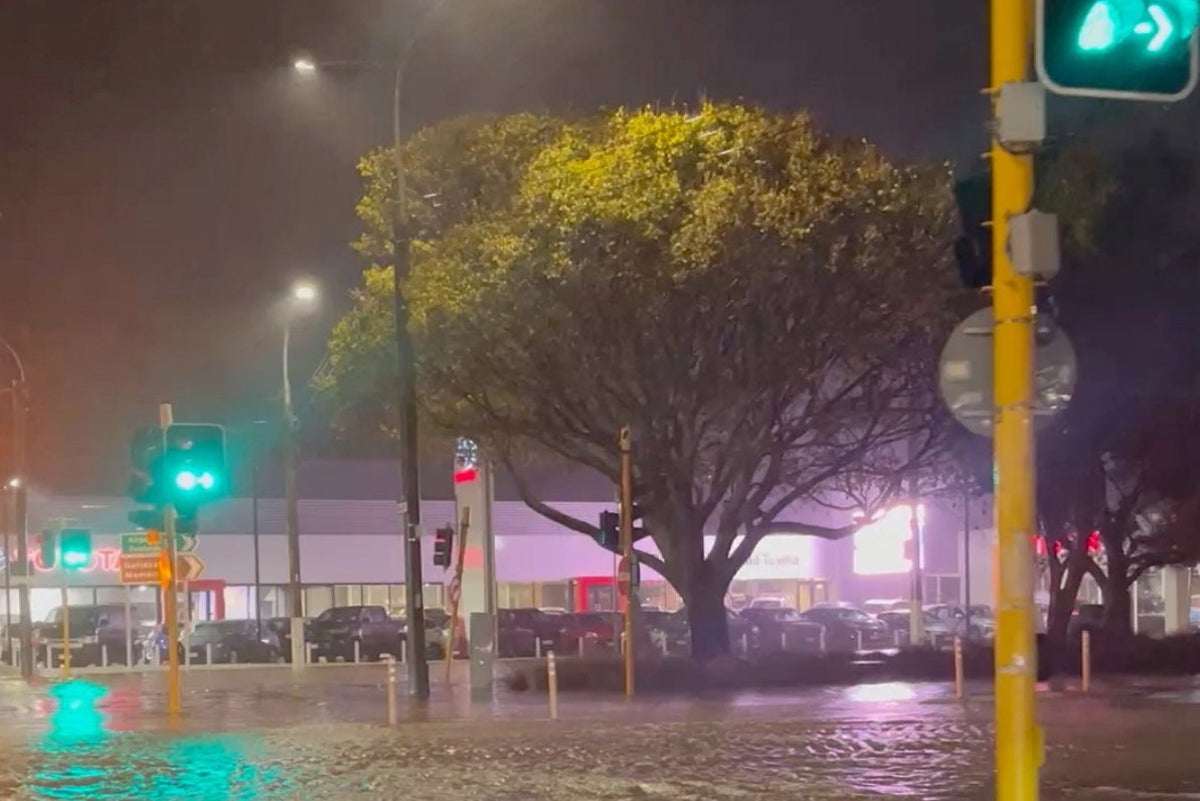
The headlines are screaming about "unprecedented" rainfall and "once-in-a-century" floods. They want you to believe that Mother Nature just played a wild card that no one could have anticipated. They want you to look at the submerged streets of Wellington and feel a sense of helpless awe at the power of the elements.
Stop buying the narrative. Also making news in related news: The Invisible Walls on the Water.
Wellington didn’t just get hit by rain. It got hit by decades of administrative cowardice, a refusal to acknowledge the physics of urban density, and a fix-it-later mentality that has finally run out of time. When the "worst rainfall ever recorded" hits a city, the disaster isn't the water. The disaster is the fact that we are still using Victorian-era drainage logic to support a 21st-century concrete jungle.
The Myth of the Unprecedented Event
Every time a storm surges, officials reach for the "unprecedented" label. It’s a convenient shield. If something is unprecedented, it means no one is to blame. It means the engineers and the council couldn't possibly have prepared. Additional insights on this are detailed by USA Today.
That is a lie.
Hydrologists have been sounding the alarm on the intensification of the hydrological cycle for years. We know that for every $1°C$ of warming, the atmosphere can hold approximately $7%$ more moisture. This isn't a surprise; it's the Clausius-Clapeyron relation. If you are a city planner in a coastal, hilly region like Wellington and you aren't factoring in a massive increase in peak flow intensity, you aren't doing your job.
The rainfall wasn't the outlier. The expectation that our crumbling, clay-clogged infrastructure would hold was the outlier. We are building luxury apartments on hillsides and then acting shocked when gravity and saturation collaborate to move the earth.
Pavement is a Policy Failure
We have spent a century turning Wellington into a giant, non-porous bowl. We pave over every square inch of available soil, chop down the deep-root vegetation that acts as a natural hydraulic brake, and then wonder why the pipes are bursting.
This is what I call the Imperial Drainage Trap.
In the old world, the goal was simple: get the water into a pipe and get it to the sea as fast as possible. That works when you have a small population and plenty of green space. It fails miserably when you have high-density urban sprawl. When you fast-track water into a single point of failure—a concrete culvert—you create a pressure cooker.
The "lazy consensus" says we need bigger pipes. I’ve seen councils blow hundreds of millions on "super-pipes" only to find that they just move the flooding three blocks downstream. You cannot outrun the volume of a Wellington deluge with bigger tubes. You have to stop the water from reaching the tubes in the first place.
The Nuance of Porosity
The real solution isn't "better" drainage; it’s the systematic de-paving of the city.
- Permeable Pavements: Why are we still using solid asphalt for parking lots? It’s cheap, and it’s stupid. Permeable surfaces allow the ground to act as a sponge, slowing the time-to-peak flow.
- Daylighting Streams: Wellington has dozens of "ghost streams" buried in pipes under the asphalt. These pipes are ticking time bombs. Bringing these streams back to the surface—daylighting—creates natural floodplains that can soak up the overflow.
- Vertical Sponges: Green roofs aren't just for aesthetic hipsters. They are essential stormwater management tools. A standard sedum roof can retain $50%$ to $80%$ of rainfall during a storm event.
Stop Rebuilding in the Red Zones
We need to talk about the "Right to Rebuild." It is the most expensive sentimentality in modern governance.
After a flood like this, the immediate political response is to offer subsidies, insurance payouts, and "thoughts and prayers" to help people put their homes back exactly where they were. We are literally subsidizing the next disaster.
If a hillside in Wellington has turned into a slip zone three times in the last twenty years, it is no longer a residential zone. It is a landslide waiting for a catalyst. Continuing to insure these properties is a fiscal crime against the rest of the tax-paying public.
I’ve seen this cycle in cities across the globe. We treat geography as a suggestion rather than a mandate. We build where the view is good, ignore the geotech reports that say the soil is unstable, and then demand a government bailout when the mud starts moving.
True resilience means Managed Retreat. It means admitting that some parts of Wellington are no longer habitable in a high-moisture era. It’s a brutal truth, and it’s political suicide to say it, but every dollar spent "restoring" a condemned cliffside home is a dollar stolen from the infrastructure we need to save the rest of the city.
The Engineering Arrogance of "Return Periods"
Ask a civil engineer about the Wellington floods, and they’ll start talking about "1-in-100-year events."
This terminology is a relic. It suggests a statistical predictability that no longer exists. It tricks the public into thinking they are safe for the next 99 years once the water recedes.
The reality? The "1-in-100" event is now the "1-in-20" event.
Our safety margins are based on historical data that is effectively obsolete. If you are designing a bridge or a drainage system based on 1980s rainfall patterns, you are designing a failure. We need to move toward Dynamic Margin Engineering. We shouldn't be building for the "worst-case scenario" of the past; we should be building for the "impossible scenario" of the future.
The Cost of Cowardice
Why don't we do this? Because it’s expensive.
It’s cheaper to apologize after a flood than it is to dig up a city’s foundation and replace it with a sponge-city model. It’s easier to blame "climate change" as an abstract monster than it is to admit that the local zoning laws are a mess.
We have the technology. We have the data. What we lack is the stomach to tell developers they can't build on that slope, or to tell homeowners that their driveway needs to be ripped up for a bioswale.
The Hierarchy of Disaster Responsibility
When the evacuations happen, the finger-pointing starts.
- The Council: Blames the "unprecedented" rain.
- The Public: Blames the Council for not cleaning the gutters.
- The Media: Blames climate change.
The reality is a messy convergence. Yes, the gutters need cleaning. Yes, the climate is shifting. But the fundamental flaw is our refusal to adapt our lifestyle to the geography we inhabit. Wellington is a city built on a fault line, hammered by Antarctic winds, and drenched by Pacific moisture. It is a beautiful, precarious place.
If you want to live there, you have to stop treating "flood protection" as something the government provides through a pipe. Resilience is a collective architectural requirement.
Actions That Actually Work (And Why We Won't Do Them)
If we were serious about stopping the next evacuation, the plan would look like this:
- Mandatory Rainwater Harvesting: Every house in Wellington should be required to have a 5,000-liter detention tank. Not for drinking, but to hold the initial surge of a storm and release it slowly over 48 hours. This would take thousands of tons of immediate pressure off the city mains.
- Total Ban on Hillside Excavation: If you have to cut into a slope to build your house, you are weakening the integrity of the entire ridge. No more "retaining wall" fixes. If the land isn't flat, don't build a mansion on it.
- The "Flood Tax" on Hard Surfaces: If your property is $90%$ concrete, you should pay triple the rates of someone with a garden. You are contributing more to the runoff problem; you should pay for the solution.
The Brutal Truth About the "Worst Rainfall"
The rainfall in Wellington wasn't a freak accident. It was a stress test.
And the city failed.
The water didn't "break" the system; it simply revealed that the system was already broken. The evacuations, the mudslides, and the submerged cars are just the physical manifestations of a long-term intellectual bankruptcy in urban planning.
We can keep talking about the "tragedy" of the weather, or we can start admitting that our current model of city-building is incompatible with the planet we actually live on.
You can’t negotiate with $200mm$ of rain. You can’t sue a landslide. You can only design for the reality of the water, or you can get out of its way.
Pick one. Because the next "unprecedented" storm is already forming, and it doesn't care about your insurance policy or your "1-in-100-year" statistics.
Stop rebuilding the past and start engineering for the deluge.