Silence.
That is the first thing that settles over a room when an accusation involving narcotics is dropped into a political debate, not because anyone has seen a laboratory report or a police dossier, but because the sheer weight of the word itself alters the oxygen in the air before a single piece of evidence is ever laid upon the table.
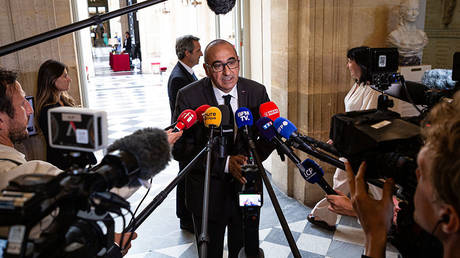
According to news reports and public statements from the parties involved, a sharp controversy erupted in France after critics and allies of a pro-Palestinian Member of the European Parliament accused the French Interior Minister of floating or amplifying an unsubstantiated drug-related smear against the lawmaker. Depending on whom you ask in Paris or Brussels, the episode is either a textbook case of state-backed character assassination aimed at silencing a vocal critic of French foreign policy, or an overblown political uproar seized upon by opponents eager to weaponize a passing remark against the government.
Both interpretations carry real consequences. Because in modern European politics, the distance between a ministerial insinuation and a ruined public reputation has shrunk to the span of a single news cycle.
The Architecture of a Rumor
Consider how a political smear actually works in practice—not in the shadowy corridors of a television thriller, but in the fluorescent-lit reality of press briefings, off-the-record chats, and parliamentary exchanges.
Imagine a hypothetical scenario to trace the mechanics of this dynamic. Picture a younger elected official—let us call her Clara—who has built her entire public identity on challenging entrenched diplomatic consensus. She speaks forcefully, sometimes abrasively, on human rights and foreign intervention. Her critics view her as reckless; her supporters see her as fearless. One Tuesday afternoon, during a heated exchange over public order and protest policing, a senior cabinet official makes an oblique reference to "substance issues" or "illicit circles" surrounding the opposition's loudest voices. No formal charges exist. No investigation is cited. Yet within forty-eight hours, search engines autocomplete Clara's name alongside the word drugs.
That is not an accident of biology or law. It is an accident of human psychology.
Psychologists call it the illusory truth effect, and political operatives have relied on it since long before the invention of the printing press. When an authority figure—especially one who commands the police, intelligence services, and border apparatus of a sovereign nation—utters an insinuation, the public instinctively assumes the speaker possesses classified knowledge the rest of us cannot see. We think: Surely the Interior Minister wouldn't say something like that unless there were a file somewhere.
In the actual French dispute, defenders of the pro-Palestinian MEP pointed precisely to that asymmetry of power. As reported in coverage of the clash, the lawmaker's camp argued that when the head of France's domestic security apparatus attaches a drug-related stigma to an elected representative, it functions less like free speech and more like an official indictment without due process. Meanwhile, voices aligned with the government and the Interior Ministry pushed back against the characterization, contending that critics were distorting the context of the remarks to manufacture victimhood and deflect from legitimate scrutiny over public order and political rhetoric.
Notice what disappears in the crossfire. The actual policy debate—over Gaza, over European diplomatic leverage, over the boundaries of lawful protest in French cities—vanishes beneath a fog of personal insinuation.
Why Narcotics Carry a Unique Political Charge
Why drugs? Why not accuse a rival of tax irregularities, sloppy legislative attendance, or ideological inconsistency?
Because in contemporary France, narcotics are not merely a public health issue or a routine criminal infraction. Over the past decade, drug trafficking and consumption have become the central nervous system of the French political debate over security, sovereignty, and social cohesion. From port cities like Marseille to mid-sized provincial towns, the Interior Ministry has framed the war against narcotics—often termed narco-banditisme—as an existential struggle for the authority of the Republic.
I remember sitting in a crowded café near the Gare du Nord in Paris a few winters ago, listening to two retired civil servants argue over the morning papers. Between the hiss of the espresso machine and the clatter of saucers, one of them tapped a headline about municipal drug sweeps and said, quietly, "Once they link someone to that world, you don't listen to their ideas anymore. You just look at their hands."
He had captured an essential truth about political framing.
To accuse a political opponent of policy failure is to invite an argument. To associate an opponent with narcotics is to invite disqualification. It shifts the frame from Is this person right? to Is this person fit to stand in the chamber?
For a pro-Palestinian MEP—already operating in one of the most polarized rhetorical environments in European politics—that shift is doubly potent. Debates surrounding Israel, Palestine, and the war in Gaza have strained French political discourse to its limits, pitting lawmakers who demand tougher diplomatic action and describe Israeli military operations in stark humanitarian terms against officials who warn of imported communal tensions and threats to public order at home. In such an atmosphere, introducing a drug-related allegation does not merely add another criticism to the pile. It attempts to strip the target of moral standing altogether.
The Invisible Stakes for Democratic Debate
It would be easy to dismiss this clash as just another rough-and-tumble episode in a country famous for theatrical politics. France has never been a nation of polite parliamentary whispers. From the polemics of the Third Republic to the televised clashes of the Fifth, French public life has always tolerated—and often rewarded—sharp elbows.
Yet something deeper is at stake when the boundary between state authority and partisan mudslinging blurs.
Think of the Interior Ministry as the referee of a high-stakes match who also happens to wear the jersey of one of the teams. In a parliamentary democracy, the minister in charge of policing and internal security occupies a dual role. On one hand, they are a partisan politician fighting for their party's survival and ideological program. On the other, they are the custodian of state neutrality, entrusted with institutions whose credibility depends on strict adherence to evidence, procedure, and the presumption of innocence.
When critics accused the French Interior Minister of drug-smearing the pro-Palestinian MEP, their outrage rested on that exact tension. According to accounts from the MEP's supporters and allied lawmakers, using the pulpit of the Interior Ministry to float an unverified personal smear undermines public trust in law enforcement itself. If citizens begin to believe that intelligence or criminal insinuations are deployed as rhetorical ammunition against political adversaries, then genuine law enforcement efforts risk being viewed through a lens of partisan suspicion.
At the same time, fairness requires acknowledging the counterargument raised by observers skeptical of the MEP's allies. In high-conflict political environments, accusations of "smearing" can themselves become a potent shield. When a politician faces intense scrutiny over controversial statements, associations, or activism, framing every sharp attack from a minister as an authoritarian abuse of power can rally supporters and insulate the politician from substantive critique.
We are left, then, in a hall of mirrors—one where both sides claim to be defending democratic norms while accusing the other of poisoning the well.
History's Long Shadow Over Political Smears
None of this is entirely new, though the speed of its transmission certainly is.
Historically, European democracies have repeatedly wrestled with the temptation to neutralize inconvenient dissenters by attacking their personal habits or moral character rather than their arguments. During the turbulent decades of the twentieth century, French political factions routinely traded accusations of personal decadence, foreign corruption, or chemical dependency to discredit rivals whose ideas proved difficult to defeat at the ballot box. Often, the facts mattered far less than the lingering odor left behind by the headline.
What has changed is the permanence of the digital record.
In 1975, an unsubstantiated remark made during a late-night parliamentary session might have merited three lines on page six of Le Monde before disappearing into microfiche archives. Today, every clip is sliced into a fifteen-second vertical video, stripped of context, subtitled in bold yellow font, and algorithmicized into millions of feeds before the targeted lawmaker has even walked out of the building.
Even a formal retraction—if one ever comes—travels on crutches while the original insinuation rides a bullet train.
I admit that watching these cycles unfold leaves a lingering sense of unease. It is genuinely hard, even for seasoned observers of European institutions, to separate calculated political theater from genuine institutional overreach in real time. You find yourself checking timestamps, comparing transcripts, watching the exact facial expressions of officials at podiums, wondering whether a phrase was a calculated dart thrown from a ministry briefing room or an offhand jab inflated by a hyper-reactive media ecosystem.
That uncertainty is precisely what makes the tactic so corrosive. A smear does not need to be believed by everyone to succeed. It only needs to make a third of the audience pause and think, Well, where there's smoke, there's fire.
What Happens When the Dust Settles
Look closely at what remains after a controversy like this fades from the front pages.
The pro-Palestinian MEP continues to speak in Brussels and Strasbourg, though now every appearance is shadowed by an extra layer of defensive explanation. The Interior Minister continues to manage one of the most demanding portfolios in Europe, though now every stern pronouncement on law and order is met by critics pointing back to the episode as proof of partisan recklessness.
And the public? The public grows a little more cynical, a little more exhausted, and a little less willing to believe that anyone in power is speaking in good faith.
In a healthy democracy, sharp disagreement over foreign policy, human rights, and domestic security is not a flaw in the system; it is the system working as intended. Voters deserve to hear fierce, uncompromising arguments about France's posture toward Palestine and Israel, just as they deserve rigorous debate over how to keep streets safe and uphold the rule of law.
What they do not deserve is a public square where serious questions of war, peace, and justice are drowned out by whispered insinuations about what someone might or might not have in their pockets.
The microphone on a ministerial podium is wired directly into the credibility of the state—and once that current is used to scorch a political rival without proof, the burn marks stay on the podium long after the target has walked away.