The Strait of Hormuz does not care about international law. It is a choke point of jagged rock and deep, churning salt water where the world’s thirst for energy meets the ancient, simmering grudges of empire. At its narrowest, the passage is barely twenty-one miles wide. It is a throat. And when that throat tightens, the entire global economy begins to suffocate.
Imagine a deckhand named Elias. He is fictional, but his fear is a documented reality for every merchant sailor who crosses this threshold. He stands on the rusted deck of a bulk carrier, watching the sunrise paint the Omani coast in shades of bruised purple. He knows that beneath the waves and across the radar screens, a silent chess match is unfolding. To him, the "geopolitical tensions" described in morning briefings aren't abstractions. They are the sound of a fast-attack craft’s engine humming in the distance. They are the cold realization that his ship, carrying nothing more provocative than grain or iron ore, is a pawn in a game played by men in air-conditioned rooms thousands of miles away. For an alternative perspective, check out: this related article.
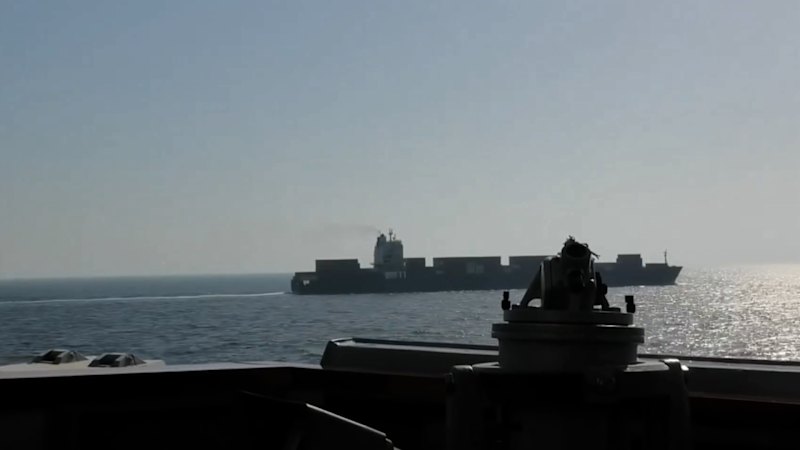
The recent engagement involving a U.S. naval vessel and an Iranian-flagged cargo ship isn't just a headline. It is a rupture in the fragile silence that keeps the lights on in London, Tokyo, and New York.
The Anatomy of a Confrontation
The encounter began not with a bang, but with a series of ignored signals. In the maritime world, radio silence is a form of aggression. When the U.S. Navy identifies a vessel behaving erratically or deviating from established corridors, the protocol is a rhythmic escalation. First, the Bridge-to-Bridge radio calls. Then, the flashing lights. Finally, the long, mournful blast of the ship’s whistle. Further insight on this matter has been published by Reuters.
When those sounds go unheeded, the air changes.
The Iranian-flagged vessel, moving with a deliberate lack of transparency, crossed an invisible line. To the crew of the American destroyer, the cargo ship wasn't just a merchant vessel; it was a variable. In this region, "cargo" is a flexible term. It can mean humanitarian aid, or it can mean sophisticated drone components destined for proxy militias. The ambiguity is the point. This is the gray zone of modern warfare, where the goal isn't to sink a ship, but to test a boundary.
The U.S. vessel fired. These weren't shots meant to send the Iranian ship to the bottom of the ocean. They were warning shots—kinetic punctuation marks. The rounds hit the water, sending plumes of white spray into the air, a violent reminder that the ocean is not a lawless vacuum, even if certain actors wish it to be.
The Invisible Strings of Global Trade
We often think of the internet as the backbone of the modern world, but the true nervous system is made of steel hulls and heavy fuel oil. Roughly twenty percent of the world’s petroleum passes through this single, narrow gateway. If a single tanker is seized or a single cargo ship is fired upon, the ripples move faster than the tide.
Traders in Chicago see the flash on their screens and adjust the price of crude. Logistics managers in Germany begin rerouting shipments around the Cape of Good Hope, adding weeks and millions of dollars to the cost of simple consumer goods. You feel this event when you find the price of a gallon of gas has ticked up five cents for no apparent reason, or when a part for your car is backordered for another month.
The Iranian strategy relies on this sensitivity. They understand that they do not need to win a naval battle against a superpower. They only need to make the passage of goods so risky and expensive that the international community loses its collective nerve. By using merchant-flagged vessels to skirt Sanctions or transport sensitive materials, they turn the global trade system against itself. They hide behind the very "freedom of navigation" they frequently threaten.
The Technology of the Watchtower
Modern maritime security is a feat of data fusion that sounds like science fiction. Satellites track the "dark" vessels that turn off their Automatic Identification Systems (AIS) to disappear from public maps. High-altitude drones loiter for twenty-four hours at a stretch, their cameras capable of reading the serial number on a shipping container from miles away.
But technology has a ceiling. A sensor can tell you where a ship is, but it cannot tell you the intent of the captain. It cannot tell you if the man at the helm is acting under duress or following a secret order from Tehran. This is where the human element becomes a liability. On the bridge of the U.S. destroyer, a commanding officer has seconds to decide if a closing vessel is a suicide boat laden with explosives or a confused merchant sailor with a broken radio.
The pressure is immense. A mistake in one direction leads to a diplomatic catastrophe; a mistake in the other leads to a hole in the hull and dead sailors.
The Weight of the Silence Following the Storm
After the shots were fired, the Iranian vessel eventually altered its course. The immediate threat dissipated. The destroyer returned to its patrol pattern, and the cargo ship vanished into the haze of the Persian Gulf. On the surface, the status quo was restored.
However, the silence that follows such an encounter is never truly peaceful. It is the silence of a held breath.
Every time a weapon is discharged in the Strait, the psychological barrier against open conflict thins. We are watching the slow erosion of the maritime order that has existed since the end of the second World War. For decades, the assumption was that the seas were a commons, open to all for the sake of mutual prosperity. That assumption is dying. It is being replaced by a fragmented reality where every mile of water is contested, and every ship is a potential weapon.
Elias, the deckhand, watches the destroyer fade into a gray speck on the horizon. He goes back to his coffee. He checks the lashings on the containers. He does his job because the world demands the cargo he carries. But he looks at the horizon differently now. He understands that the blue expanse isn't just a highway. It is a front line.
The sun climbs higher, burning off the morning mist, revealing dozens of other ships waiting their turn to pass through the throat. They move in a slow, stately procession, a funeral march for the idea of a simple, safe world. The water remains deep and indifferent, hiding the wreckage of the past and the tensions of the present, waiting for the next time the silence is broken.