The sky over the Rockies doesn’t turn grey when a storm of this magnitude arrives. It turns a bruised, heavy shade of purple, a color that suggests the atmosphere is physically leaning against the earth. By the time the first flakes drift across the Highway 2 corridor, the wind has already begun its work, scouring the pavement until it shines with the treacherous, glass-like finish of black ice.
This isn't just a weather report. It is a blockade.
Meteorologists are currently tracking a system that threatens to bury parts of Alberta under a staggering 30 centimeters of snow. To a city dweller, 30 centimeters is a nuisance—a Saturday morning spent with a plastic shovel and a sore back. But on the open stretch between Calgary and Edmonton, or the winding climb through the mountain passes, that number represents a fundamental shift in the laws of physics. Friction becomes a memory. Visibility becomes a myth.
The Anatomy of a Whiteout
Consider a hypothetical driver named Elias. He’s behind the wheel of a late-model SUV, equipped with all-wheel drive and a false sense of security. He has a meeting in Red Deer he can’t miss. He sees the warnings on his phone, the scrolling red banners of the Alberta 511 app, but he looks out his window in Calgary and sees only a light dusting. He decides to push it.
Ten kilometers north of Airdrie, the world disappears.
This is the "tricky" travel the official forecasts mention with such clinical detachment. When 30 centimeters of snow is whipped by 60-kilometer-per-hour gusts, it creates a phenomenon known as a ground blizzard. You aren't just dealing with falling snow; you are navigating a vortex of recycled ice. The headlights reflect off the swirling white wall, blinding the driver with their own light.
Elias feels his steering wheel go light. It’s a sickening sensation, like the floor of an elevator dropping out from under your feet. The tires are no longer biting into the asphalt. They are hydroplaning on a microscopic layer of water created by the friction of the rubber against the ice. At 100 kilometers per hour, he is no longer driving a vehicle. He is piloting a two-ton projectile.
The Invisible Mathematics of the Storm
The physics of an Alberta winter are unforgiving. We often talk about "slippery roads" as if they are a binary state—either they are or they aren't. In reality, the danger exists on a sliding scale dictated by the "Goldilocks Zone" of temperature.
When it is -20°C, the snow is dry and crunchy. It offers a surprising amount of grip. The real danger, and what meteorologists are currently sweating over, is the -2°C to -5°C range. This is where the snow is heavy, wet, and prone to melting and refreezing instantly under the weight of passing tires.
- The Accumulation Factor: 30 centimeters of snow is roughly the height of a standard ruler.
- The Weight: Wet snow can weigh up to 200 kilograms per cubic meter.
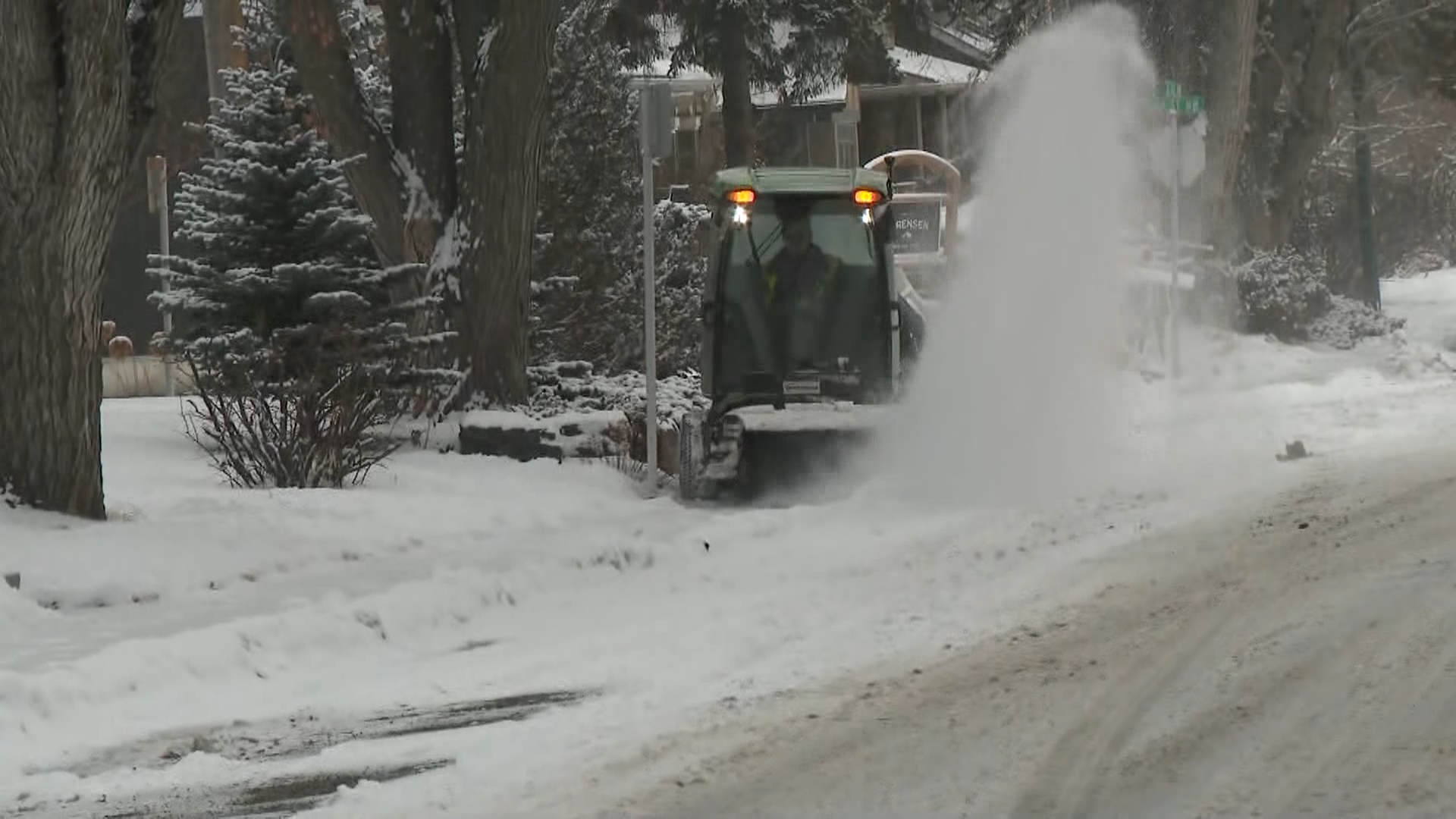
- The Displacement: A standard snowplow must move thousands of tons of material every hour just to keep a single lane viable.
But the machines can’t be everywhere. The provincial highway maintenance crews are elite, operating multi-ton trucks with wing blades that can clear a shoulder and a lane simultaneously, but they are fighting a losing battle against the rate of accumulation. If the sky is dumping three centimeters an hour, a plow that passed ten minutes ago might as well have never been there.
The Human Cost of "Making Good Time"
Why do we do it? Why do we risk the ditch, or worse, for a meeting or a family dinner?
There is a psychological trap built into the Canadian psyche. We pride ourselves on our hardiness. We joke about "winter driving" as a rite of passage. But this cultural bravado masks a dangerous lack of respect for the sheer energy involved in a highway collision.
Imagine Elias again. He’s slowed down to 60, but the person behind him is impatient. They pull out to pass. In the swirl of the "snow globe" effect, the passing driver loses the horizon line. Without a horizon, the human inner ear begins to fail. Spatial disorientation sets in. They drift.
The metal-on-metal scream of a collision in a blizzard is muffled by the snow, making it hauntingly quiet. The emergency crews who respond to these calls aren't just battling the wreckage; they are battling the elements. Paramedics describe the "Golden Hour"—the window of time where a life can be saved—shrinking to minutes when the ambient temperature is plummeting and the wind chill is biting through their gear.
Beyond the Shovel
The warnings issued for this 30-centimeter event aren't suggestions. They are a plea for common sense in an era of digital distraction. While the government issues "Travel Not Recommended" advisories, the choice ultimately rests with the hand on the ignition.
Preparation is often framed as a checklist of "stuff." Keep a candle in the car. Pack a blanket. Ensure your washer fluid is rated for -40°C. These are the tools of survival, but the mindset is the engine.
True preparedness is the humility to admit that the machine cannot overcome the mountain. It is the willingness to call the boss and say, "I'm not coming in," and the grace for the boss to say, "Good." It is the understanding that 30 centimeters of snow is not a challenge to be conquered, but a force of nature to be respected.
The storm will pass. The sun will eventually break through, turning the Alberta prairie into a blinding, crystalline kingdom of white. The plows will finish their loops, the salt will do its chemical dance with the ice, and the grip will return to the road.
Until then, the highway belongs to the wind.
Wait for the silence to return before you try to break it.