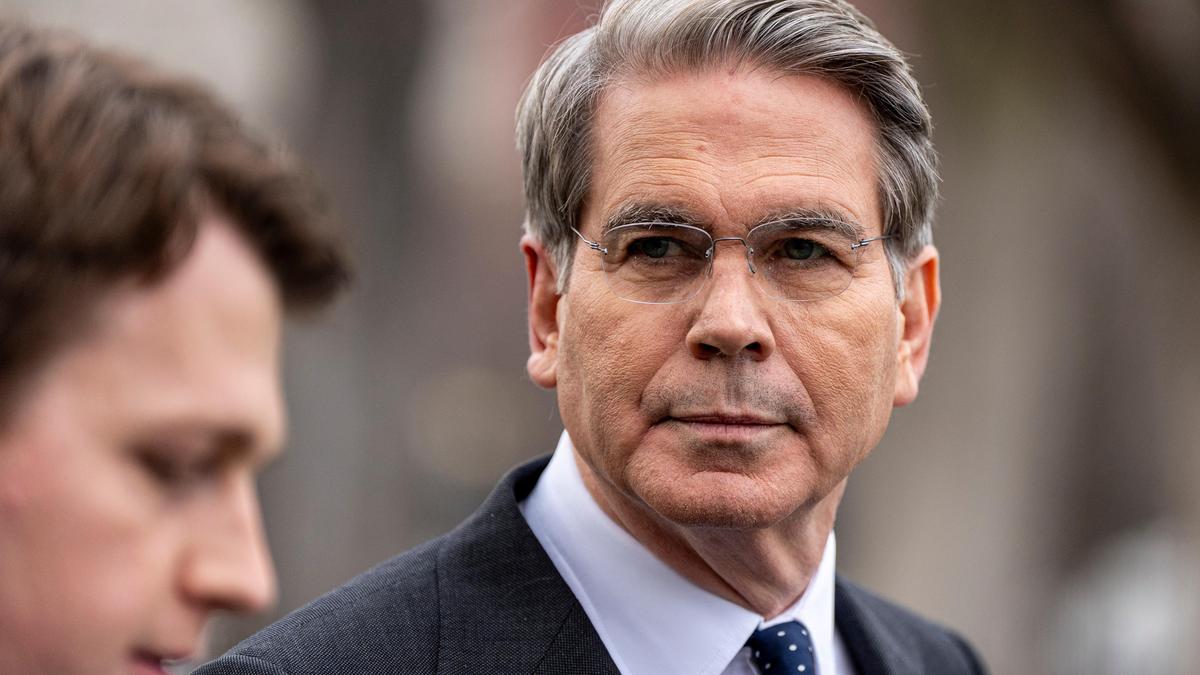
A cold, steady rain slicked the streets of Washington D.C. as Scott Bessent, the U.S. Treasury Secretary, sat behind a desk that carries the weight of global markets. He wasn't looking at spreadsheets or ticker tapes. He was looking at a map of the Indian Ocean. For years, that vast stretch of blue has been the world’s most expensive game of cat and mouse. On one side, a desperate Russian economy trying to find a backdoor for its "black gold." On the other, a global coalition trying to starve a war machine without crashing the global economy.
The news that broke this week wasn't just a policy update. It was a tectonic shift. India, the world’s third-largest oil consumer and Russia's most reliable customer since the invasion of Ukraine, had finally blinked.
"We had asked India to stop buying sanctioned Russian oil this fall," Bessent remarked, his voice carrying the quiet confidence of a man who just saw a multi-billion dollar bet pay off. "They did."
To understand why this matters, you have to look past the diplomatic handshakes and the dry press releases. You have to look at the engine room of a global superpower and the kitchen tables of families half a world away.
The Ghost Fleet and the Shadow Price
Imagine a ship. It is rusted, over twenty years old, and its name has been painted over three times in the last six months. It sails under a flag of convenience, perhaps from a country that doesn't even have a coastline. This is a member of the "Ghost Fleet," the shadowy armada Russia assembled to bypass Western price caps.
For two years, these ghosts haunted the seas, pulling into Indian ports like Vadinar or Sikka, offloading millions of barrels of Urals crude. To the casual observer, it looked like India was simply looking out for its own. They needed cheap energy to keep the lights on for 1.4 billion people. Russia needed a buyer. It was a marriage of convenience that frustrated the West and filled the Kremlin’s coffers with rupees and yuan.
But then, the pressure changed. It wasn't a sudden explosion; it was a slow, deliberate tightening of the vise.
The U.S. Treasury began blacklisting individual ships. Not just companies, but the actual steel vessels themselves. Suddenly, a tanker that was worth $50 million became a floating liability. If an Indian refiner touched that oil, they risked being cut off from the dollar-based financial system.
Consider the choice facing an executive at Reliance Industries or Indian Oil. On one hand, you have a discount on a barrel of oil. On the other, you have the total freezing of your international bank accounts and the collapse of your global supply chain.
The math changed. The risk finally outweighed the reward.
The Human Cost of a Stalled Engine
Policy is often discussed in the abstract, but its impact is visceral. When Russia loses a customer like India, the ripple effects travel from the boardroom to the front line.
Every barrel of oil that India rejects is a barrel that Russia must try to sell elsewhere at an even steeper discount, or worse, shut into the ground. Closing an oil well in the Siberian permafrost isn't like turning off a faucet. If the pressure drops and the pipes freeze, that well might never produce again. It is a permanent scar on Russia’s economic future.
But why did India move now?
It wasn't just American pressure. It was a realization of long-term survival. Prime Minister Modi’s government is playing a 50-year game. They know that while Russian oil is cheap today, the American and European markets are where the technology, the capital, and the future lie. You don't burn down your house to keep warm for one night with a stack of cheap rubles.
The shift happened this fall. As the leaves turned in D.C., the tankers began to turn around in the Arabian Sea. Bessent and his team had been in constant contact with New Delhi. They weren't just making threats; they were offering alternatives. They were ensuring that if India stepped away from the sanctioned Russian barrels, the global supply wouldn't dry up, and Indian motorists wouldn't face a riot-inducing spike at the pump.
The Invisible Stakes
There is a tendency to view these geopolitical maneuvers as a scoreboard. US: 1, Russia: 0. But that misses the human element.
Think of a small-scale manufacturer in Pune. He makes car parts. His biggest overhead is electricity. If oil prices skyrocket because of a bungled sanction, he goes out of business. His twelve employees lose their livelihoods. This is the tightrope the Treasury Department walks. If they push too hard, they cause a global recession. If they don't push hard enough, the war in Ukraine continues indefinitely, funded by the very energy we consume.
Bessent’s announcement signifies that the tightrope has been crossed.
The U.S. has managed to convince the world’s largest democracy that being a "middleman" for sanctioned goods is a dead end. This isn't just about oil; it’s about the credibility of the global financial order. It proves that even in a multipolar world, the greenback still carries a heavy stick.
A Quiet Victory in the Cold
The real story isn't the data point. It’s the silence.
It’s the silence of a Russian tanker that can't find a port to dock in. It’s the silence of a Moscow accountant realizing the projected revenue for Q4 is a fantasy. It’s the silence of a diplomatic victory won through months of grueling, unglamorous technical negotiations rather than flashy rhetoric.
We often wait for "game-changing" moments—a massive battle, a sudden coup, a dramatic treaty. But history is more often made in the shadows of the Treasury Department, in the fine print of maritime insurance policies, and in the quiet decision of an Indian port authority to turn a rusted ship away.
The fall of 2025 will be remembered as the moment the backdoor began to swing shut. Russia is finding that the world is a much smaller place when you have nothing to sell that the world is willing to risk its future to buy.
Bessent sat back. The rain continued to fall outside his window. The map of the Indian Ocean looked the same as it did yesterday, but the ships—the ghosts—were finally starting to vanish.
The heat in the Kremlin is getting harder to maintain, and winter hasn't even fully arrived.