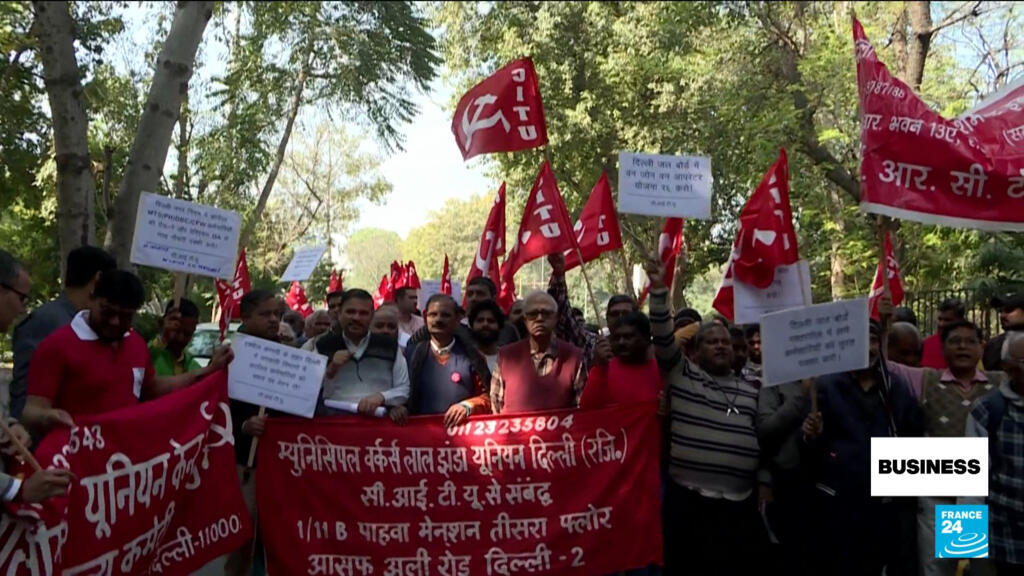
The friction between Indian smallholder farmers and United States trade objectives is not merely a localized protest; it is a fundamental clash between two incompatible agricultural models. On one side sits the US industrial-export model, characterized by high capital intensity, massive per-acre subsidies, and a reliance on global market price discovery. On the other is the Indian subsistence-security model, which prioritizes rural employment, price floors, and state-managed distribution to ensure food sovereignty for 1.4 billion people. To understand the current impasse, one must deconstruct the structural mechanics of Indian agricultural protectionism and the specific threats posed by US demands for market access.
The Trilemma of Indian Agricultural Policy
The Indian government operates under a "Policy Trilemma" where it must simultaneously balance three conflicting objectives:
- Fiscal Constraint: Limiting the massive budgetary drain of food subsidies.
- Consumer Inflation: Keeping food prices low for a massive urban and rural poor population.
- Producer Welfare: Ensuring the 40% of the Indian workforce engaged in farming remains economically viable.
Liberalizing trade with the US threatens this delicate equilibrium. US trade negotiators typically seek the elimination of "distortive" subsidies and the reduction of import tariffs, which currently stand as some of the highest in the world for certain commodities. If India yields, the influx of cheaper, subsidized US grain and dairy would theoretically benefit the "Consumer Inflation" pillar but would cause a catastrophic collapse in "Producer Welfare," leading to mass rural-to-urban migration that the Indian industrial sector is not currently equipped to absorb.
The Subsidy Asymmetry Mechanism
The core of the dispute lies in the definition of "Fair Trade" under World Trade Organization (WTO) definitions of Amber Box versus Green Box subsidies.
Indian farmers rely on Minimum Support Prices (MSP), a direct price intervention where the government promises to buy crops (primarily wheat and paddy) if market prices fall below a specific threshold. The US argues that MSP violates the de minimis limit of 10% of the value of production allowed for developing nations.
However, the US utilizes a different structural mechanism. While Indian subsidies are "product-specific" (and thus easily targeted in trade disputes), US subsidies are often "decoupled" or categorized as insurance and conservation payments. In 2020, US federal direct payments to farmers hit record highs, yet they are often shielded from WTO litigation through sophisticated legal categorization. Indian farmer unions recognize this asymmetry; they view US demands for "market parity" as a strategic attempt to dismantle India’s domestic procurement system while maintaining their own state-supported export advantage.
The Three Pillars of Agrarian Resistance
The resistance to a US-India trade deal among farmers is concentrated in three specific systemic threats:
1. The Intellectual Property and Seed Sovereignty Gap
The US trade agenda frequently pushes for the adoption of UPOV 91 (International Union for the Protection of New Varieties of Plants) standards. These standards strictly limit the ability of farmers to save, exchange, or sell seeds from protected varieties. In India, the Protection of Plant Varieties and Farmers' Rights Act (PPVFR) 2001 provides a unique legal framework that allows farmers to save and re-sow seeds even from protected varieties. Transitioning to a US-aligned IP regime would shift the cost function of Indian farming from a labor-intensive model to a high-input, royalty-dependent model, increasing the debt burden on smallholders who possess little collateral.
2. The Dairy Sector Vulnerability
The US dairy industry is a high-volume, automated machine looking for new markets. Conversely, India is the world’s largest dairy producer, but the industry is built on the backs of 80 million small-scale producers, many of whom own fewer than five cows. US demands for access to the Indian dairy market are met with fierce resistance because:
- Scale Inefficiency: Indian smallholders cannot compete on price with US industrial-scale operations.
- Cultural and Religious Norms: US cattle are often fed blood meal or other animal byproducts, which is a significant barrier for a predominantly vegetarian consumer base and a sensitive political issue for the ruling administration.
- The Cooperative Model: The success of entities like Amul relies on a protected domestic market to ensure that profits flow back to the rural producers rather than being extracted by global processors.
3. The Dismantling of the Public Distribution System (PDS)
The US has long questioned the legality of India's National Food Security Act, which provides subsidized grains to over 800 million people. To fuel this system, the Indian government must maintain massive stockpiles. The US views these stockpiles as potential "dumping" hazards that suppress global prices. Indian farmers, however, view the PDS as their only guaranteed buyer. Any trade deal that forces India to reduce its public stockholding directly shrinks the market for Indian farmers, forcing them into a volatile global market where they lack the hedging tools and infrastructure available to their American counterparts.
The Logistics of the Bottleneck
Even if tariffs were removed today, the physical and regulatory infrastructure of Indian agriculture creates a natural barrier to US entry—and a point of pain for Indian farmers.
- Cold Chain Deficiencies: India loses an estimated 15-20% of its produce due to lack of refrigerated transport. US exporters, who require high-standard cold chains for perishables, would necessitate an infrastructure overhaul that would likely be financed by private equity, potentially displacing local middlemen (Arhtiyas) who currently provide informal credit to farmers.
- Sanitary and Phytosanitary (SPS) Barriers: India frequently uses SPS measures to block US imports (e.g., the ban on US poultry due to concerns over avian flu). The US views these as "pseudo-tariffs." Farmers fear that "harmonizing" these standards will lead to an influx of products that do not meet local preferences but undercut local prices.
The Strategic Shift to "Atmanirbhar" (Self-Reliance)
The Indian government's shift toward the "Atmanirbhar Bharat" policy framework represents a hardening of the stance against broad-spectrum trade liberalization in agriculture. This is not merely protectionism; it is a calculated survival strategy. The logic follows that internal market integration—connecting farmers directly to Indian urban centers through digital platforms like e-NAM (Electronic National Agriculture Market)—is a higher priority than integration with global value chains.
The risk of the current trajectory is a "Low-Equilibrium Trap." By protecting inefficient, small-scale farming, India maintains social stability but sacrifices the productivity gains that come with mechanization and specialization. However, the political cost of the "Shock Therapy" required to modernize via trade liberalization is currently viewed as an existential threat to any ruling party. The 2020-2021 farmer protests, which forced the repeal of domestic market liberalizing laws, proved that the agrarian lobby possesses a veto over radical structural change.
Quantitative Divergence in Production Costs
The primary friction point in any trade negotiation is the unit cost of production. In the US, the cost of production for corn and soy is heavily influenced by land rent and fuel prices, but offset by massive yields per hectare. In India, the cost is dominated by labor and increasingly expensive fertilizers, but yields remain significantly lower than the global average.
- US Corn Yield: ~11 metric tons per hectare.
- India Corn Yield: ~3 metric tons per hectare.
This yield gap means that in a truly open market, Indian farmers would be decimated. Trade negotiators are essentially arguing over the price of social stability. For India, a tariff is not just a tax; it is a "social insurance premium" paid to prevent the collapse of the rural economy.
Calculated Forecast for Trade Negotiations
The probability of a comprehensive Free Trade Agreement (FTA) involving agriculture between the US and India remains near zero for the next five-year cycle. The tactical move for the US will be to pivot away from broad "market access" and toward "niche entry." Expect the following maneuvers:
- The Component Strategy: The US will attempt to de-link specific commodities (e.g., almonds, walnuts, fresh cherries) from the broader grain and dairy disputes. These are non-staple crops where India has a supply deficit and where local farmer opposition is minimal.
- Technology for Access: The US will offer ag-tech, precision farming tools, and satellite data in exchange for lower tariffs on specific high-value processed foods. This allows the Indian government to frame the deal as "modernization" rather than "surrender."
- The Ethanol Hedge: With India pushing for 20% ethanol blending in fuel, there is a burgeoning opening for US corn or ethanol exports that does not directly compete with the Indian food plate.
The strategic play for analysts is to monitor the Commission for Agricultural Costs and Prices (CACP) reports in India. Any significant shift in how MSP is calculated—specifically moving toward the "C2" (comprehensive cost) formula demanded by farmers—will signal a further retreat from trade liberalization. If India moves to legally guarantee MSP, it effectively signals the end of US hopes for significant grain market penetration. Investors should prioritize Indian ag-tech firms focusing on "Post-Harvest Loss Reduction" and "Direct-to-Consumer Logistics," as these sectors will receive the bulk of state support as an alternative to the "Global Trade" path.