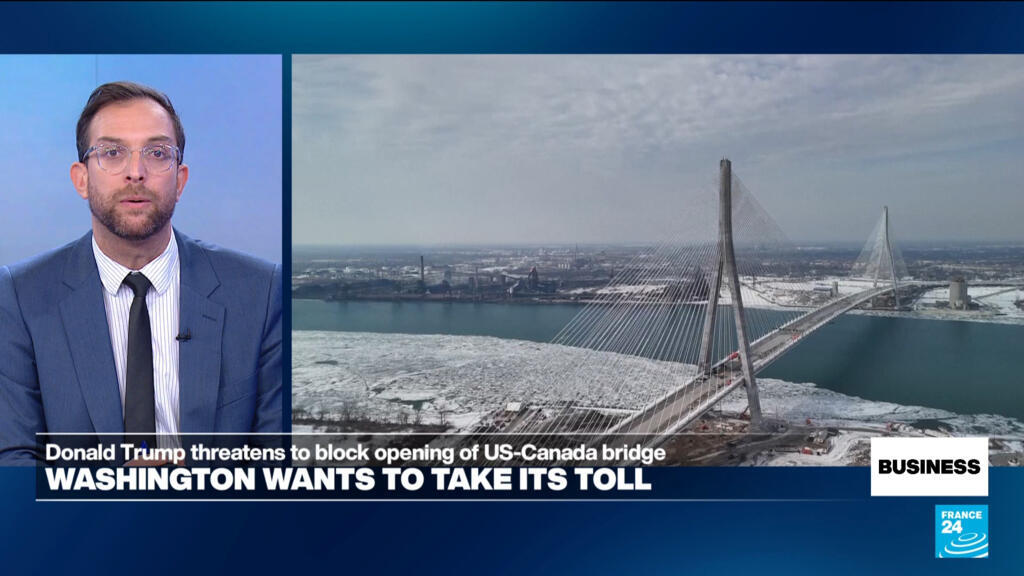
The recent executive threats to block the opening of the Gordie Howe International Bridge represent more than a localized infrastructure dispute; they signal the transition of physical trade architecture into a high-stakes instrument of economic coercion. To evaluate the strategic implications of these threats, one must move beyond the political rhetoric and analyze the bridge through the lens of bilateral dependency ratios, supply chain elasticity, and the mechanics of the Presidential Permit.
The $6.4 billion (CAD) project, funded entirely by the Canadian government via the Windsor-Detroit Bridge Authority (WDBA), is designed to bypass the century-old, privately owned Ambassador Bridge. By providing a direct highway-to-highway link between Ontario’s Highway 401 and Michigan’s I-75, the bridge targets the primary bottleneck of the Windsor-Detroit corridor, which currently facilitates approximately 25% of all surface trade between the United States and Canada.
The Mechanism of Obstruction: The Presidential Permit
The legal basis for a potential blockade rests on the Presidential Permit system, governed by Executive Order. Under U.S. law, any cross-border infrastructure project requires a permit certifying that the facility serves the "national interest."
- Revocation Authority: While the permit for the Gordie Howe International Bridge was issued in 2013, the executive branch maintains the authority to modify or revoke these permits based on changing definitions of national security or economic interest.
- Operational Decertification: Beyond revoking the permit, the administration can utilize the Department of Homeland Security (DHS) and Customs and Border Protection (CBP) to withhold the staffing of inspection plazas. A bridge without active federal customs agents is functionally an impassable monument.
- The Compensation Argument: The demand for "full compensation" and 50% U.S. ownership ignores the P3 (Public-Private Partnership) structure where Canada assumed the entirety of the financial risk in exchange for future toll revenues. Forcing an ownership transfer mid-completion constitutes a sovereign risk event that challenges the sanctity of international infrastructure contracts.
The Cost Function of Delay: Quantifying Economic Friction
The "Cost of Delay" is not linear; it is an accelerating function that impacts the just-in-time (JIT) manufacturing models dominant in the Great Lakes region. The automotive sector, in particular, operates on a "border-as-a-conveyor-belt" philosophy.
- Inventory Carry Costs: Every hour of idling at the border increases the capital tied up in transit. A study by the University of Windsor suggests the new bridge could reduce crossing times by up to 20 minutes. Across the estimated 2.5 million annual truck crossings, this represents a massive reduction in deadweight loss.
- Supply Chain Decoupling: If the bridge remains closed, the region remains dependent on the Ambassador Bridge. This creates a single point of failure. The 2022 "Freedom Convoy" blockades demonstrated that a multi-day closure of this single artery costs the North American economy approximately $300 million to $500 million per day in lost production.
- Toll Revenue Cannibalization: The financial model for the bridge relies on capturing approximately 45% of the commercial traffic currently using the Ambassador Bridge. A delay in opening prevents the WDBA from recouping the $6.4 billion investment, essentially turning a productive asset into a stranded asset.
The Geopolitical Triangle: Canada, the U.S., and China
The executive rhetoric specifically links the bridge’s opening to Canada’s trade posture toward China. This creates a three-way logical bottleneck:
- Trade Diversification vs. Continental Integration: Canada’s attempts to diversify trade via agreements with China are viewed by the U.S. administration as a "backdoor" for Chinese goods to enter the U.S. market under the USMCA (United States-Mexico-Canada Agreement) framework.
- The Decertification Threat: The threat to block the bridge is being used as a "linkage strategy" to force Canada to adopt U.S.-aligned tariffs on Chinese EVs and steel. By targeting a fixed Canadian asset on U.S. soil, the administration is exercising extraterritorial leverage.
Structural Vulnerabilities of the Ambassador Bridge Monopoly
The strategic necessity of the Gordie Howe bridge is underscored by the limitations of the current infrastructure. The Ambassador Bridge, completed in 1929, suffers from:
- Geographical Inefficiency: Trucks must navigate 17 sets of traffic lights on the Canadian side before reaching the highway.
- Maintenance Fragility: As a privately owned structure nearing its centennial, the risk of structural failure or emergency closure is non-negligible.
- Capacity Caps: The existing span cannot accommodate the projected 2030-2040 growth in cross-border freight volume, which is expected to rise as North American near-shoring increases.
Tactical Realities: The "Leverage" Hypothesis
The threat to block the bridge may be more of a negotiating tactic than a literal policy goal. In the lead-up to the 2026 USMCA review, the U.S. administration is identifying "pain points" to extract concessions on dairy, digital services taxes, and defense spending.
The Gordie Howe bridge is an ideal target because:
- It is high-visibility and symbolic of Canadian national pride.
- It is physically located partly within U.S. jurisdiction, making it vulnerable to local regulatory stalling.
- It has immediate fiscal consequences for the Canadian federal budget if toll revenues do not materialize as scheduled.
However, the strategy carries a significant backfire risk. Michigan’s economy is the most exposed to Canadian trade of any U.S. state. Blocking the bridge doesn't just "punish Canada"; it imposes a permanent "efficiency tax" on Michigan manufacturers who rely on seamless integration with Ontario’s industrial base.
Strategic Forecast: The Path to Resolution
The bridge will likely open, but its operational launch will be preceded by a "Grand Bargain" that includes:
- CBP Staffing Agreements: A Memorandum of Understanding (MOU) where Canada pays a higher percentage of U.S. operational costs for the first five years.
- Tariff Alignment: Canada adopting synchronized tariffs on Chinese industrial inputs to "protect" the integrity of the bridge as a secure trade conduit.
- Joint Oversight Boards: The creation of a binational commission that grants the U.S. a greater say in the bridge’s security protocols, satisfying the demand for "respect and fairness" without requiring a formal transfer of equity.
The bridge is no longer just a span of steel and concrete; it is the first major casualty of a new era of infrastructure-centric diplomacy. Investors and logistics firms must now price "political transit risk" into their long-term Great Lakes strategy.
Monitor the Federal Register for any notices regarding the modification of the Presidential Permit for the Gordie Howe International Bridge. Any movement toward a "review" of the 2013 permit will serve as the primary indicator of a prolonged delay and a subsequent spike in regional logistics costs.