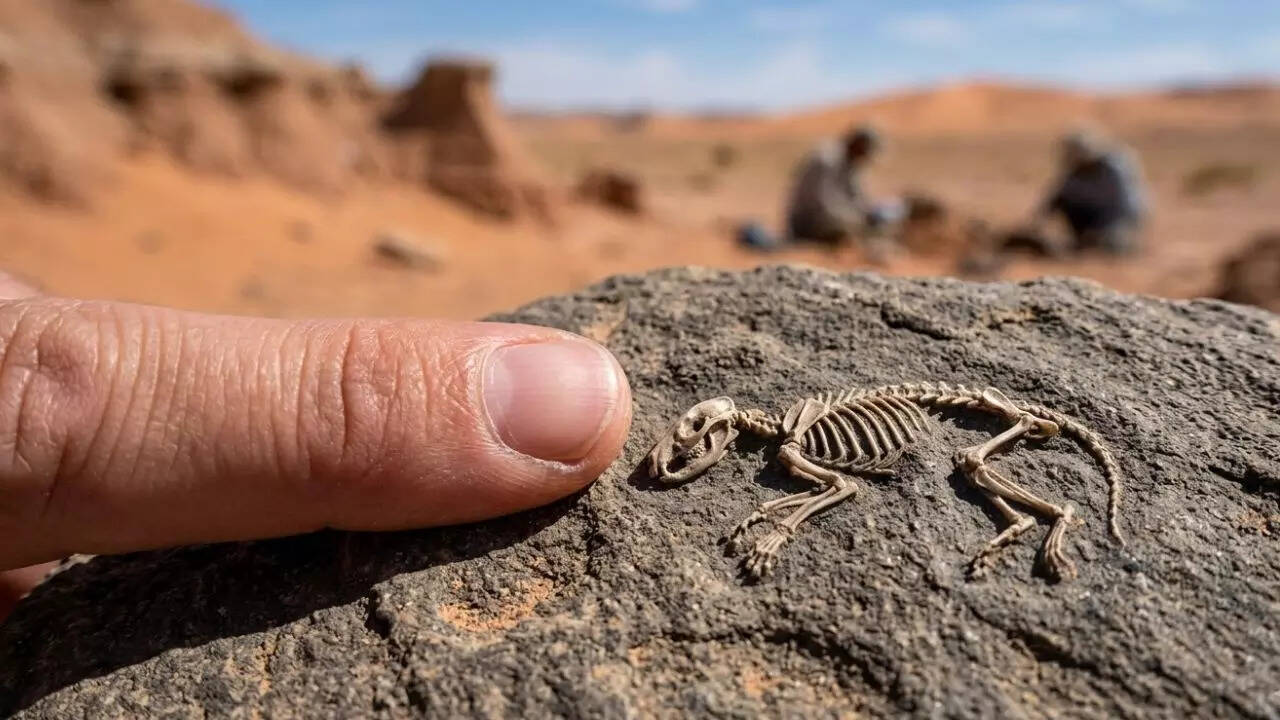
The wind in the Gobi Desert doesn’t just blow; it scours. It carries a fine, alkaline grit that finds its way into your teeth, your watch gears, and the very pores of your skin. For days, the team of paleontologists had seen nothing but the infinite, undulating beige of the Nemegt Formation. They were looking for giants. In this part of Mongolia, the earth usually yields the bones of titans—creatures like Tarvosaurus, the Asian cousin of the T-Rex, whose femurs are the size of tree trunks.
Then, a glint. Not of bone, but of something so small it nearly vanished against the horizon.
A researcher knelt. The silence of the desert pressed in. There, nestled in the red sandstone, was a fossil no larger than a fingernail. It was a fragment of a skull, barely one centimeter long. In the grand theater of deep time, we are taught to marvel at the massive. We queue up in museums to stand beneath the ribcages of leviathans. But this tiny, fragile speck of calcium was about to do something a thousand-ton sauropod never could.
It was about to rewrite the biography of how we became human.
The Tyranny of the Large
We suffer from a biological bias toward the enormous. When we think of the Cretaceous period, we visualize a world of cinematic violence—clashing monsters and shaking earth. Yet, while the "thunder lizards" were busy dominating the landscape, a far more sophisticated revolution was happening underfoot, literally in the shadows.
This one-centimeter skull belonged to a shrew-like mammal, a creature that lived roughly 70 million years ago. To the dinosaurs, it was an irrelevance. To us, it is a mirror.
Scientists back in the lab used high-resolution CT scanning to peer through the stone encasing the specimen. What they found was a sensory map of a lost world. Unlike the reptiles of its day, this tiny creature possessed an expanded braincase and specialized middle ear bones. It was built for the dark. While the giants relied on brute force and solar heat, this scrap of life was developing the hardware for high-fidelity hearing and complex scent processing.
It was a survival machine built on information, not muscle.
Consider the stakes of being that small. For this mammal, a heavy rainstorm wasn't weather; it was a series of falling liquid boulders. A passing Velociraptor wasn't a predator; it was a localized earthquake. Every single heartbeat was a gamble against extinction. The fact that this skull exists at all—that it wasn't crushed into dust by the shifting sands or dissolved by acidic groundwater—is a statistical miracle.
The Architecture of a Miracle
The discovery shocks the scientific community because it challenges the timeline of mammalian sophistication. We used to believe that mammals remained primitive, "generalist" organisms until the dinosaurs were cleared out of the way by an asteroid. We viewed them as the understudies waiting for the lead actors to die so they could finally take the stage.
The Gobi fossil tells a different story.
It suggests that the "advanced" features of mammals—the intricate inner ear that allows us to hear the nuance in a symphony or the tremor in a loved one's voice—were already perfected while the dinosaurs were at their peak. The middle ear of this specimen is a masterpiece of biological engineering. It disconnected the bones used for chewing from the bones used for hearing.
This separation is what allowed mammals to develop an incredibly wide range of auditory frequencies. It gave them the "high ground" of the night.
Imagine the desert 70 million years ago. The sun sets, and the great cold-blooded predators grow sluggish as their internal temperatures drop. The world becomes a theater of sounds: the rustle of a beetle, the snap of a twig, the distant hiss of a predator. While the giants slept, our ancestors were awake, processing a data-rich environment with a precision the world had never seen. They weren't just surviving. They were out-thinking the world.
The Invisible Threads of Connection
When you look at a photo of the fossil, it looks like a piece of gravel. It’s easy to dismiss. But hold your hand up and look at your thumb. The DNA instructions that built your skeletal structure, the way your brain interprets the sound of your own breathing—those blueprints are etched into the architecture of that one-centimeter find.
There is a profound loneliness in paleontology. You spend your life digging through the graveyards of species that failed. You see the dead ends of evolution, the bizarre experiments that didn't make it. But then, you find a link.
The Mongolian discovery is a reminder that the most significant shifts in history rarely happen with a bang. They happen in the quiet, in the small corners, through the refinement of internal systems rather than the growth of external armor. We are the descendants of the creatures that were small enough to be overlooked.
But how did something so delicate survive the Gobi’s brutal history? The preservation of the specimen is almost haunting. The delicate struts of bone, thinner than a human hair, remained intact through the rise of the Himalayas and the cooling of the planet. It waited in the dark for seventy million years just to tell us that we were wrong about our own origins.
The Weight of a Gram
We often measure the importance of news by its scale. We look for the big numbers, the global shifts, the massive disruptions. But the most "robust" things in the universe are often the most microscopic.
This fossil forces a confrontation with our own ego. We think of ourselves as the masters of the planet, the pinnacle of a long journey. We forget that our survival was once dependent on a creature that could be crushed by a falling pinecone. That tiny skull is a testament to the power of the "marginal." It proves that being small is not the same as being weak. In fact, in the eyes of deep time, being small was the ultimate competitive advantage. It allowed for agility, for lower caloric needs, and for the development of the very intelligence we now use to dig these fossils up.
The researchers who found it didn't celebrate with a shout. They celebrated with a collective intake of breath. They knew that they weren't just looking at a bone. They were looking at a beginning.
The Gobi Desert continues to give up its secrets, one grain of sand at a time. Somewhere out there, beneath the scorched earth, are the remains of a thousand other stories we haven't yet learned how to read. We go there looking for the kings of the past, the massive and the terrifying.
Instead, we find ourselves.
A one-centimeter fragment of hope, preserved in a wasteland of giants. It is a reminder that no matter how loud the world gets, the most important voices are often the ones we have to lean in to hear. The history of life isn't written in the footprints of the huge, but in the silent, enduring pulse of the small.
The wind continues to scour the Nemegt, erasing tracks and uncovering truths, indifferent to the giants it buried or the tiny ghosts it finally decided to set free.