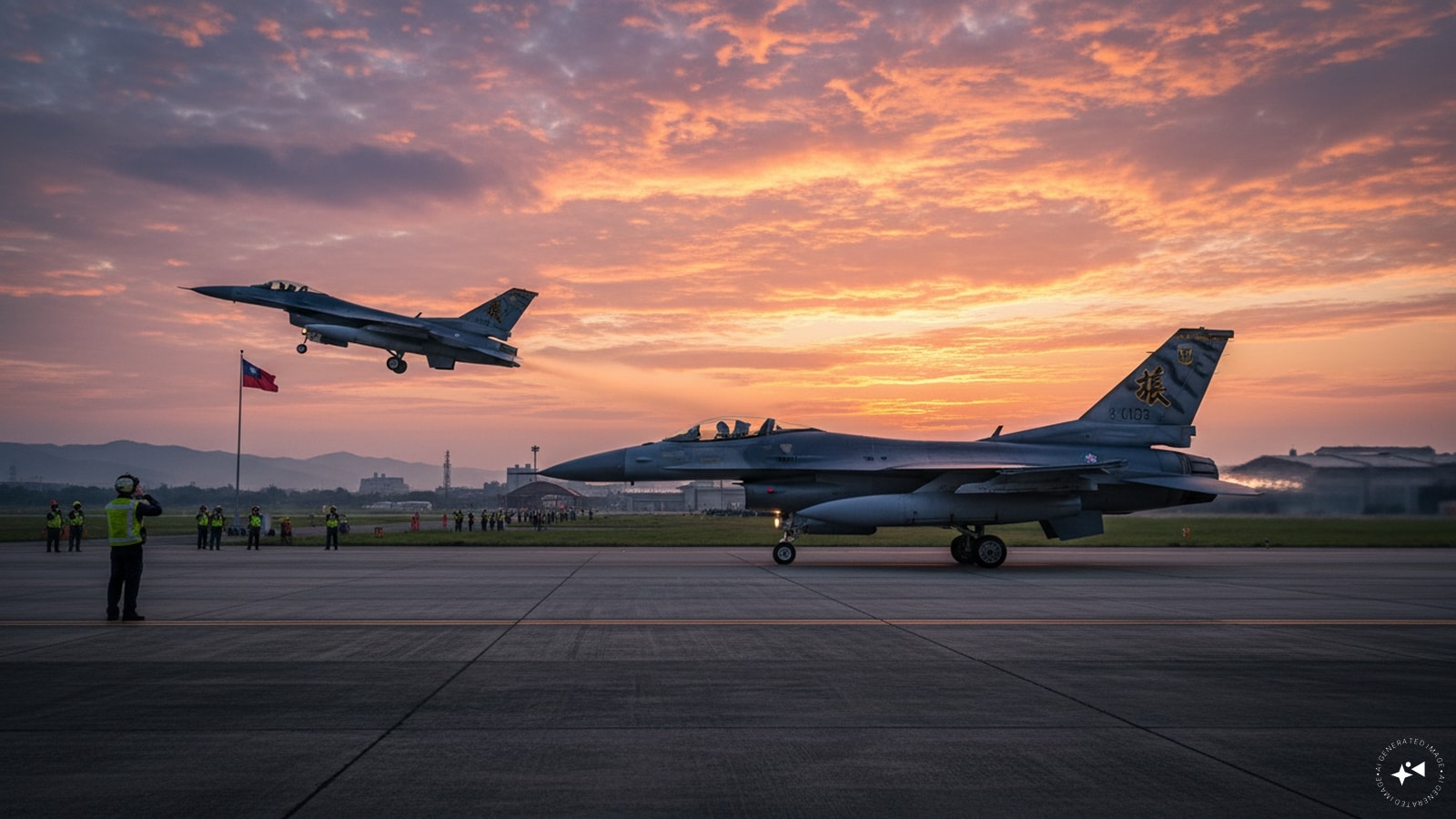
The tarmac at Chihhang Air Base in Taitung County bore the heavy weight of a 29-year wait when the first two new-build F-16C/D Block 70 fighter jets touched down in Taiwan. For an island democracy facing an increasingly aggressive People's Liberation Army Air Force, the arrival of these aircraft represents a vital injection of modernized air power. Yet, beneath the official pageantry and the unfurled flags of the Republic of China, a sobering operational reality persists. Sixty-six jets were purchased under an eight-billion-dollar foreign military sale approved back in 2019. They were supposed to arrive starting in 2023. Instead, manufacturing bottlenecks, production line relocations to South Carolina, and lingering global supply chain fractures pushed the timeline back by years.
The arrival of these initial airframes and subsequent batches does not instantly solve the structural deficit facing Taiwan's military. It merely stops the bleeding. Understanding the true significance of these fighters requires looking past the press releases and examining the mechanics of procurement, pilot training pipelines, and the grueling attrition math of modern air defense across the Taiwan Strait.
The Anatomy of the Delay
To comprehend why these jets took until late 2026 to reach Taitung, one must look at the industrial capacity of American defense manufacturing. When Washington and Taipei finalized the 8 billion dollar deal for 66 new Block 70 aircraft, Lockheed Martin was simultaneously managing a crowded production queue for international buyers like Bahrain, Slovakia, Morocco, and Bulgaria.
The structural shift of moving F-16 production lines from Fort Worth, Texas, to Greenville, South Carolina, created deep initial friction. Supply chain snarls compounded the issue. Sub-tier suppliers struggled to deliver specialized avionics, structural bulkheads, and wiring harnesses on time.
For Taiwan's Air Force, known officially as the ROCAF, these delays meant stretching an already exhausted fleet of legacy fighters to their absolute limits. The older F-16A/B airframes, currently undergoing their own extensive upgrades to the "Viper" configuration domestically, have logged thousands of hours intercepting near-daily incursions by Chinese air patrols. Every month of delay meant accelerated fatigue on legacy airframes, putting immense pressure on maintenance crews working around the clock in subterranean hangars like those carved into the mountains at Chiashan.
What the Block 70 Brings to the Fight
The newly delivered jets are not mere carbon copies of the planes Taiwan has flown for decades. The Block 70 configuration introduces substantial technological upgrades that alter the tactical calculus in the skies above the strait.
At the heart of this upgrade is the Northrop Grumman AN/APG-83 Active Electronically Scanned Array radar. Unlike the mechanical radars of older variants, an AESA radar provides extreme resistance to electronic jamming, faster target acquisition, and the ability to track multiple threats simultaneously across cluttered land and sea environments. In a scenario where mainland forces routinely deploy electronic countermeasures to blind defenders, the APG-83 offers a critical edge.
Furthermore, these new-build airframes arrive with a certified structural life of 12,000 hours—significantly higher than the legacy airframes that have already consumed a large portion of their initial design limits. They also feature heavyweight landing gear designed to support increased maximum takeoff weights, heavier weapons payloads, and enhanced conformal fuel tanks.
The aircraft incorporate an advanced automated ground collision avoidance system, a life-saving safety feature for pilots executing high-G maneuvers at low altitudes during interception runs. Weapon integration matches this hardware leap. The jets are paired with advanced missile inventories, including modern variants of the AIM-120 Advanced Medium-Range Air-to-Air Missile and AGM-88 anti-radiation missiles, giving the ROCAF a credible standoff capability that forces opposing planners to calculate risks carefully.
The Attrition Trap and Pilot Bottlenecks
Hardware is only as effective as the infrastructure supporting it. Buying 66 advanced fighters creates a secondary crisis that military analysts rarely emphasize enough: personnel constraints.
Training a modern fighter pilot takes years of rigorous instruction, starting from propeller trainers to fast jets domestically, before transitioning overseas to specialized conversion units like those operating at Luke Air Force Base in Arizona. Taiwan faces a persistent pilot shortage. The sheer volume of scramble alerts—responding to constant gray-zone incursions by mainland bombers, early warning aircraft, and fighters—pulls experienced instructor pilots away from training duties just to maintain daily Quick Reaction Alert postures.
When new jets arrive in batches, the Republic of China Air Force must carefully sequence how many pilots are deployed to the United States for transition training while ensuring enough personnel remain behind to fly and maintain the operational units. Pushing too many pilots overseas creates a temporary capability dip at home. Rushing them through creates safety vulnerabilities.
There is also the harsh reality of geographic concentration. Taiwan is geographically compact. Its primary air bases, including Chihhang in the east and facilities along the western plain, are well within range of precision-guided ballistic and cruise missiles stationed across the strait.
While eastern bases like Taitung offer some protection due to the rugged spine of the Central Mountain Range blocking direct radar lines of sight and incoming trajectories, an initial salvos campaign could crater runways and trap aircraft on the ground. The utility of advanced F-16Vs diminishes rapidly if they cannot safely take off, land, and refuel beneath a sustained missile barrage. To counter this, the military routinely practices emergency highway landings and decentralized dispersal operations, yet these measures remain difficult substitutes for hardened, fully operational underground air complexes.
Strategic Signals in a Shifting Diplomatic Climate
The timing of these deliveries carries heavy political weight. The arrival of the initial jets occurred shortly after high-level diplomatic engagements between Washington and Beijing, serving as a tangible indicator of security commitments under the Taiwan Relations Act.
For Taipei, receiving physical hardware is the ultimate metric of alliance reliability. Diplomatic communiques and verbal assurances from foreign partners provide comfort, but steel arriving on the tarmac provides a deterrent.
Yet, relying purely on foreign arms acquisitions exposes vulnerabilities rooted in global defense industrial capacity. The multi-year lag between contract signing in 2019 and the delivery of the first airframes highlights the danger of depending on external supply chains during an era of great power competition and industrial strain. As future batches trickle in over the coming years to complete the 66-jet order, defense planners in Taipei are already calculating whether production milestones will slip further as global demands on American aerospace manufacturing intensify.
The Vipers are finally on the ground. The pilots are stepping out onto the tarmac at Chihhang. But the margin for error in the skies of East Asia has never been thinner, and the clock on completing the full fleet integration is ticking against a modernization program across the water that shows no signs of slowing down.
F-16V Block 70 Arrival Coverage
This video provides footage and local news coverage of the arrival of Taiwan's first new F-16V Block 70 fighter jets at Chihhang Air Base.