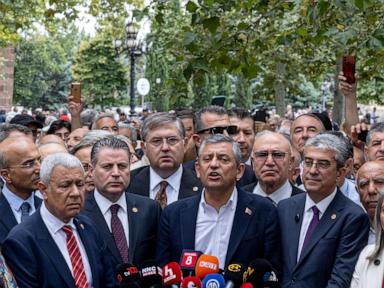
Turkish opposition leader Ozgur Ozel has detonated a political hand grenade inside his own camp, resigning from the historic Republican People's Party (CHP) alongside dozens of lawmakers to launch a breakaway faction. This fracture arrives courtesy of a controversial court ruling that stripped Ozel of the chairmanship and resurrected his deeply unpopular predecessor, Kemal Kilicdaroglu. For President Recep Tayyip Erdogan, who has dominated Turkish statecraft for over twenty-two years, this self-inflicted opposition implosion represents an extraordinary stroke of geopolitical fortune.
Anatomy of a Judicial Coup
To understand why a major political party would tear itself apart from the inside, one must examine the weaponization of the Turkish judiciary. In May, an appeals court annulled the 2023 CHP congress that had swept Ozel into power on a wave of modernizing optimism. The official justification pointed toward technical irregularities in the voting process, but the political reality was glaringly obvious. Ozel had engineered a stunning municipal victory in 2024, stripping AKP strongholds of key metropolitan centers like Istanbul and Ankara while positioning mayors like Ekrem Imamoglu as credible national alternatives to Erdogan.
Instead of capitalizing on that momentum, the opposition machine locked into a protracted legal civil war. The court's decision to reinstate Kilicdaroglu—the man whose electoral failures against Erdogan had demoralized millions of secular Turks for over a decade—triggered immediate outrage.
Ozel faced a grim choice. He could submit to an institutional apparatus hijacked by old-guard loyalists and judicial meddling, or he could blow up the chess board. He chose demolition. Walking out of parliament with dozens of defecting MPs, Ozel shed his CHP badge and began filing papers for a brand-new political entity.
The Mechanics of the Breakaway
This splinter movement is not merely a bruised politician throwing a tantrum. It is a calculated structural realignment. By pulling a massive bloc of legislators out of the CHP, Ozel intends to strip his former home of its official status as the main opposition party in parliament, transferring that mantle directly to his new banner.
History offers eerie precedents. Turkey's foundational opposition traditions have long been plagued by splintering. When political rigidities prevent organic evolution within historic parties, ambitious factions routinely peel away to seek cleaner slates. Yet, attempting this while the state prosecutes a sweeping legal crackdown against municipal leaders is equivalent to walking through a munitions factory with a lit match.
The state's apparatus has not been idle. While Ozel currently hides behind the procedural shield of parliamentary immunity, dozens of municipal officials, party organizers, and heavyweights like imprisoned Istanbul Mayor Ekrem Imamoglu face unrelenting legal assaults. Corruption charges and conspiracy indictments are standard operating procedure designed to paralyze institutional memory and exhaust financial resources.
Playing Right Into the Palace's Hands
Despite Ozel's populist framing of a brave new beginning, the immediate strategic beneficiary of this theater is clear. A fractured opposition fighting two separate wars—one against the ruling Justice and Development Party (AKP) and another against its own internal ghosts—cannot project disciplined strength.
Erdogan is a master of weathering political storms by watching his adversaries consume one another. If early elections are forced onto the calendar before 2028, a divided secular electorate risks splitting its vote between nostalgic CHP loyalists clinging to Kilicdaroglu and Ozel's fresh-faced defectors. The mathematical reality of Turkey's electoral system is unforgiving to fractured coalitions.
Ozel insists his new movement will capture the center-left and reach across ideological aisles to disaffected conservatives. But rhetoric does not patch over institutional scars. The party machinery left behind in the CHP remains entrenched, vindictive, and reluctant to surrender its historical branding to an upstart breakaway.
The next few weeks will test whether public frustration over Turkey's grinding cost-of-living crisis can override personal vendettas and institutional sabotage. If the opposition cannot close ranks, this brilliant act of defiance will be remembered as the moment the dream of unseating Erdogan was legally and structurally dismantled from within.
Ozgur Ozel launches new party in Turkey
This video provides an on-the-ground look at Ozgur Ozel's announcement and the immediate political fallout splitting Turkey's opposition.
http://googleusercontent.com/youtube_content/1