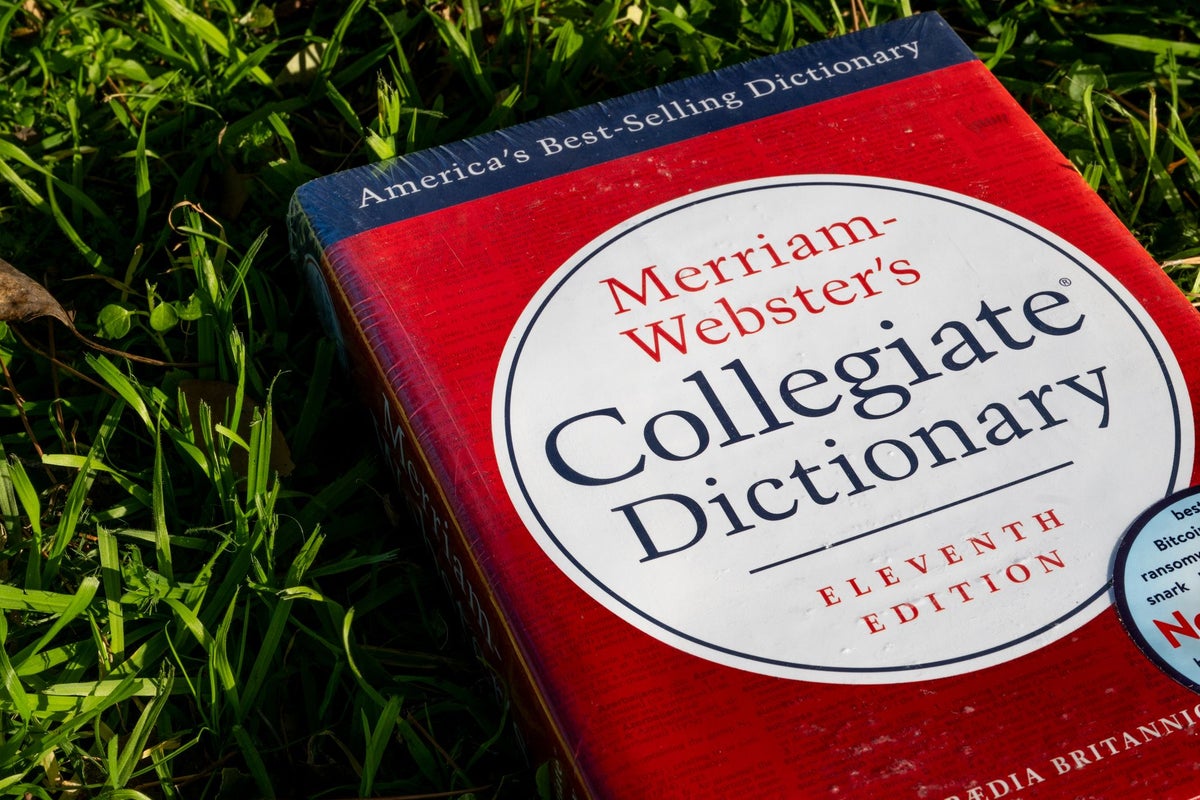
In a quiet, climate-controlled room in Springfield, Massachusetts, a lexicographer sits at a desk cluttered with digital citations and physical notes. For decades, this has been the steady, rhythmic heart of the English language. This is where "vibe" was finally codified, where "truthiness" earned its stripes, and where the shifting sands of human expression were captured, dried, and pinned like butterflies in a glass case.
Merriam-Webster has always been the silent arbiter of our reality. We turn to it when we argue over Scrabble, when we write legal briefs, and when we need to know if we are using a word that makes us look like fools. But now, that quiet room is the staging ground for a war over the very soul of meaning. Don't miss our previous post on this related article.
The dictionary giant has filed a lawsuit against OpenAI, the creator of ChatGPT. It is a collision between the oldest gatekeepers of language and the newest, most voracious consumers of it. At its core, the claim is simple and devastating: ChatGPT didn't just learn how to speak; it stole the dictionary to do it.
The Ghost in the Library
To understand why a dictionary is suing a mathematical model, you have to understand how a dictionary is built. It isn't a list of words that fell from the sky. It is a cathedral built brick by brick. Every definition in a Merriam-Webster entry is the result of "reading and marking"—a process where human editors scan millions of pages of literature, news, and technical manuals to see how a word is actually living in the wild. To read more about the context here, Ars Technica offers an excellent breakdown.
They write the definitions from scratch. They craft the nuance. They decide the difference between "sarcastic" and "sardonic."
Now, imagine an entity that can read every book ever written in the blink of an eye. It doesn't have a soul, and it doesn't have a pulse, but it has an appetite. OpenAI’s GPT models were fed a diet of nearly the entire internet. Included in that feast, Merriam-Webster alleges, were the proprietary, copyrighted definitions that the company has spent nearly two centuries refining.
The lawsuit argues that when you ask ChatGPT for a definition, you aren't getting a "creative synthesis" of human thought. You are getting a repackaged version of Merriam-Webster’s intellectual property. It is the literary equivalent of a restaurant stealing a chef’s secret spice blend, putting it in a shiny new bottle, and claiming they invented flavor.
The Invisible Labor of a Definition
Consider the word "justice."
To a machine, "justice" is a high-probability string of tokens that often appear near words like "court," "fairness," or "law." To a Merriam-Webster editor, it is a concept that requires careful historical guarding. If the AI scrapes those definitions without permission, it isn't just taking data. It is taking the labor of the people who sat in those quiet rooms in Springfield, debating for hours whether a semicolon belonged in the third sub-definition of a legal term.
We often think of AI as a magic trick. We type a prompt, and a miracle appears. But that magic is fueled by the work of millions of humans who never signed up to be the "training data" for their own replacement.
The stakes are higher than just a copyright dispute over some text. This is about the value of human expertise in an era of automated imitation. If we allow a system to ingest the definitive record of our language, strip away the brand, and sell it back to us as its own "intelligence," what happens to the people who curate that record?
A Mirror That Steals Your Face
The defense from the tech world usually follows a predictable path. They call it "fair use." They argue that the AI is like a student reading a book in a library. A student learns from the book and then uses that knowledge to write their own essays. Why should a machine be any different?
But a student doesn't replicate the library at scale. A student doesn't offer a competing library service based entirely on the books they read for free.
Merriam-Webster’s legal team points to the "transformative" nature—or lack thereof—in how these models operate. If the AI provides a definition that is 95% identical to the one found in the Merriam-Webster Collegiate Dictionary, it hasn't transformed anything. It has simply photocopied it with a digital brain.
This creates a parasitic relationship. The AI needs the dictionary to be accurate, but the more people use the AI for definitions, the less they visit the dictionary’s website. The revenue that pays the lexicographers starts to dry up. If the lexicographers go away, who is going to track the new words of 2027? Who will do the "reading and marking" for the next generation?
The AI cannot go out into the world and experience a new social trend. It cannot feel the shift in how we use the word "equity" or "cringe." It can only look backward at what humans have already written. If the humans stop writing the definitions because they can no longer afford to eat, the AI’s "intelligence" will begin to rot. It will become a closed loop of increasingly stale information.
The Cost of Convenience
We are currently in a honeymoon phase with automation. It is so easy to ask a chatbot for a quick summary that we forget to ask where that summary came from. We treat the output as a commodity, like water from a tap.
But water comes from an infrastructure of pipes, treatment plants, and engineers. Language has an infrastructure, too. It is built on trust. We trust the dictionary because it has a reputation for accuracy that spans generations. We trust it because there are names and faces behind the entries.
When OpenAI uses that data to train its models, it is essentially mining the "trust" that Merriam-Webster built over 180 years and converting it into "user engagement" for a Silicon Valley startup.
The lawsuit highlights several instances where the AI’s responses mirrored the dictionary’s unique phrasing, including specific examples and idiosyncratic ways of organizing information. These aren't accidents. They are the fingerprints of a heist.
The Weight of the Printed Page
There is a specific smell to a dictionary. It’s the smell of thin paper, old ink, and the collective memory of a civilization. When you hold a physical copy of Merriam-Webster, you are holding the boundaries of your world.
The Silicon Valley ethos has always been to "move fast and break things." Usually, they break industries—taxis, hotels, print newspapers. This time, they are moving toward the foundation of thought itself.
If a company can own the tool that defines what words mean, and that company trained that tool on the work of others without payment, they haven't just built a product. They have built a monopoly on meaning.
The lawyers will argue about "training weights" and "latent space" and "statistical modeling." They will try to make the case so technical that we lose sight of the theft. But the theft is happening in plain English.
Imagine you spent your entire life writing a memoir, only for someone to take your book, run it through a shredder, glue the pieces back together in a slightly different order, and sell it as their own autobiography. That is the "learning" process OpenAI describes.
The Friction of Truth
We are moving toward a frictionless world. We want answers without searching. We want content without creators. We want the dictionary without the lexicographer.
But the friction is where the truth lives. The friction is the debate in the Springfield office. The friction is the struggle to find the exact right word for a feeling that didn't exist five years ago.
This lawsuit is a hand on the lever, trying to slow down the machine before it grinds the source material into dust. It is an old-world institution standing in the path of a digital hurricane, clutching a book.
It feels like a David and Goliath story, but it’s harder to tell who is who. OpenAI has the billions of dollars and the cultural momentum. Merriam-Webster has the words.
Perhaps the most ironic part of this entire saga is that the word "theft" has a very specific definition. If you look it up in the Merriam-Webster dictionary, it involves the "illegal taking of the property of another."
The courts will now have to decide if that definition applies to the very people who wrote it.
The lexicographer in Springfield clears their desk. They have a new word to track, a new nuance to explore, even as the walls of their sanctuary begin to vibrate with the hum of a thousand servers nearby. They keep working, because the world needs to know what things mean, and a machine that only knows how to mimic can never truly understand the weight of a word.
The ink is still wet on the filing. The servers are still spinning. Somewhere, in a dark room of code, a model is processing the word "litigation." It doesn't know what it feels like to be sued. It doesn't know what it feels like to lose. It only knows the probability of the next letter.
But for the rest of us, the letters still matter. The order we put them in matters. And who we stole them from matters most of all.


-0a221419-1920w.png)