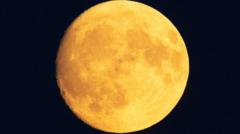
Observing celestial events requires shifting focus from romanticized folklore to the precise mechanics of photon transmission and atmospheric optics. The July full moon, colloquially designated as the Buck Moon, offers a predictable case study in positional astronomy. Maximizing observation fidelity demands a rigorous breakdown of temporal coordinates, atmospheric attenuation factors, and the physiological constraints of human visual perception.
The Temporal and Orbital Mechanics
The visual prominence of any lunar phase is governed by the relative geometry of the Sun, Earth, and Moon. The full moon occurs precisely when the lunar disk is positioned opposite the Sun relative to Earth, achieving maximum illumination of the visible hemisphere.
- The Zenith Paradox: Peak optical illumination frequently occurs during daylight hours for specific geographic longitudes, rendering the precise mathematical peak invisible to local observers.
- The Persistence Variable: Because the lunar orbit operates on a continuous continuum rather than an instantaneous flash, the observable disk remains ninety-nine percent illuminated for a span of approximately forty-eight hours centered on the peak moment.
- The Horizon Window: Optimal observation efficiency occurs exclusively during moonrise, which coincides directly with local sunset. At this juncture, the observer's line of sight intersects the eastern horizon immediately as solar glare recedes.
Atmospheric Attenuation and Optical Physics
Light emitted or reflected from the lunar surface must traverse a variable column of tropospheric particles before reaching the human eye or recording sensor. The clarity of the Buck Moon depends on quantitative atmospheric interference variables.
- Air Mass Coefficients: When the Moon rests low on the horizon, its light travels through a significantly thicker slice of Earth's atmosphere compared to when it occupies a zenith position. This increases the air mass coefficient, creating severe refraction.
- Rayleigh Scattering Profiles: Shorter wavelengths of light, specifically blue and violet, scatter off atmospheric molecules and particulate matter. Longer wavelengths, primarily red and orange, penetrate this particulate barrier with lower attenuation rates. This physical constraint explains why a low-hanging lunar body manifests a distinct amber hue rather than stark white.
- The Horizon Elevation Factor: Placing an observation point at a higher topographical elevation reduces the lower atmospheric column density, minimizing particulate obstruction and sharpening contrast ratios against terrestrial foreground elements.
Psychological Optics Versus Instrument Performance
Evaluating the visual scale of a lunar event requires separating objective angular diameter from subjective cognitive processing.
- The Angular Size Constant: The physical angular diameter of the Moon remains constant at approximately half a degree regardless of its altitude above the horizon.
- The Cognitive Distortion Mechanism: When the lunar body appears near terrestrial reference objects such as tree lines or architectural structures, human neural pathways misinterpret spatial context. This produces the recognized moon illusion, wherein cognitive bias falsely amplifies the perceived scale of the satellite.
- Optical Equipment Tradeoffs: Unassisted human vision optimizes for wide-field angular perspective during moonrise. Conversely, high-magnification optical instruments such as telescopes or telephoto lenses compress the field of view, washing out structural surface contrast due to the extreme albedo of a fully illuminated lunar disk.
Position yourself at an elevated eastern vantage point precisely at local sunset, filtering out urban light pollution to minimize local atmospheric turbulence while exploiting Rayleigh scattering for optimal chromatic depth.