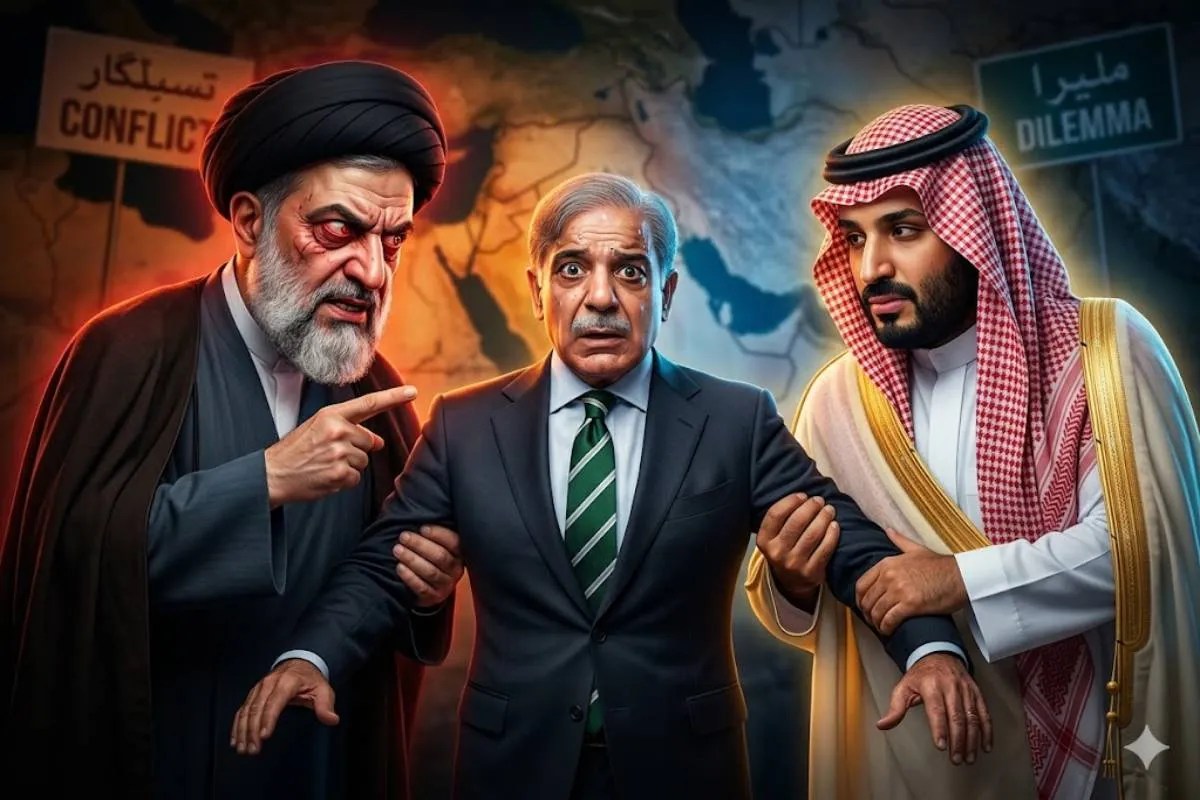
Pakistan’s foreign policy regarding the Iran-Israel conflict is not a matter of ideological preference but a forced navigation of a high-stakes financial and security trilemma. The state is currently caught between three mutually exclusive pressures: the requirement for Saudi capital to prevent sovereign default, the necessity of a stable border with Iran to contain Baloch insurgency, and the risk of domestic civil unrest fueled by sectarian polarization. While public discourse focuses on diplomatic "balancing," the operational reality is a series of reactive trade-offs where every move to satisfy one pillar of this trilemma directly degrades the stability of the other two.
The Financial Dependency Function
The primary constraint on Pakistan’s strategic autonomy is its debt-to-GDP ratio and its reliance on the "Special Investment Facilitation Council" (SIFC) to attract Gulf capital. Saudi Arabia is no longer providing "brotherly loans" without strings; the contemporary Saudi approach, driven by Vision 2030, treats Pakistan as a distressed asset that requires structural reform and geopolitical alignment in exchange for liquidity.
- The Liquidity Trap: Pakistan’s immediate need for IMF program roll-overs and Saudi deposits creates a hard ceiling on its ability to remain neutral. If Riyadh perceives Pakistan as tilting too far toward Tehran—or even remaining too passive during an active kinetic conflict—the flow of "oil on deferred payments" and central bank deposits risks suspension.
- The Investment Incentive: The SIFC is banking on a $25 billion investment package from the GCC. This capital is contingent on a stable, pro-Gulf security environment. Any Pakistani hesitation to support Saudi interests in the Red Sea or against Iranian proxies threatens the valuation of these long-term projects.
The Border-Security Correlation
While the financial gravity pulls toward Riyadh, the physical geography creates a hard dependency on Tehran. Pakistan shares a 900-kilometer border with Iran, a region defined by the "Balochistan Problem." The security of the China-Pakistan Economic Corridor (CPEC) is tethered to Iranian cooperation.
- Proxy Vulnerability: If Pakistan aligns too closely with the Saudi-US axis against Iran, Tehran possesses the tactical capability to increase support for the Balochistan Liberation Army (BLA) or other separatist factions.
- The "Tit-for-Tat" Precedent: The January 2024 missile exchanges between Iran and Pakistan demonstrated that the border is "hot." Unlike the border with India, which is heavily militarized and predictable in its escalation cycles, the Iran-Pakistan border is porous and prone to miscalculation by non-state actors.
- Energy Infrastructure Stagnation: The Iran-Pakistan (IP) gas pipeline remains a dormant asset. While Pakistan needs the energy, the threat of US sanctions prevents completion. This creates a "sunk cost" frustration in Tehran, making them less likely to offer security concessions to Islamabad.
Domestic Sectarian Friction Coefficients
Pakistan’s internal stability is sensitive to Middle Eastern geopolitics due to its significant Shia minority (estimated at 15-20%) and a vocal, Saudi-funded Sunni clerical establishment. A full-scale Iran-Israel war, with Saudi Arabia providing tacit support to the anti-Iran coalition, would likely export the conflict into Pakistan’s urban centers.
The state’s "National Action Plan" is designed to suppress sectarian violence, but a major regional war would overwhelm these internal controls. The government faces a "Legitimacy Gap": the military leadership may prioritize the Saudi financial relationship, while the "Street" remains fiercely pro-Palestine and increasingly sympathetic to the "Axis of Resistance" due to its active stance against Israel. This creates an environment where the state's geopolitical decisions can trigger domestic riots, strikes, and a breakdown of the civil-military consensus.
The Neutrality Paradox
Pakistan’s traditional "neutrality" is reaching a point of diminishing returns. In previous decades, Islamabad could offer military training to the Saudis while maintaining diplomatic channels with Iran. In a post-October 7 world, "neutrality" is interpreted by both sides as a form of latent hostility.
- The Saudi Expectation: Riyadh expects Pakistan to act as a "security guarantor" for the Kingdom, potentially providing hardware or personnel for defense.
- The Iranian Expectation: Tehran expects Pakistan to refuse its airspace and soil to US or Israeli assets.
This creates a structural bottleneck. Pakistan cannot fulfill both expectations. If it grants airspace to a coalition, it risks an Iranian kinetic response on its Western border. If it refuses, it risks a financial collapse triggered by a withdrawal of Gulf support.
The China Factor as a Stabilizing Variable
The only variable capable of breaking this trilemma is China. As the primary underwriter of CPEC and a mediator in the Saudi-Iran rapprochement of 2023, Beijing has a vested interest in preventing a hot war between its partners.
However, China’s influence has limits. While Beijing can facilitate a "cold peace," it cannot provide the immediate dollar liquidity that the IMF and Saudi Arabia offer. Therefore, Pakistan’s reliance on China acts as a floor for its security but not a ceiling for its financial ambitions. The Chinese "Strategic Hedging" model is what Pakistan attempts to replicate, but Pakistan lacks the economic weight to make hedging profitable; for Islamabad, hedging is merely a survival mechanism.
Strategic Optimization Path
To navigate this crisis, the Pakistani state must shift from a "Balance of Power" mindset to a "Risk Mitigation" framework. The objective is not to satisfy both parties—which is mathematically impossible—but to minimize the specific costs of the inevitable fallout.
- Financial De-risking: Expedite the privatization of state-owned enterprises (SOEs) to Saudi entities. By turning "loans" into "equity," Pakistan gives Riyadh a stake in its internal stability, making a financial "pull-out" more costly for the Saudis themselves.
- Border Decentralization: Decouple the Balochistan security issue from the Iran-Israel conflict. This requires localized intelligence-sharing agreements with Tehran that function independently of the broader regional diplomatic temperature.
- Narrative Control: The state must aggressively frame its stance through the lens of "National Interest" (Geoeconomics) rather than religious or ideological solidarity. This is necessary to dampen the domestic sectarian response to its inevitable pragmatism.
The most probable outcome is a policy of "Strategic Silence." Pakistan will likely provide behind-the-scenes logistical support to Saudi Arabia while maintaining a high-volume, public-facing rhetoric of de-escalation and support for Palestinian sovereignty. This allows the state to collect the "Security Premium" from Riyadh while avoiding a direct casus belli with Tehran. However, this strategy is highly sensitive to external shocks; a single Israeli strike on Iranian nuclear facilities, or an Iranian blockade of the Strait of Hormuz, would render this "Strategic Silence" obsolete, forcing a choice that will either bankrupt the state or ignite its borders.