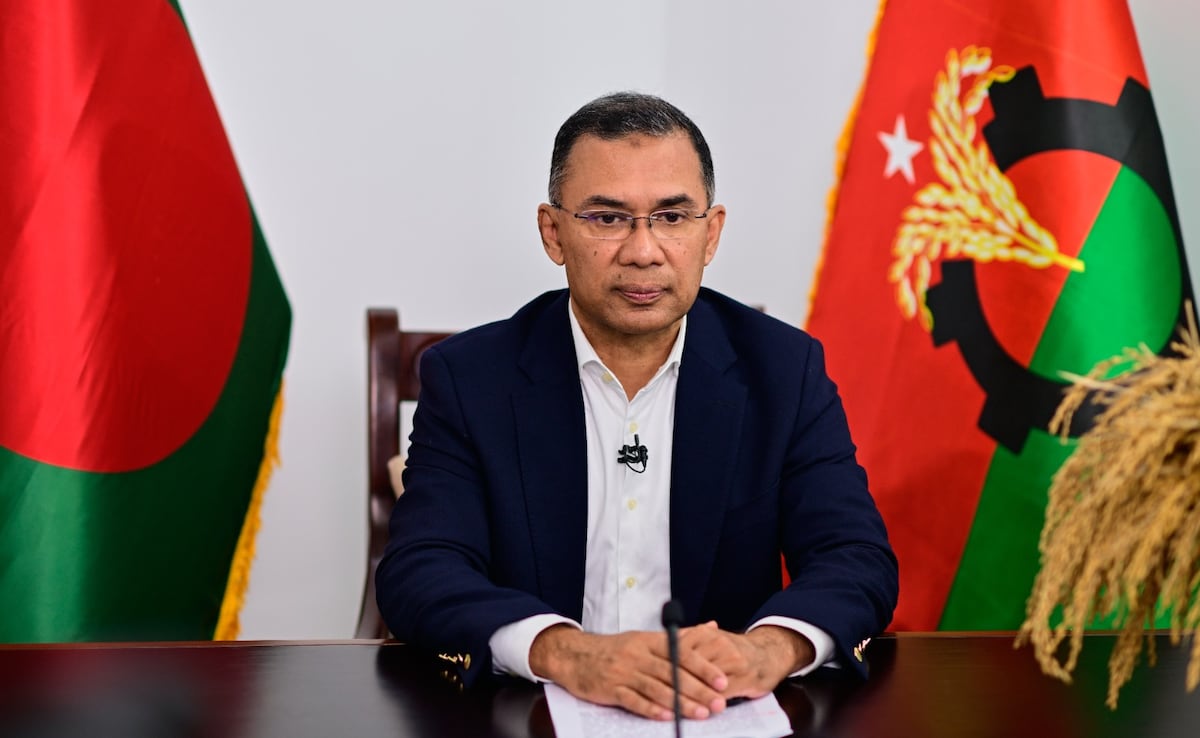
Tarique Rahman, the acting chairman of the Bangladesh Nationalist Party (BNP), recently broke a long-standing political silence by explicitly linking the 1971 Pakistani military crackdown to the modern struggle for Bangladeshi sovereignty. His "Genocide Day" message did more than just commemorate the dead. It signaled a tectonic shift in how the BNP—a party often accused by its rivals of being soft on Islamabad—intends to weaponize history against the current Awami League administration. By identifying the "blood trail" left by the Pakistani occupation forces, Rahman is attempting to reclaim the liberation narrative from a government that has used its role as the "party of independence" to maintain a decade-long grip on power.
This move is a calculated risk. For years, the BNP’s critics have pointed to its alliances with Islamist groups like Jamaat-e-Islami as evidence of a betrayal of the 1971 spirit. Now, from his exile in London, Rahman is pivoting. He is positioning the BNP not as an alternative to the liberation war legacy, but as its truest guardian. The subtext is clear. If the Awami League claims the past, the BNP will claim the trauma, using the memory of the genocide to highlight what they describe as a "new form of subjugation" under the present regime.
The Ghost of Operation Searchlight
March 25 remains a jagged scar on the collective psyche of Bangladesh. It was the night the Pakistani military launched Operation Searchlight, a systematic campaign of extrajudicial killings, rapes, and arson designed to crush the Bengali nationalist movement in East Pakistan. While the Awami League has successfully lobbied for international recognition of this date as Genocide Day, the BNP has historically been more reserved, focusing instead on the role of its founder, Ziaur Rahman, in the declaration of independence.
Rahman’s recent messaging changes the internal geometry of this debate. By focusing on the "blood trail," he is forcing a confrontation with the reality of the atrocities. This isn't just about historical accuracy. It is about domestic legitimacy. In a country where the 1971 war is the ultimate barometer of patriotism, any party viewed as distancing itself from that struggle is effectively DOA at the ballot box. Rahman knows this. He is trying to bridge the gap between his father’s military legacy and the civilian suffering that defined the war.
The complexity of this pivot cannot be overstated. The 1971 genocide was not a localized skirmish; it was a mass-scale ethnic cleansing. Estimates of the death toll vary, but the consensus among historians points to hundreds of thousands, if not millions, of lives lost. When Rahman invokes this history, he is reaching out to the "Projanmo" or the younger generation who did not witness the war but live in its shadow. He is betting that the memory of Pakistani aggression can be used to fuel a contemporary movement against what he calls "Indian hegemony" and domestic authoritarianism.
Reclaiming the Narrative from the Awami League
The Awami League has spent years building a political fortress around the events of 1971. They have established a binary world where they are the protectors of the "Muktijuddho" (Liberation War) and anyone else is a "Razakar" (collaborator). This branding has been incredibly effective. It has allowed the government to dismiss dissent as anti-state activity.
Rahman’s strategy is to disrupt this binary. By using the language of genocide, he is effectively saying, "We remember too." This is a defensive maneuver designed to neutralize the government's most potent weapon. However, it also serves an offensive purpose. By highlighting the atrocities of 1971, the BNP can argue that the current government has failed to protect the very sovereignty that so much blood was spilled to achieve.
The Problem of Historical Alliances
The biggest obstacle to this new narrative is the BNP’s own history. The party’s association with groups that actively opposed the creation of Bangladesh creates a credibility gap. It is one thing to issue a press release about the 1971 genocide; it is another to reconcile that message with a political base that includes descendants of the anti-liberation forces.
Observers note that Rahman is treading a thin line. If he goes too far in condemning the Pakistani military, he risks alienating the hardline conservative elements of his coalition. If he says too little, he remains an easy target for the Awami League’s "collaboration" rhetoric. The "blood trail" phrasing is an attempt to find a middle ground—focusing on the external aggressor (Pakistan) to unify a fractured domestic front.
Geopolitical Ripples and the Pakistan Factor
Islamabad remains a sensitive subject in Dhaka. While trade relations exist, the lack of a formal apology from Pakistan for the 1971 atrocities remains a permanent roadblock to true reconciliation. Rahman’s mention of the genocide puts Pakistan in a difficult position. For years, the BNP was seen as a party that Pakistan could work with. By taking a harder line on 1971, Rahman is signaling to the international community—and specifically to New Delhi—that a BNP-led Bangladesh would not necessarily return to a pro-Pakistan orbit.
This is a crucial bit of diplomatic theater. India, which played a decisive role in the 1971 war, has long viewed the BNP with suspicion. By adopting the language of the genocide, Rahman is signaling a desire for a reset. He is attempting to prove that the BNP is a "nationalist" party in the truest sense, one that prioritizes Bangladeshi history over any perceived ideological ties to Pakistan.
The Strategy of the London Exile
Operating from London, Tarique Rahman has a different perspective than his colleagues on the ground in Dhaka. He is less susceptible to the immediate pressures of the Bangladeshi police state, but he is also further removed from the pulse of the street. His focus on 1971 suggests he believes that the "identity politics" of the war are still the primary driver of Bangladeshi elections.
Is he right? The youth of Bangladesh are increasingly focused on jobs, inflation, and digital freedom. While the 1971 war is respected, there is a growing exhaustion with how it is used as a political shield by all sides. Rahman’s challenge is to make the "blood trail" relevant to a 20-year-old in 2026. He is trying to do this by framing the current struggle for democracy as a continuation of the 1971 fight.
The rhetoric is sharp. It invokes the image of the "oppressor" and the "oppressed." It suggests that the mission of 1971—to create a democratic, sovereign state—remains unfulfilled. By doing so, he is turning a historical commemoration into a call for revolution.
The Risks of Reopening Old Wounds
There is a danger in this approach. When you invoke the genocide, you invite a level of scrutiny that can be uncomfortable. If the BNP wants to lead the conversation on 1971, it must be prepared to answer for its own role in the 1970s and 80s, including the rehabilitation of figures who were perceived as anti-liberation.
Furthermore, the Awami League is unlikely to let this challenge go unanswered. We can expect an escalation in the "war of words" over who has the right to speak for the martyrs. The government will likely double down on its own 1971 credentials, perhaps by introducing even stricter laws against "distorting" the history of the liberation war.
A New Era of Bangladeshi Identity Politics
What we are seeing is the birth of a more aggressive, history-focused BNP. This is no longer just a party of economic grievances. It is a party fighting for the soul of the nation's origin story. Rahman’s "blood trail" comment is the first shot in a long campaign to strip the Awami League of its historical monopoly.
Success depends on consistency. If this is a one-off message, it will be forgotten by the next news cycle. But if it represents a fundamental shift in the BNP's DNA, it could change the landscape of Bangladeshi politics forever. The party is finally realizing that to win the future, it must first win the past.
The true test will come in how the public responds. Will the people of Bangladesh see this as a sincere embrace of their history, or as a cynical political ploy? The answer lies in whether the BNP can back up its words with actions that prove it has truly moved on from its controversial associations. For now, the "blood trail" remains a powerful, if polarizing, symbol of a nation still struggling to define itself fifty-five years after its birth.
The ghosts of 1971 are not resting. They are being drafted into service for the next great political battle in South Asia. Tarique Rahman has made his move, and in doing so, he has ensured that the history of the genocide will remain at the heart of the Bangladeshi struggle for years to come.
Would you like me to analyze the specific international legal frameworks regarding the recognition of the 1971 events as a formal genocide?