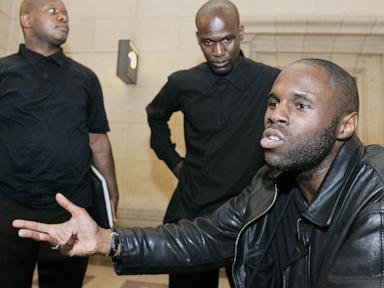
The arrest happened in the sprawling, sun-drenched suburbs of Johannesburg, a city built on gold and secrets. It was quiet. It was efficient. When the South African authorities finally closed in on Kemi Seba, a man whose presence in a room can feel like a physical weight, they weren't just arresting a body. They were attempting to halt a specific kind of momentum—a digital and ideological firestorm that has been sweeping across the African continent, fueled by Russian interests and directed at the foundations of Western influence.
Seba, born Stellio Gilles Robert Capo Chichi, is not your average activist. He is a charismatic force of nature, a man who knows exactly how to use the modern machinery of social media to resurrect old ghosts of colonial resentment. But this time, the law caught up with him for reasons that go beyond his fiery speeches. Behind the scenes, a legal net from Benin was tightening.
The Man Behind the Megaphone
To understand why a single arrest in South Africa ripples through the halls of power in Paris and Moscow, you have to look at the man himself. Seba is a master of the pivot. He is a French-born Beninese activist who has spent decades refining a brand of Pan-Africanism that looks less like a historical movement and more like a modern geopolitical weapon. He speaks of "sovereignty" and "dignity," words that taste like honey to a generation tired of seeing their resources managed by foreign hands.
But follow the money and the influence. It leads to the Kremlin.
Seba has never been shy about his ties to Russian ideologues. He was a frequent guest of Alexander Dugin, the man often called "Putin’s Brain." In the world of grey-zone warfare, Seba is the bridge. He translates Russian strategic goals into the vernacular of African liberation. It is a brilliant, if dangerous, alchemy. By framing Russian intervention as a brotherhood of equals against the "imperialist" West, he creates a vacuum where Russian paramilitary groups like the Wagner Group—now rebranded as the Africa Corps—can step in as "security partners."
The Benin Connection
The arrest in South Africa was not a random act of local policing. It was triggered by an international warrant from Benin. Back home, the government views Seba not as a hero, but as a destabilizing force. They see a man who uses his French passport and his Russian connections to incite unrest, to challenge the legitimacy of the state, and to pave the way for a different kind of foreign influence—one that doesn't use diplomats, but mercenaries and disinformation bots.
In Benin, the stakes are physical. The country sits at a delicate crossroads in West Africa, watching its neighbors in Mali, Burkina Faso, and Niger fall like dominoes into the hands of military juntas backed by Moscow. For the authorities in Cotonou, Seba is the herald of that chaos. He is the person who arrives before the coup. He is the voice on the radio that tells the youth the old system must be burned down.
The Digital Front Line
Walk through any market in Bamako or Ouagadougou, and you will see the influence of Seba’s narrative. It’s on the screens of cheap smartphones. It’s in the viral TikToks that show Russian flags being waved at protests. This is the new front line of the Cold War, and it is fought in the minds of the disillusioned.
Russia’s strategy in Africa is remarkably cost-effective. They don't build massive infrastructure projects like the Chinese, nor do they send billions in aid like the Americans. Instead, they export influence. They find existing fractures—ethnic tensions, economic despair, post-colonial anger—and they drive a wedge into them. Seba is that wedge.
He is a storyteller. He tells a story where the West is a dying vampire and Russia is the sturdy, traditionalist friend coming to save the day. It’s a compelling narrative if you don't look too closely at the mineral rights being signed away in exchange for that "friendship." It’s a story that ignores the mass graves and the suppressed media in the countries where Russia has already "helped."
The Invisible Stakes
Why should we care about an activist in a Johannesburg jail cell?
Because Seba’s arrest represents a rare moment where the "Grey Zone" becomes visible. Usually, this kind of influence operates in the shadows. It’s a bot farm in St. Petersburg; it’s a quiet bank transfer; it’s a telegram message. But when the handcuffs click shut, the abstract becomes concrete.
South Africa finds itself in a precarious position. The country has long maintained a "non-aligned" stance that often looks suspiciously like an alignment with the East. By arresting Seba, they are signaling a boundary. Even in a country that hosts BRICS summits and conducts naval drills with Russia, there is a limit to how much destabilization can be tolerated under the guise of activism.
The Alchemy of Resentment
The real danger isn't the man; it's the message. If you take away Seba, the resentment he tapped into remains. It is a dry forest, and he was simply the one holding the match. The West has spent decades assuming its influence in Africa was a permanent fixture, a default setting of the global order. They were wrong.
The new generation of African leaders and activists is looking for alternatives. They are savvy, they are connected, and they are tired of being lectured. When a man like Seba stands up and says, "We don't need your democracy," it resonates because that democracy has often failed to put food on the table or provide safety from jihadist insurgents.
Russia understands this. They don't offer democracy; they offer "stability" through force. They offer a seat at the table where no one asks about human rights or election transparency. For a certain type of leader, that is an intoxicating prospect.
The Hollow Hero
There is a tragedy in Seba’s trajectory. A man who claims to fight for African independence has become one of the most effective tools for a new kind of external control. It is a classic bait-and-switch. You trade the French for the Russians, the euro for the ruble, and in the end, the sovereignty you were promised is just a different color of paint on the same old walls.
As the legal proceedings move forward, the narrative will continue to shift. On Telegram channels and pro-Russian news sites, Seba will be portrayed as a martyr, a political prisoner of the West’s puppets. His arrest will be used to further the very cause he was championing. Every day he spends behind bars is a day his legend grows in the corners of the internet where the new world order is being drafted.
The authorities may have the man, but they are still struggling to catch the ghost of his ideas. In the high-stakes game of African geopolitics, a single charismatic voice can be more powerful than a battalion. And right now, that voice is echoing from a cell, waiting for the next opportunity to set the world on fire.
The sun sets over Johannesburg, casting long, dark shadows across the city of gold. The silence in the suburb where he was taken is deceptive. Somewhere, a phone pings. A video is uploaded. A comment section ignites. The man is in custody, but the fire is already out of the bottle.