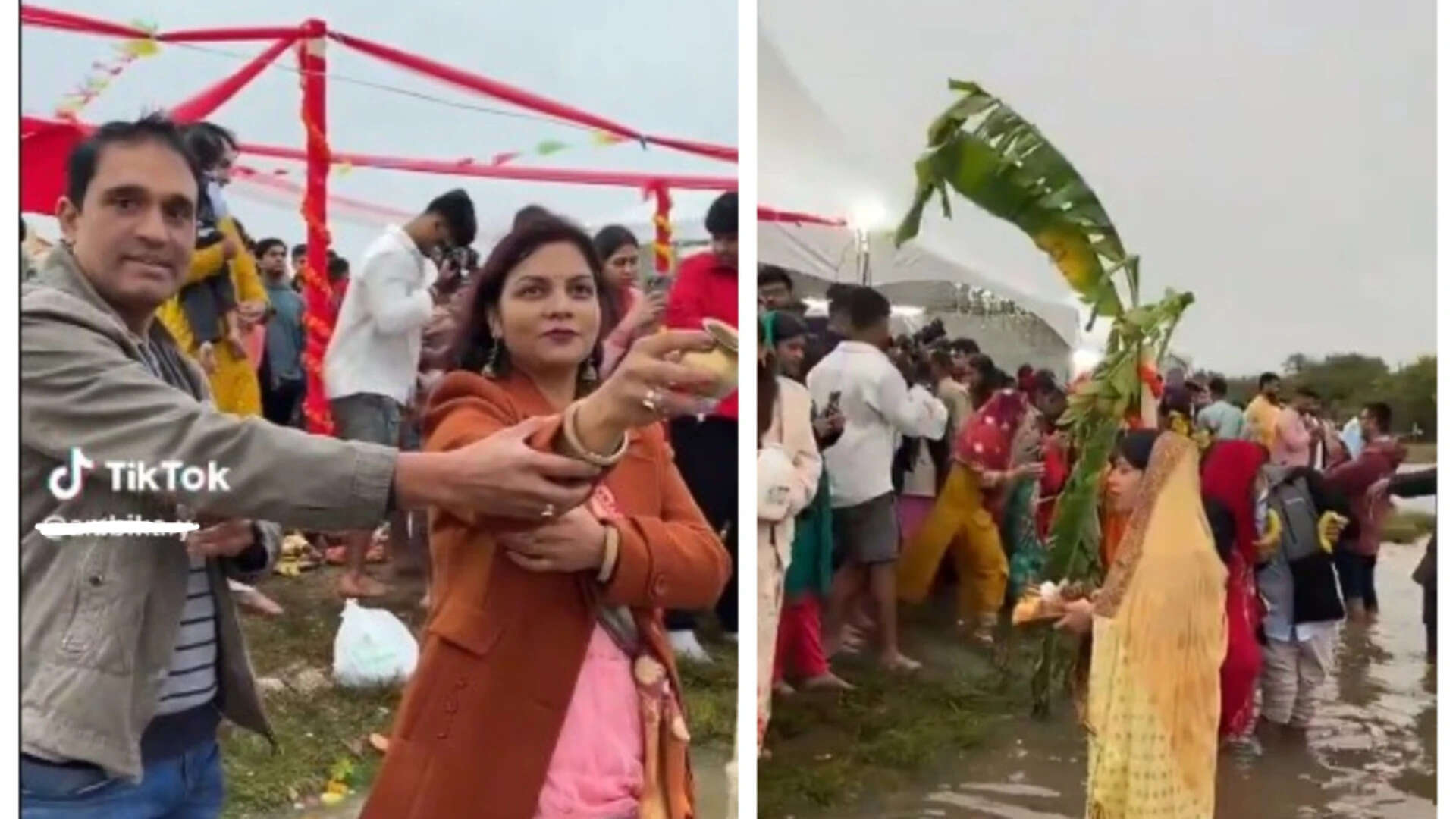
The sight of devotees waist-deep in the waters of a Texas lake, offering prayers to the rising sun, should be a quiet moment of spiritual reflection. Instead, it has become the latest flashpoint in an increasingly volatile American cultural landscape. When a local politician recently expressed outrage over the celebration of Chhath Puja in a public space, the Hindu American Foundation (HAF) didn't just issue a standard press release. They fired back with a pointed critique that questioned the priorities of elected officials during a time of global instability. This isn't just a dispute over a permit or a park. It is a fundamental clash over who gets to claim "Americanness" in the suburban sprawl of the Lone Star State.
Chhath Puja is a four-day Vedic festival dedicated to the sun god, Surya, and his sister, Shashti Devi. It involves rigorous fasting and standing in water to offer "arghya" at dawn and dusk. For the growing Indian-American diaspora in North Texas, finding a body of water that approximates the sanctity of the Ganges is a logistical challenge. They often turn to public parks and lakes, securing the necessary municipal permits to gather. The friction begins when these ancient rituals meet the modern American political machine, where every public act is filtered through the lens of partisan identity.
The Geography of Discontent
Texas has seen one of the fastest-growing Hindu populations in the United States over the last decade. Collin and Denton counties, once bastions of traditional Western ranching culture, are now home to high-tech hubs and sprawling mandirs. This demographic shift is not merely a data point in a census report. It is a physical transformation of the suburbs. When a politician singles out a specific religious gathering for criticism, they are rarely talking about the theology. They are talking about the changing face of their constituency.
The specific grievance often centers on the "appropriation" of public resources or environmental concerns. However, these arguments frequently crumble under scrutiny. Most Chhath Puja organizers coordinate closely with local parks departments to ensure waste removal and safety protocols are followed. The outrage, therefore, feels manufactured. It serves as a dog whistle to a base that views the diversification of the public square as a loss of heritage rather than an expansion of it.
The HAF Counterstrike and the Question of Priority
The Hindu American Foundation’s response—"Isn't there an actual war?"—was a calculated move to shift the frame of the conversation. By juxtaposing a peaceful religious ritual against the backdrop of global conflicts, the HAF highlighted the absurdity of local political grandstanding. It was an attempt to shame the critic for focusing on a non-issue while the world faces genuine crises.
This tactic reflects a broader shift in Hindu American advocacy. For years, the community's leadership took a quieter, more conciliatory approach to public friction. That era is over. The new guard is more willing to use the tools of American political combat: social media call-outs, direct confrontation, and the framing of Hinduphobia as a distinct form of prejudice. They are no longer asking for a seat at the table; they are pointing out that they helped build the room.
Beyond the Surface of Religious Freedom
The legal backbone of this dispute is the Religious Land Use and Institutionalized Persons Act (RLUIPA) and the First Amendment. In the United States, religious groups have a broad right to use public spaces for expression, provided they follow content-neutral "time, place, and manner" restrictions. If a city allows a Christmas tree lighting or a community barbecue in a park, it generally cannot bar a Hindu festival without facing a massive civil rights lawsuit.
Politicians who target these events are often aware of the legal protections, but the goal isn't necessarily to win in court. The goal is the headline. By creating a controversy where none existed, they signal to their voters that they are "protecting" the local culture from outside influence. It is a performance. The devotees in the water are merely props in a larger play about American identity and who is allowed to define it.
The Environmental Argument as a Proxy
Critics sometimes hide behind environmentalism to mask cultural discomfort. They point to the offerings of fruits, flowers, and sweets placed in the water as a source of pollution. While it is true that any large gathering impacts an ecosystem, the scale of Chhath Puja offerings is negligible compared to the runoff from local golf courses or the industrial waste of North Texas's rapid development.
Responsible journalism requires looking at the data. In most cases, the biodegradable offerings used in Chhath Puja break down naturally. Furthermore, community organizations often conduct "clean-up drives" immediately following the ceremony, leaving the site in better condition than they found it. When a politician focuses on a few marigolds in a lake while ignoring the systemic environmental issues of their district, the hypocrisy is deafening.
The Suburban Frontline
Suburban Texas is the new frontline of American pluralism. In cities like Frisco, Plano, and Irving, the strip malls are a mosaic of barbecue pits and biryani houses. This coexistence is largely peaceful and economically productive, but it remains fragile. The Chhath Puja incident is a reminder that the "melting pot" is a high-pressure environment.
When an elected official uses their platform to cast a shadow on a minority group's sacred traditions, it has a chilling effect. it encourages "othering." It tells the software engineer, the doctor, and the small business owner—all of whom might be standing in that lake—that their presence is tolerated but not truly accepted. The HAF's "clap back" was not just a defense of a festival; it was a defense of the right to belong.
The Role of Social Media in Escalating Local Tensions
The speed at which these local disputes go viral is a new factor in the equation. A single tweet or a recorded snippet of a town hall meeting can turn a minor permit dispute into a national talking point for the 24-hour news cycle. This creates an incentive for radicalization. A politician who might have quietly resolved a concern ten years ago now finds more value in an explosive public confrontation.
This feedback loop rewards the loudest voices on both sides. While the HAF's response was sharp and effective, it also highlights how exhausted the public discourse has become. We are no longer debating policy; we are debating the right of our neighbors to exist in our shared spaces.
Economic Contributions and Political Leverage
The Indian-American community in Texas is one of the most affluent and highly educated demographics in the country. They are a significant source of tax revenue and political donations. Historically, this has not translated into proportional political power, but the tide is turning. As the community becomes more politically active, they are less likely to ignore slights from local representatives.
Candidates who once ignored the "Indian vote" are now finding that it can be the margin of victory in swing districts. This economic and political leverage is why the "isn't there a war" comment carried so much weight. It was a reminder that the community has the global perspective and the local power to hold officials accountable for their pettiness.
The Need for Genuine Engagement
If the goal is truly to manage public spaces and maintain community harmony, the solution isn't outrage. It is engagement. Local governments that proactively work with diverse religious groups to designate specific areas for ritual use find that conflicts are almost entirely avoided. When there is a clear channel of communication, logistical concerns about parking, trash, and noise are solved long before the first prayer is offered.
The failure here isn't one of religion or culture. It is a failure of leadership. A leader's job is to weave the various threads of their community together, not to pull at the loose ones until the fabric unravels. The Chhath Puja controversy in Texas is a warning shot. It signals that as the American demographic landscape continues to shift, the old tactics of exclusion will be met with increasingly sophisticated and uncompromising resistance.
The next time a politician feels the urge to complain about a peaceful gathering at a local lake, they might want to look at the polling data. The people in the water aren't just devotees; they are voters, and they are paying very close attention to who views them as neighbors and who views them as an eyesore.
Document the permits. Record the town halls. Challenge the false environmental narratives. The era of the silent minority is over, replaced by a community that knows exactly how to use the "actual wars" of the world to put local small-mindedness in its proper, insignificant place.