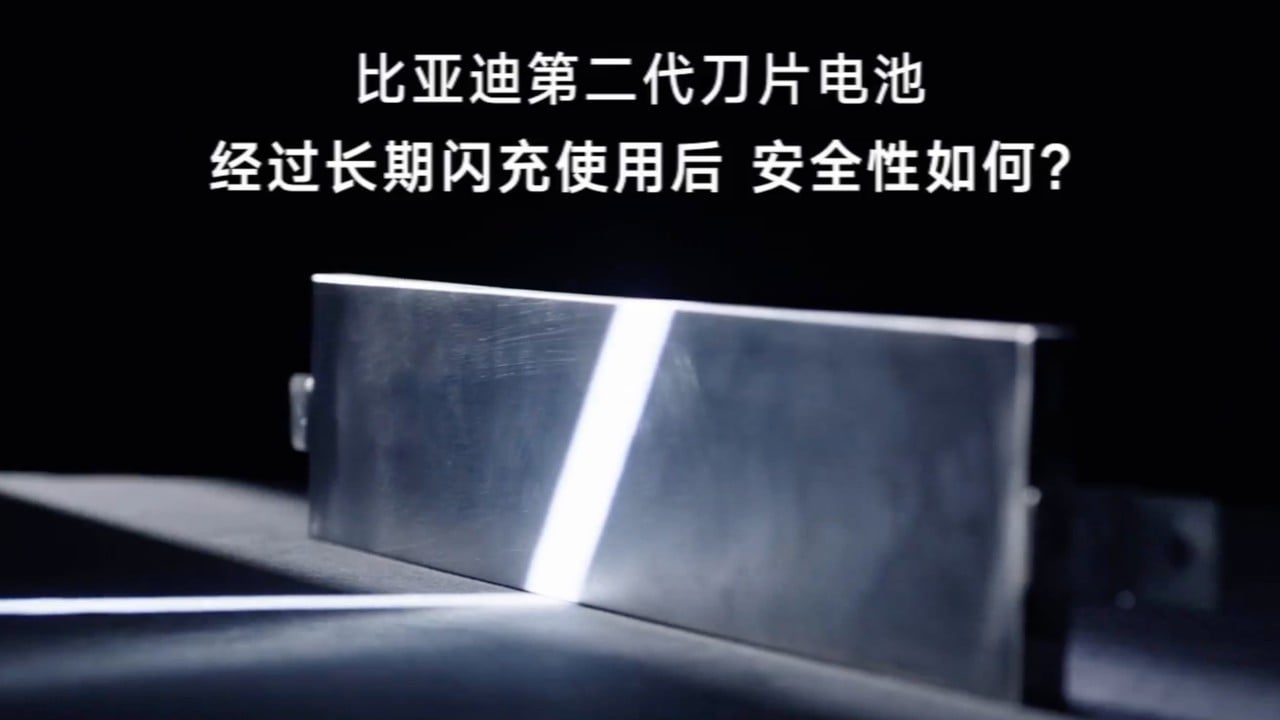
The transition from internal combustion engines to electric vehicles (EVs) hinges not on energy density, but on the parity of "refueling time." While lithium-ion batteries have historically been throttled by chemical degradation during rapid energy transfer, BYD’s shift toward ultra-fast charging architectures represents a move to decouple the EV value proposition from the limitations of current grid infrastructure. The objective is to achieve a 10% to 80% state-of-charge (SoC) window in under ten minutes—a threshold that effectively neutralizes "range anxiety" by mimicking the consumer behavior of a petrol station stop.
The Triad of Charging Constraints
To understand BYD’s technical trajectory, one must categorize the three fundamental bottlenecks that have historically prevented EVs from matching the refueling speed of hydrocarbons.
- The Thermal Management Barrier: Rapidly moving ions through an electrolyte generates internal resistance. This resistance manifests as heat. If the heat is not dissipated at a rate equal to or greater than its generation, the battery enters thermal runaway or suffers permanent lithium plating, which destroys cycle life.
- The Chemical Kinetics of the Anode: Standard graphite anodes face a physical limit on how quickly they can intercalate lithium ions. Forcing ions too quickly leads to "bottlenecks" at the anode surface.
- The Infrastructure-Vehicle Interface: A vehicle capable of 500kW charging is irrelevant if the charging station is capped at 120kW or if the vehicle’s internal wiring cannot handle the amperage without melting.
BYD is addressing these through a vertically integrated approach that spans from the molecular level of the Blade Battery to the high-voltage architecture of the e-Platform 3.0 Evo.
Engineering the e-Platform 3.0 Evo
Most legacy EVs operate on a 400V system. This requires high current (amperage) to achieve high power. High current requires thick, heavy copper wiring and generates significant heat ($P = I^2R$). By transitioning to an 800V high-voltage silicon carbide (SiC) platform, BYD halves the current required for the same power output.
The Evo platform utilizes a "full-map" ultra-fast charging technology. Unlike standard systems that hit a "peak" charge rate for only a few minutes before thermal throttling kicks in, BYD’s architecture aims to flatten the charging curve. This is achieved through an intelligent pulse-heating system. In cold conditions, the battery uses high-frequency fluctuations to warm itself from the inside out, increasing ionic conductivity before the high-power stream begins.
The Cost Function of Extreme Fast Charging
There is no "free lunch" in battery physics. The push for six-to-ten-minute charging introduces a specific set of trade-offs that dictate the long-term viability of the strategy.
- Cycle Life vs. C-Rate: The "C-rate" measures how fast a battery is charged relative to its capacity. A 6C rate means charging the full battery in 10 minutes. Historically, high C-rates lead to the formation of dendrites—microscopic spikes that can short-circuit the cell. BYD’s LFP (Lithium Iron Phosphate) chemistry is inherently more stable than NCM (Nickel Cobalt Manganese), allowing it to withstand higher C-rates with less risk of catastrophic failure, though at the cost of lower overall energy density per kilogram.
- The Cooling Tax: To maintain stability during a 500kW+ charge, the vehicle must dedicated significant energy and weight to active liquid cooling systems. This increases the "dead weight" of the vehicle during normal driving, slightly reducing efficiency.
- Grid Strain and Buffer Storage: A station with ten BYD vehicles charging at 500kW requires a 5-megawatt connection. This is equivalent to the power draw of a small town. To bypass this, the strategy must shift toward "Buffer Storage," where stationary batteries at the charging site slowly trickle-charge from the grid and then dump that energy into the vehicle in a high-speed burst.
Comparative Advantage through Vertical Integration
BYD’s primary advantage over Western competitors like Tesla or Ford is not necessarily superior chemistry, but superior supply chain control. Because BYD manufactures its own semiconductors (SiC MOSFETs), battery cells, and thermal management systems, they can optimize the "handshake" between the charger and the battery BMS (Battery Management System).
In many EVs, the BMS acts as a conservative gatekeeper, frequently slowing down the charge to protect the battery because it lacks granular data on the cell's real-time state. BYD’s integrated sensors allow for "Edge Charging Control," where the system pushes the battery closer to its physical limits by monitoring internal pressure and temperature at a resolution that third-party battery buyers cannot match.
The Infrastructure Deadlock
While the vehicle technology is nearing the "petrol parity" mark, the deployment of 800V-capable chargers remains the true systemic bottleneck. In China, the rollout of "Liquid-Cooled Overcharging" stations is accelerating, but the global landscape is fragmented.
- Standardization Issues: The divergence between CCS1, CCS2, and NACS (Tesla’s standard) creates a hardware overhead for manufacturers.
- Upstream Power Requirements: Many existing commercial zones cannot support the high-voltage transformers required for 480kW+ charging without massive capital expenditure.
BYD’s response to this has been the implementation of "dual-gun" charging on some models. Instead of waiting for a single 500kW charger, the vehicle can plug into two separate 250kW chargers simultaneously. This is a pragmatic, albeit cumbersome, workaround that leverages existing infrastructure while the ultra-high-speed network catches up.
Strategic Forecast: The End of the Range Race
The industry is reaching a point of diminishing returns regarding battery size. Adding more cells to increase range from 400 miles to 500 miles adds weight, cost, and decreases vehicle efficiency. The data suggests that once a 10-minute charge for 250 miles of range becomes ubiquitous, the need for 100kWh+ batteries will evaporate.
BYD’s focus on charging speed over raw range indicates a shift toward a "high-utilization" model. This is particularly critical for the fleet and taxi markets, where every minute spent at a charger is lost revenue. By optimizing for the 800V Evo platform, BYD is positioning itself to dominate the mid-to-high-tier market where time-poverty is a greater factor than absolute vehicle cost.
The final hurdle is the "Last 20% Problem." Due to the physics of ion saturation, charging speeds will always drop significantly as the battery approaches 100%. Manufacturers who can maintain high speeds up to 90% SoC through advanced electrolyte additives and anode coatings will win the next phase of the market. BYD's investment in SiC and LFP-manganese chemistry suggests they are targeting this specific saturation curve.
Strategic move: Investors and competitors should monitor BYD’s patent filings related to "anode-free" or "silicon-carbon" anodes. If BYD successfully integrates silicon-carbon into the Blade Battery format, they will achieve the holy grail of EV engineering: the energy density of high-nickel batteries with the safety and lightning-fast charging speeds of LFP. This would render the current distinction between "budget" and "premium" EV powertrains obsolete.