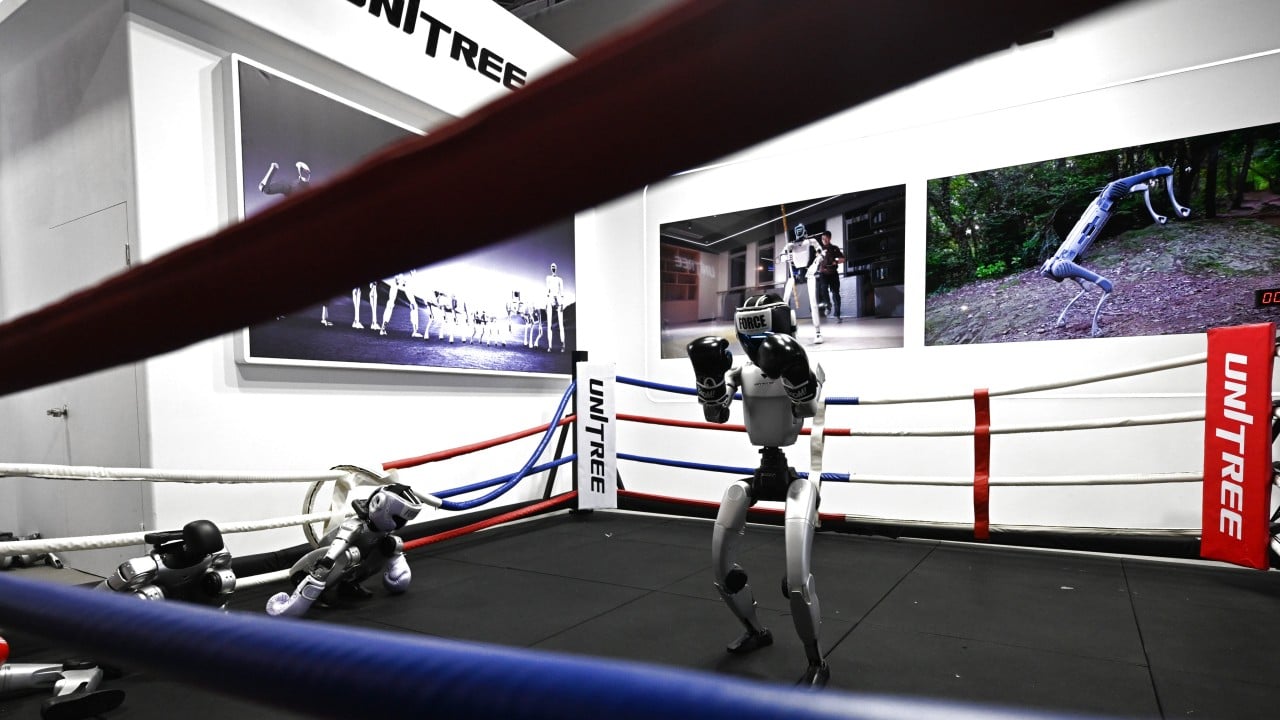
The Pentagon is sweating over a piece of hardware that currently struggles to climb a flight of stairs without a software seizure.
Washington’s latest panic attack involves the "security threat" of Chinese humanoid robots. The narrative is predictably stale: Beijing will use these bipedal machines as trojan horses, vacuuming up data from our factories, mapping our secret labs, and eventually turning into a literal army of Manchurian Candidates in titanium shells.
This isn't just a misreading of the technology; it’s a fundamental misunderstanding of how power works in the 21st century.
If you’re worried about a Unitree G1 or an Agibot "spying" on a warehouse, you’re about fifteen years too late to the data privacy funeral. Your smartphone already tracked your gait, your doorbell mapped your porch, and your enterprise software sold your floor plan to a third-party aggregator in 2019.
The real story isn't that China is building spies. It's that the US is using "national security" as a crutch to hide a massive, decade-long failure in domestic manufacturing and robotics integration. We aren't being out-spied; we’re being out-built.
The Myth of the Robot Trojan Horse
The "alarm" sounded by US officials rests on the idea that these robots are autonomous intelligence-gathering agents. Let’s look at the actual physics and data architecture.
Humanoid robots are data-hungry. They require massive amounts of compute to balance, navigate, and interact with objects. To "spy" effectively, a robot would need to transmit high-fidelity LIDAR maps and 4K video feeds back to a server in Hangzhou.
Do you know what we call a machine that constantly transmits massive amounts of unauthorized data over a secure corporate network? A caught machine.
Any IT department worth its salt can flag an anomalous 50GB data spike coming from a mechanical janitor. If a Chinese humanoid is successfully exfiltrating data from a sensitive US site, the problem isn't the robot. The problem is your CISO.
Why the "Espionage" Argument is a Distraction
- Fixed Assets vs. Mobile Assets: If China wanted to map a US factory, they wouldn't use a $20,000 humanoid that draws attention. They’d use a compromised firmware update on a standard industrial sensor or a sub-centimeter satellite feed.
- The Compute Gap: High-level autonomy requires local processing. If the "brain" is in the cloud (overseas), the latency makes the robot a stumbling hazard. If the "brain" is local, the hardware is right there for US engineers to teardown and reverse-engineer.
- The Cost of Infiltration: Humanoids are loud, heavy, and conspicuous. They are the least efficient way to conduct covert surveillance ever devised by man.
The security theater surrounding these machines is a convenient way to justify protectionist tariffs without admitting that American robotics firms are currently stuck in the "expensive hobbyist" phase while Chinese firms are moving toward mass-market scale.
The Real Threat: The Logistics of Cheap Competence
The US isn't afraid of what these robots see. It’s afraid of what they cost.
In the robotics world, there is a concept called the "hardware-software feedback loop." To make a robot smart, it needs to fail a million times in the real world. China has the manufacturing base to build ten thousand "average" robots, deploy them in real factories, and use the failure data to iterate.
The US builds five "perfect" robots in a lab at MIT or Stanford, keeps them behind plexiglass, and wonders why they can’t handle a slightly uneven floor.
The Math of Displacement
Imagine a scenario where a Chinese-made humanoid costs $25,000—roughly the price of a mid-range sedan—while a comparable US model costs $150,000.
- The Chinese Model: Can work 20 hours a day, requires a $2,000 annual maintenance contract, and replaces two shifts of manual labor.
- The US Model: Requires a PhD-level handler, breaks a limb if it hits a pallet, and stays in "beta" for three years.
By banning the Chinese hardware under the guise of "security," the US isn't protecting its secrets. It’s ensuring that American small businesses and mid-tier manufacturers can never afford to automate. We are voluntarily choosing to remain inefficient to spite a ghost in the machine.
I’ve spent enough time in manufacturing hubs to see this play out. When you price out the competition through regulation rather than innovation, you don’t get a stronger domestic industry. You get a stagnant one that can’t compete on the global export market because its overhead is 400% higher than everyone else's.
Dismantling the "Kill Switch" Fantasy
The most cinematic fear cited by critics is the "kill switch"—the idea that Beijing could press a button and freeze every robot in America, or worse, command them to attack.
This is Hollywood logic applied to industrial policy.
Modern industrial equipment doesn't run on an open-source "command and control" frequency that’s accessible from a penthouse in Shanghai. Any enterprise-grade deployment uses "air-gapped" or strictly firewalled local networks.
If a company buys 100 robots and connects them directly to the public internet without a proxy or a firewall, they deserve the downtime. Suggesting we should ban the hardware because some users are incompetent is like saying we should ban cars because some people forget to use their brakes.
Precision vs. Paranoia
Instead of a blanket ban, the focus should be on Hardware Root of Trust (HRoT).
We should be demanding:
- Open-source firmware audits.
- Local-only data processing mandates.
- Interoperable operating systems that allow US software to run on Chinese "dumb" hardware.
But we aren't doing that. We’re sounding "alarms" because it’s easier to scare a Senator than it is to fix the US supply chain.
The Competency Crisis in US Robotics
Let’s be brutally honest: The US is losing the humanoid race because we treated robotics as a branch of the movie industry rather than a branch of heavy industry.
We love videos of robots doing backflips. We love "General Purpose AI" demos that look like science fiction. But we have neglected the grueling, low-margin work of making a robotic arm that can survive 10,000 hours in a dusty warehouse for less than the cost of a human salary.
The Chinese firms—Unitree, Fourier, Kepler—are not trying to win an Oscar. They are trying to win the price-per-unit war. They are leveraging the same supply chains that built your iPhone to commoditize the actuator, the motor, and the carbon-fiber frame.
The Silicon Valley Delusion
For years, the "experts" in the valley said hardware is easy and software is hard. They were wrong. Software is infinitely scalable; hardware is a war of attrition against physics and logistics.
While we focused on the "brain" (LLMs), China focused on the "body." Now they have the bodies, and they can simply import the brains—often using the very same open-source models (like Llama) developed in the US.
By the time we realize that a robot's value is in its physical reliability and price point, China will have a five-year lead in manufacturing data. That data is the real "security" asset. It's the knowledge of how machines wear down, how they break, and how they optimize a workflow.
We aren't losing data; we’re losing the ability to learn from the physical world.
How to Actually Secure the Future
If the US government actually cared about security, they wouldn't be writing hysterical memos about robot spies. They would be doing three things:
- Subsidizing the Actuator, Not the AI: We need a domestic supply of high-torque motors and sensors that don't cost a mortgage. The "security" threat vanishes when the components are domestic.
- Mandating "Dumb" Hardware: Pass legislation requiring that any humanoid robot sold in the US must be capable of operating without an external internet connection. Period.
- Stop the "National Security" LARPing: Admit that this is an economic trade war. When you call it "security," you stop looking for economic solutions and start looking for bunkers.
The "alarm" is a distraction from our own lethargy. We are the incumbent who stopped practicing, watching the rookie's highlight reel and claiming he’s cheating because he’s faster than us.
The Downside of This Stance
Is there a risk? Of course. Every connected device is a vulnerability. A Chinese humanoid is a sensor-laden platform. But so is a DJI drone, and so is a Volvo (owned by Geely), and so is the TikTok app on the phone of every person in the Pentagon.
The difference is that a humanoid robot is a tool of production. By banning it, you aren't just "securing" the perimeter; you’re hobbling the workers inside it. You are choosing a "secure" 1950s factory over a "risky" 2030s factory.
In the long run, the most insecure nation is the one that cannot produce goods efficiently. Economic irrelevance is a much greater threat than a robot taking a picture of your breakroom.
Stop Asking if They Are Spies
The question "Are Chinese robots a security threat?" is the wrong question. It’s a low-resolution inquiry designed for cable news segments.
The right question is: "Why can't we build a better one for less?"
If the answer is "Because our labor is too expensive, our supply chain is fragmented, and our venture capital only wants to fund SaaS apps," then no amount of "alarms" will save us.
We are currently witnessing the commoditization of human form and function. You can either own the commodity, or you can complain about the people who do. Washington has chosen to complain.
If you want to win, stop looking for "kill switches" and start looking for a wrench. The threat isn't that the robot will turn on you; it's that it will work for someone else while you’re still trying to figure out how to turn it on.
Stop fearing the hardware. Start fearing the incompetence that makes the hardware look like magic.