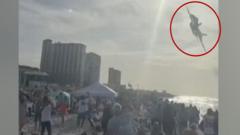
When a United States Navy F/A-18F Super Hornet screamed past a crowded Pensacola Beach just feet above the waterline, it created an instant viral sensation. Umbrellas flew. Tents collapsed. Beachgoers cheered, ducked, and filmed the fighter jet as its twin General Electric F414 engines rattled their ribcages. This viral stunt was not an officially sanctioned airshow maneuver, but rather a high-stakes display of low-altitude flight that exposed a glaring friction point between military public relations and public safety.
The video, shared across TikTok, Instagram, and YouTube, was framed as a thrilling display of American airpower. Yet, beneath the digital applause lies a deeply concerning reality. This was a calculated, high-risk maneuver that skirted the edge of military regulations and federal aviation law, putting hundreds of unsuspecting civilians in direct physical danger for the sake of a social media moment. If you found value in this article, you should read: this related article.
The Aerodynamics of Low Altitude Flight
To understand the danger of a fighter jet flying at near-sonic speeds at fifty feet, you have to look at the atmosphere as a fluid.
A 30,000-pound aircraft flying at 400 knots does not just pass through the air. It violently displaces it. The wings of the Super Hornet generate lift by creating a massive pressure differential, pushing down on the air beneath them with immense force. This is known as wake turbulence. It is accompanied by the high-velocity exhaust of the jet engines, which can exceed temperatures of several hundred degrees Fahrenheit and velocities of hundreds of miles per hour. For another perspective on this development, check out the recent coverage from TIME.
When this pocket of displaced air meets the ground, it behaves like a physical wall. The downward force hits the sand and radiates outward in a microburst-like effect. Beach umbrellas, which are essentially small sails anchored in loose sand, become unguided projectiles.
In the Pensacola incident, heavy metal-tipped umbrellas were ripped from the sand and hurled through the air at high speeds. If one of those blunt metal poles had struck a child or an sunbather, the viral video would have quickly turned into a fatal accident report.
Then there is the acoustic hazard. The noise generated by a low-passing F/A-18 at full military power can easily exceed 120 decibels at close range. That is the threshold of physical pain. Sudden exposure to these sound levels can cause permanent hearing damage, particularly in infants and young children whose auditory systems are highly sensitive.
Beyond the noise, the rapid compression of air at high speeds creates a localized shockwave. While the jet did not break the sound barrier, flying at high subsonic speeds close to the surface still creates enough pressure to shatter windows, damage light structures, and cause temporary disorientation to anyone directly underneath the flight path.
The Dangerous Legacy of Flat Hatting
Within military aviation circles, there is a storied and forbidden tradition known as flat-hatting.
It is a term that dates back to the early days of flight, describing pilots who fly dangerously low to show off, thrill spectators, or simply amuse themselves. The military officially outlaws flat-hatting. Navy aviation manuals are explicit about the severe penalties for unauthorized low-altitude flying, which can include court-martial, loss of wings, and permanent dismissal from the service.
Yet, a quiet double standard persists.
While the official guidelines condemn unauthorized low flights, the internal culture of fighter squadrons has historically celebrated bravado. The pilot who executes a spectacular, unauthorized low pass over a friendly crowd is often greeted with quiet nods of approval in the ready room, provided they do not crash or get caught on a formal radar log.
The democratization of high-definition smartphone cameras has shattered this deniability. What used to be a local legend shared over beers at the officers' club is now uploaded to global social media platforms within minutes, forcing the military's top brass to choose between discipline and public relations.
The Regulatory Blind Spot Between FAA and Military Rules
Civilian aviation in the United States is governed by the Federal Aviation Administration (FAA), which maintains strict rules regarding minimum safe altitudes.
Under Federal Aviation Regulation 14 CFR 91.119, pilots are generally prohibited from flying closer than 500 feet to any person, vessel, vehicle, or structure over uncongested areas, and must maintain at least 1,000 feet above the highest obstacle in congested areas.
The military operates in a different legal stratosphere.
Active-duty military aircraft are technically exempt from many FAA flight rules during tactical training missions, airshows, or when operating under military-controlled airspace. Instead, they are governed by the Chief of Naval Operations instructions, specifically OPNAVINST 3710.7. This document allows for exceptions when flights are deemed essential to military missions or are conducted within designated military training routes or warning areas.
A public beach is not a military training route.
When a fighter jet buzzes a civilian beach outside of a designated, closed-airspace airshow box, it exploits a dangerous gray area. Pilots are expected to use good judgment, but the definition of that term becomes highly elastic when a pilot is flying back to base with fuel to burn and a beach full of spectators below.
The FAA rarely exercises enforcement actions against active-duty military pilots, preferring to defer to the military's internal chain of command. This hands-off approach creates a system where civilian safety relies entirely on the self-restraint of young, adrenaline-fueled pilots sitting behind the controls of a seventy-million-dollar weapon system.
The Pentagon Strategic Use of Viral Risks
There is a reason the Navy's public affairs officers rarely issue harsh public condemnations after these incidents.
They are marketing gold.
The military faces an ongoing recruitment challenge, struggling to meet quotas in an era where traditional advertising has lost its efficacy. A high-production recruitment commercial on television cannot compete with a ten-second, raw TikTok video of a Super Hornet shaking the sand off a beach towel. The sensation of raw speed and power appeals directly to the demographic the Navy desperately needs to recruit: young, thrill-seeking individuals who want to operate high-performance machinery.
This utility creates a profound systemic hypocrisy.
The Navy cannot openly encourage its pilots to break flight safety regulations to generate viral content. At the same time, the service cannot ignore the massive recruiting value of these stunts. Consequently, the response to these incidents is almost always a quiet, internal review for the pilot, combined with a public statement emphasizing that safety is the top priority and that the incident is under investigation.
The investigation rarely leads to public court-martial proceedings unless there is actual loss of life or destruction of property, ensuring the pipeline of viral adrenaline remains open.
Historical Precedents of Low Altitude Disasters
The belief that these elite military pilots are too skilled to make a mistake on a casual flyby is a dangerous illusion.
Aviation history is littered with the wreckage of aircraft operated by highly trained pilots who misjudged their altitude, speed, or environmental factors during low-level displays. The margin for error at fifty feet is measured in milliseconds.
In 1998, a US Marine Corps EA-6B Prowler flying a low-altitude training mission in Cavalese, Italy, sliced through the support cables of an aerial tramway, plunging a cabin to the ground and killing twenty civilians. The crew was flying lower and faster than authorized, attempting to capture scenic footage on a personal video camera. The tragedy serves as a grim reminder of what happens when military bravado overrides flight safety parameters.
Consider the physical limits of the aircraft itself. At low altitudes, the air is dense, and the engine intakes are highly vulnerable to foreign object debris, including low-flying sea gulls. A single bird sucked into the engine intake of an F/A-18 at high speed can cause catastrophic engine failure.
If an engine fails at 5,000 feet, the pilot has time to react, glide, and steer the aircraft away from populated areas before ejecting. If an engine fails at fifty feet while banking over a crowded beach, the aircraft will plunge into the sand before the pilot can even reach for the ejection handle.
The spectators on the beach are completely unprotected. Unlike organized airshows, where the FAA mandates a strict minimum crowd-line distance from the flight path to protect spectators from potential crashes, a spontaneous beach flypast offers zero buffer zones. The beachgoers are standing directly in the potential impact zone of a fully fueled tactical jet.
The Illusion of Absolute Control
Military training is designed to push pilots to the absolute limits of human physiology and machine capability. This training creates some of the finest aviators in the world, but it also fosters a dangerous sense of invincibility.
When flying over water, pilots are susceptible to a phenomenon known as spatial disorientation. The flat, featureless surface of the ocean can blend seamlessly with the sky, especially on hazy summer days. At low altitudes, a minor miscalculation in pitch or a momentary distraction can result in controlled flight into terrain—or in this case, controlled flight into the water.
When the Navy allows these flypasts to go unpunished, it reinforces the dangerous idea that rules are secondary to style. It signals to junior officers that safety margins are negotiable if the resulting footage is spectacular enough.
To protect both civilian lives and the integrity of military aviation, there must be a strict separation between tactical training and public entertainment. Airshows exist for a reason. They are heavily regulated, meticulously planned events where safety zones are calculated down to the foot, and emergency response teams are stationed on-site. Converting public beaches into improvised, unregulated airshow arenas is a gamble that the military cannot afford to keep playing.
The next time a multi-million-dollar fighter jet screams low over a crowd of sunbathers, sending their belongings flying, it should not be celebrated as a triumph of American airpower or a viral marketing success. It must be recognized for what it actually is: a dangerous violation of the trust between the armed forces and the public they are sworn to protect. The cost of a recruiting video should never be measured in civilian lives.