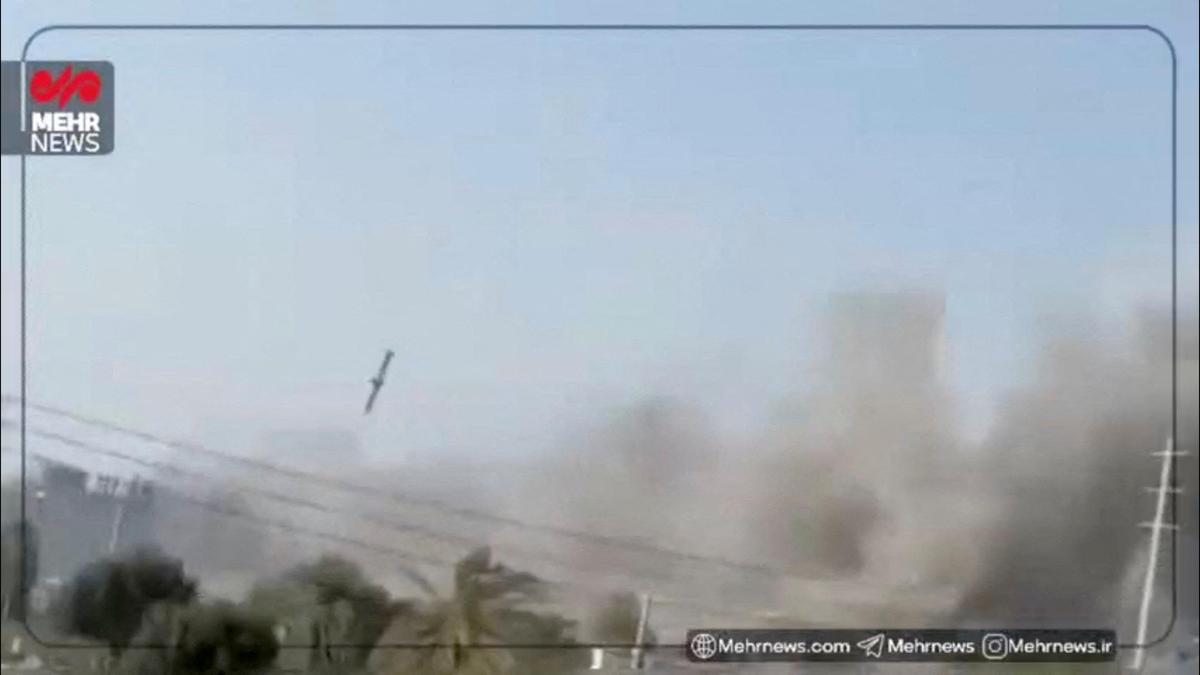
The Pentagon has quietly shifted its stance on the missile strike that leveled a vocational center in western Iran, moving from a standard "monitoring" phase into a high-priority formal investigation. While initial reports focused on the tragic loss of life and the immediate diplomatic fallout, the real story lies in the forensic evidence being gathered by U.S. intelligence officials. They aren't just looking at who pulled the trigger; they are scrutinizing a catastrophic failure in the digital chain of command that governs modern precision warfare. This elevation of the probe suggests that the hardware involved may have acted on data that was either corrupted or intentionally manipulated by a third party, a scenario that terrifies every military strategist in the West.
Washington’s sudden urgency stems from the discovery of specific electronic signatures at the site that do not match the standard operational profile of the regional actors involved. For decades, the assumption has been that "smart" bombs are only as smart as their human handlers. We are now entering an era where the software layer between the command and the kinetic strike has become a primary target for sabotage. If the investigation confirms that a spoofed signal redirected a mid-flight munition toward a civilian target, the implications for global security will outweigh the immediate geopolitical tension between Washington and Tehran.
The Failure of Identification Friend or Foe Systems
At the heart of this investigation is the IFF (Identification Friend or Foe) protocol, a sophisticated mesh of transponders and encrypted handshakes designed to prevent exactly this kind of disaster. In the chaos of the strike near the border, these systems should have flagged the school as a protected site. They didn't.
Military analysts are currently dissecting the "black box" data from the launch platform. The objective is to determine if the coordinates were altered after the pilot—or the remote operator—confirmed the target. In high-stakes environments, the margin for error is measured in centimeters. When a precision-guided munition hits a target with zero deviation but that target happens to be a school rather than a suspected missile silo, you no longer have a human error problem. You have a systemic integrity crisis.
Recent history shows that electronic warfare suites in the region have become incredibly dense. Signals are jammed, GPS coordinates are offset by "spoofing" towers, and the very airwaves are thick with digital noise. However, overriding a hardened military encryption to redirect a strike is a feat of engineering that requires state-level resources. The Pentagon is currently tracking the origin of a localized burst of high-frequency interference that occurred exactly four seconds before impact.
Why the Vocational Center Became a Target
The specific location of the strike—a vocational training center—adds a layer of complexity to the investigation. From a satellite's perspective, large industrial buildings often mimic the heat signatures and structural layouts of assembly plants for drone components or ballistic missile parts. This is the inherent danger of "pattern-of-life" targeting.
Intelligence agencies rely on algorithms to flag suspicious activity. If a school starts receiving heavy shipments of crates or sees an influx of vehicles at odd hours, the software may automatically elevate its threat level.
- Input: Satellite imagery showing heavy logistics at a civilian site.
- Algorithm: Flags the site as a high-probability storage facility.
- Outcome: A strike is authorized based on a digital shadow rather than human intelligence.
The investigation is looking into whether the Iranian military intentionally used the school as a "human shield" by moving sensitive equipment nearby, or if a foreign intelligence agency "salted" the location with electronic decoys to bait a strike. Both possibilities are on the table. The former is a common, albeit cynical, tactic in modern insurgency; the latter is a sophisticated act of provocation designed to strip the attacking force of its moral and diplomatic standing.
The Invisible Battlefield of Signal Intelligence
While the world watches the smoke clear on the ground, the real war is being fought in the electromagnetic spectrum. The Pentagon’s decision to elevate the investigation follows a classified briefing regarding "GPS folding," a technique where a fake signal is wrapped around a genuine one, slowly drifting the target coordinates without triggering any onboard alarms.
Modern missiles use a combination of Inertial Navigation Systems (INS) and GPS. The INS is a physical backup—it uses gyroscopes and accelerometers to track movement from a starting point. It cannot be hacked. However, it can drift over time. To stay accurate, the missile constantly "checks" its position against GPS satellites. If a malicious actor can feed the missile a false GPS location that is only slightly different from its actual location, the missile will "correct" its flight path. It will fly perfectly into the wrong building, believing with absolute digital certainty that it is hitting the right one.
This is the "Deadly Geometry" that investigators are now mapping out. They are recreating the flight path of the strike using raw data from every available sensor in the region—weather satellites, commercial aircraft transponders, and even ground-based cell towers. If the physical wreckage shows the missile's fins were adjusted to compensate for a non-existent GPS error, the Pentagon has proof of a sophisticated cyber-kinetic attack.
Accountability in the Age of Automated Warfare
The legal framework for military strikes has not kept pace with the speed of the technology. When a human pilot makes a mistake, the chain of responsibility is clear. When an automated system is compromised by an external signal, the blame becomes a murky, distributed mess.
Iran has already moved to capitalize on the tragedy, using the incident to demand international sanctions and a total withdrawal of foreign forces from its borders. Their narrative is simple: a reckless superpower struck a school. The Pentagon's counter-narrative is far more difficult to explain to the public. Trying to convince the global community that a "signal anomaly" caused the death of civilians sounds like a convenient excuse. This is why the investigation has been elevated. Washington needs a "smoking gun" of electronic interference to avoid a total diplomatic collapse in the region.
The Problem with Precision
We have sold the world on the idea of "surgical" strikes. We promised that we could remove a threat with the precision of a scalpel, leaving the surrounding tissue—the civilian population—untouched. This strike has shattered that illusion.
- Over-reliance on Sensors: Humans are no longer the primary decision-makers in the final seconds of a strike.
- Vulnerability of Data Links: Every wireless connection is a door that can be kicked open.
- The Fog of Cyber War: It is now possible to cause an enemy to commit a war crime by simply changing a few lines of code in transit.
If the investigation reveals that the strike was the result of a "Man-in-the-Middle" attack on the missile’s guidance system, it will necessitate a complete overhaul of how the U.S. and its allies conduct air operations. Every piece of equipment in the inventory would suddenly be viewed as a potential liability.
The Geopolitical Fallout and the Path Forward
The Iranian government’s response has been uncharacteristically organized. Within hours of the strike, high-definition footage of the aftermath was being broadcast globally. This suggests they were prepared for the event, or at least prepared for an event. Some analysts suggest that the school may have been a "trap" designed to be hit, specifically to trigger the exact international outcry we are seeing now.
The Pentagon is also investigating the role of private contractors. Much of the software used in target identification and signal processing is developed by third-party firms. If a vulnerability was sold on the gray market or if a developer was compromised, the breach could be systemic. This isn't just about one missile; it's about the integrity of the entire Western defense architecture.
The elevated investigation will likely produce a report that is 90% redacted. The public will see the headlines about "procedural failures" and "technical glitches." But between the blacked-out lines, the military establishment will be scrambling to patch a hole in their digital armor that they didn't know existed until the screams started in a vocational school in Iran.
The immediate task for the Pentagon is to prove that this wasn't an act of negligence. They must demonstrate that the system worked exactly as designed, but that the design itself was exploited. In the world of high-stakes intelligence, being hacked is almost as embarrassing as being incompetent, but it is far easier to fix. You can update software. You cannot easily fix a reputation for killing children.
The investigation must now pivot toward identifying the "Third Actor." If it wasn't a U.S. error and it wasn't an Iranian setup, then someone else was in the wires. Identifying that presence is the only way to prevent the next "precision" disaster from starting a global conflagration.
Check the serial numbers on the recovered guidance chips and cross-reference them with the batch-level encryption keys issued during the last maintenance cycle.