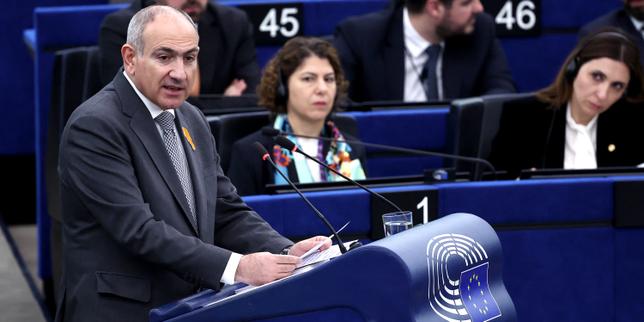
Yerevan is no longer asking for permission. After decades of tethering its security and economy to the Kremlin, Armenia is aggressively pivoting toward the European Union and the United States. This is not a symbolic gesture or a mere diplomatic flirtation. It is a desperate, calculated survival strategy triggered by a fundamental breakdown in the post-Soviet security architecture. The shift follows a series of catastrophic failures by the Russian-led Collective Security Treaty Organization (CSTO) to protect Armenian borders, leaving the small Caucasian nation to conclude that its "strategic ally" in Moscow is at best indifferent and at worst complicit in its territorial erosion.
The acceleration toward Brussels is fueled by a harsh realization. For thirty years, Armenia traded its sovereignty for a Russian security umbrella that proved to be made of paper. When Azerbaijani forces seized Nagorno-Karabakh in a lightning offensive in September 2023, the Russian "peacekeepers" stationed there stood by. They watched. They did nothing. This inaction was the final nail in the coffin of the Russo-Armenian alliance. Now, Prime Minister Nikol Pashinyan is navigating a minefield, attempting to extract his country from Moscow’s orbit while simultaneously integrating into European systems before the next regional conflict erupts.
The Cost of the Russian Security Illusion
For the average citizen in Yerevan, the CSTO was once viewed as the ultimate insurance policy. If Azerbaijan or Turkey threatened the Armenian heartland, the Russian Bear would intervene. That belief has been shattered. Between 2020 and 2024, Azerbaijan conducted several incursions into Armenia proper—not just the disputed territory of Karabakh, but internationally recognized Armenian soil. Each time, Yerevan invoked the mutual defense clauses of the CSTO. Each time, the response from Moscow was a shrug and a call for "restraint on both sides."
This was a betrayal of the highest order. It signaled to the world that Russia’s priorities had shifted. With its military resources bogged down in Ukraine, the Kremlin no longer has the appetite or the capacity to police the Caucasus. More importantly, Moscow’s growing reliance on Baku and Ankara for sanctions-evasion routes and energy transit has made Armenia an expendable pawn. Armenia is reacting to this new reality by freezing its participation in the CSTO and seeking "security diversification." This is a polite way of saying they are shopping for new protectors.
France has emerged as the most vocal Western partner, shipping Bastion armored vehicles and signing contracts for sophisticated radar systems like the GM200. India, another rising power wary of the Turkey-Azerbaijan-Pakistan axis, has become a major weapons supplier to Yerevan. But weapons are only part of the equation. To truly detach from Russia, Armenia needs the economic and political gravity of the European Union.
Breaking the Energy and Trade Shackles
The difficulty of this pivot cannot be overstated. Russia owns Armenia’s energy grid. It owns the railways. It provides the vast majority of the country's natural gas and grain. Moving toward the EU isn't just about signing papers in Brussels; it’s about a painful, multi-year process of decoupling an economy that was designed to be a satellite.
The European Union’s response has been uncharacteristically swift. The launch of the European Union Mission in Armenia (EUMA) put civilian observers on the border with Azerbaijan. While they carry no weapons, their presence serves as a "tripwire" for Western diplomatic fallout. It is a psychological deterrent. More critically, the EU-US-Armenia high-level meeting in April 2024 unlocked a Resilience and Growth Plan, promising hundreds of millions of euros to modernize Armenia’s infrastructure and energy independence.
The Nuclear Hurdle
The Metsamor nuclear power plant is perhaps the most significant symbol of Armenia's dependency. It provides nearly 40% of the country’s electricity and runs on Russian fuel, managed by Russian technicians. You cannot simply flip a switch and replace a Soviet-era reactor with a Western one. The EU and the US are now discussing the feasibility of small modular reactors (SMRs) to eventually replace Metsamor. This is a decades-long project. In the meantime, Armenia remains vulnerable to a "gas blackmail" scenario where Moscow could plunge the country into darkness during a cold winter to punish its political insolence.
Economic Reorientation
Armenia's exports are currently skewed toward the Eurasian Economic Union (EAEU). While Western sanctions on Russia have ironically boosted Armenia's GDP through re-export trade, the government knows this is a temporary and dangerous windfall. The goal is to align Armenian standards with the EU’s Single Market. This requires a massive overhaul of food safety regulations, industrial standards, and anti-corruption measures. It is a bureaucratic marathon that the Pashinyan administration is sprinting through.
The Existential Threat of the Zangezur Corridor
At the heart of the tension lies a strip of land in Armenia’s southern Syunik province. Azerbaijan, backed by Turkey, demands a "corridor" through this region to connect its mainland with its exclave of Nakhchivan. They call it the Zangezur Corridor. Crucially, Russia wants to control this route, as per the 2020 ceasefire agreement.
Armenia sees this as a violation of its sovereignty. They are willing to open transport links, but only under Armenian jurisdiction and customs control. The West supports Armenia’s "Crossroads of Peace" initiative, which emphasizes national control over infrastructure. Russia, however, views its loss of control over these transit routes as a strategic defeat. If Armenia fully pivots to the West, it denies Russia a critical geopolitical lever in the South Caucasus. This is why the pressure on Yerevan is so intense. The Kremlin isn't just losing a satellite; it’s losing its grip on the bridge between Europe and Asia.
Democracy as a Geopolitical Weapon
Armenia is the only democracy in a neighborhood dominated by autocracies. This isn't just a point of pride; it’s a survival mechanism. By positioning itself as a "bastion of democracy," Yerevan makes it politically difficult for Western capitals to ignore its plight. It creates a moral imperative for the EU to provide aid and for the US to offer diplomatic cover.
However, democracy is fragile. The Armenian opposition, often backed by pro-Russian interests, frequently capitalizes on the fear of another war. They argue that the Western pivot is a suicide mission that will provoke an Azerbaijani invasion or a Russian-engineered coup. Pashinyan’s gamble is that the benefits of Western integration—visa liberalization, investment, and modern security—will arrive fast enough to keep the public on his side.
The risk of a "color revolution" in reverse is real. Moscow has a long history of using its influence in the Armenian security services and church to destabilize governments it dislikes. The recent protests led by Archbishop Bagrat Galstanyan are seen by many analysts as a manifestation of this internal struggle. Armenia is currently fighting a war on two fronts: a diplomatic one in Brussels and a subversive one at home.
The Looming Shadow of Baku
While Yerevan looks toward the West, Azerbaijan is not sitting still. President Ilham Aliyev has been vocal in his disdain for the EU monitors and French military aid to Armenia. Baku perceives the Western involvement as an interference in its "internal affairs" and regional hegemony. The concern in Yerevan is that Azerbaijan might launch a preemptive strike before Armenia can fully modernize its military or secure more concrete security guarantees from the West.
The West’s leverage over Baku is limited. Azerbaijan is a key energy partner for Europe as it tries to wean itself off Russian gas. This creates a "gas-for-silence" trap. Will the EU sacrifice its energy security to save Armenian democracy? Historical precedents are not encouraging. Armenia knows it cannot rely solely on the kindness of strangers. It must make itself indispensable as a stable, democratic corridor for trade, while building a military capable of making any invasion too costly for Azerbaijan to contemplate.
Strategic Realism Over Romanticism
The rapprochement with the EU is often framed in romantic terms of "returning to the European family." The reality is far more cold-blooded. This is about physical survival. Armenia is a landlocked nation with two of its four borders closed. It is surrounded by powers that have historically sought its partition or subjugation.
The pivot is not about liking Europeans more than Russians. It is about the fact that Russia failed to deliver on the most basic promise of any alliance: protection. When a partner fails to show up for a fight, the alliance is over, regardless of what the paperwork says. Armenia is now in the "divorce proceedings" phase, and like any high-stakes divorce, the division of assets and the threats of retaliation are messy.
Armenia is currently seeking a "Strategic Partnership" with the United States and a "Comprehensive and Enhanced Partnership Agreement" (CEPA) with the EU that goes beyond trade. They are asking for a seat at the table in the European Peace Facility—the same fund used to arm Ukraine. This is a bold move that would have been unthinkable five years ago. It signals that Armenia is willing to burn its bridges with the Kremlin if it means building a fortress with the West.
The path ahead is fraught with systemic risks. There is no guarantee that the EU will offer the level of security that Armenia truly needs, nor is there any guarantee that Russia will let go without a fight. Armenia is essentially betting its entire national future on the hope that the West is more committed to democratic values than it is to cheap gas or geopolitical convenience.
Armenia's move toward the EU is a masterclass in high-stakes regional maneuvering by a state that has run out of options. If they succeed, it will be a historic shift in the post-Soviet landscape. If they fail, Armenia faces the risk of being partitioned or reduced to a vassal state of its more aggressive neighbors. The time for middle-ground diplomacy has passed. Armenia has made its choice, and the consequences of that choice are now the most important story in the Caucasus. Use this window of opportunity to diversify your trade routes and energy sources now, before the next regional upheaval closes the door for good.