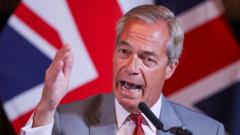
Nigel Farage secured another theatrical victory in Clacton, but his calculated by-election gambit has failed to bury an ongoing financial scandal involving a five million pound crypto donation. When a politician treats a democratic mandate as a personal shield against accountability, the underlying cracks in campaign finance laws become impossible to ignore.
The mechanics of modern British political survival rely on exploiting ancient loopholes. Westminster operates under a gentleman's agreement that assumes actors operate in good faith. Farage understands how to stress-test these brittle norms better than anyone else in contemporary politics.
The Anatomy of a Loophole
At the center of the controversy sits a five million pound transfer from cryptocurrency billionaire Christopher Harborne. For months, the exact nature of this monumental capital injection has fueled sharp friction between transparency advocates and the Reform UK leader.
Under House of Commons guidelines, newly minted lawmakers must declare any personal benefit exceeding three hundred pounds received in the preceding year if tied to political activities. Farage defends the transaction by framing it as a personal gift dedicated strictly to private security prior to his formal election.
This defense exposes a gaping chasm in regulatory oversight.
- Political parties operate under separate statutory frameworks.
- Personal security expenses blur the line between private welfare and campaign infrastructure.
- The watchdog mechanisms lack the agility to track high-velocity digital assets.
When definitions of political activity remain narrow enough to drive a campaign bus through, massive financial flows slip straight through the mesh.
The Weaponization of the Ballot Box
Faced with a mounting parliamentary inquiry that threatened formal suspension and a potential recall petition, Farage chose an aggressive counter-maneuver. By resigning his seat and forcing a snap local contest, he temporarily halted the investigation.
The strategy relied on transforming a compliance dispute into a populist referendum. Major opposition parties largely bypassed the circus, leaving a bizarre field of eccentric challengers and independent satirists to fill the ballot papers.
This maneuver achieved its immediate tactical objective. It manufactured a headline-grabbing mandate. Yet, a local majority in a coastal Essex constituency does not possess the legal jurisdiction to erase parliamentary codes of conduct.
Structural Decay in Electoral oversight
The broader institutional failure extends far beyond a single politician or party. British electoral law was constructed for an analog era defined by local branch fundraising and modest constituency spending limits. It was never engineered to withstand transnational cryptocurrency transfers or multi-million-pound benefactor backing.
Consider a hypothetical scenario where an industrial magnate funnels substantial venture capital directly into an emerging political leader's personal accounts months before a national campaign. If regulatory bodies are constrained by hyper-technical definitions of when a candidate officially becomes a candidate, transparency ceases to function.
Transparency International and various anti-corruption watchdogs have repeatedly warned that major donor influence has expanded exponentially over the past decade. The systems designed to map these dependencies are sluggish, under-resourced, and fundamentally outmatched by modern financial engineering.
Beyond the Spectacle
Farage will continue to frame every piece of financial scrutiny as an assault by entrenched elites. His supporters accept this narrative because the current system feels opaque and rigged to ordinary observers anyway.
Yet winning a seaside mandate does not rewrite statutory law. The parliamentary standards commissioner's paused investigation is designed to resume. If subsequent rulings conclude that the rules were breached, the political theater in Clacton will have served merely as a brief intermission before a much larger constitutional reckoning.
The five million pound question remains stubbornly unanswered, waiting for an institution brave enough to modernize the rules of engagement
For more context on the regulatory debates surrounding these events, you can watch this report on Elections watchdog decision. This video provides additional background on the specific spending and oversight arguments discussed by political analysts.
http://googleusercontent.com/youtube_content/1