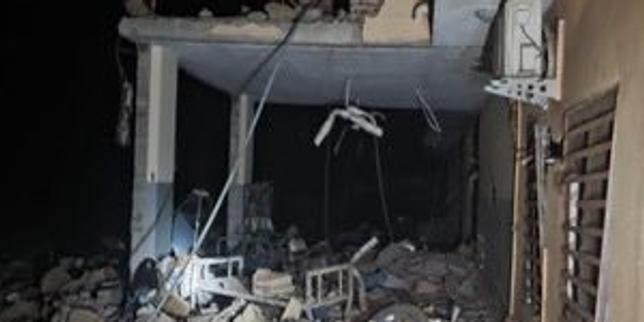
The smell of bleach usually signals safety. In a hospital, it is the scent of a battle won against infection, a sterile promise that the outside world’s chaos stops at the threshold. But in El Fasher, the capital of North Darfur, the bleach has long since been replaced by the metallic tang of old blood and the scorched-earth odor of cordite.
When the South Hospital was hit, it wasn’t just a building that collapsed. It was the last lie the city was telling itself.
For weeks, the facility had been the final lung of a suffocating region. While the Rapid Support Forces (RSF) and the Sudanese Armed Forces turned the surrounding streets into a meat grinder, the hospital remained a stubborn, fragile sanctuary. Then the shells landed. According to the World Health Organization, the death toll from the systematic dismantling of this sanctuary has now climbed to 70.
Numbers like "70" are dangerous. They are high enough to be tragic but abstract enough to be ignored. To understand what happened in El Fasher, you have to stop looking at the ledger and start looking at the floor.
Imagine a nurse named Amna. She isn't a character in a textbook; she is the composite of every medical professional currently trapped in the crossfire of Sudan's civil war. Amna hasn't slept in forty-eight hours. Her hands are stained because there are no more gloves. She is kneeling in a hallway because the wards are full, trying to suture a shrapnel wound by the light of a dying smartphone.
When the first explosion rocked the maternity ward, she didn't run. Nobody runs in a hospital under siege because there is nowhere to go. The patients are bolted to their beds by IV drips and broken limbs. To leave is to kill. So, you stay. You wait for the ceiling to become the floor.
The Geography of a Massacre
The siege of El Fasher is not a standard military engagement. It is a strangulation.
El Fasher was the last major stronghold in Darfur not controlled by the RSF. Because of this, it became a massive lifeboat. Hundreds of thousands of displaced people fled there, believing that a city of such size and historical importance would surely be protected by some unspoken international law. They were wrong.
The strategy used here is one of calculated exhaustion. By targeting the South Hospital—the only facility in the state capable of handling mass casualties—the attackers weren't just killing the 70 people who died in the immediate blasts. They were signing the death warrants of thousands more who now have nowhere to go when the next round of shelling begins.
The World Health Organization (WHO) confirmed that the hospital has been forced to shut down entirely. This is how a city dies. It doesn't happen all at once. It happens when the surgeons flee, when the oxygen tanks run dry, and when the last generator flickers out, leaving the premature babies in the neonatal unit to face the darkness alone.
The Invisible Stakes
We often talk about war in terms of territory. We look at maps and see red arrows pushing into blue circles. But the real territory of the Sudan conflict is the human body.
The 70 lives lost in the hospital attack represent a cross-section of a society being erased. There were mothers who had just given birth, elderly men with chronic heart conditions, and children who had already lost their homes in previous massacres.
Consider the logistical nightmare of a shuttered hospital in a war zone. When a facility like South Hospital closes, the "health" of a community doesn't just dip; it vanishes. A simple infection becomes a death sentence. A manageable labor becomes a double funeral. The WHO’s report isn't just a tally of the dead; it is a warning of an impending silence.
The tragedy is compounded by the fact that we have seen this before. The ghosts of the early 2000s haunt Darfur. The names of the militias have changed, and the weapons are more sophisticated, but the intent remains a terrifying constant. It is the displacement of a people through the systematic destruction of their ability to survive.
The Failure of the Global Gaze
There is a specific kind of loneliness that comes from dying in a place the world has decided is too complicated to help.
The people of El Fasher see the satellite feeds. They know the world is watching other wars with more intensity, more funding, and more moral clarity. Sudan, by contrast, is often treated as a "complex humanitarian crisis"—a phrase that acts as a sedative for the international conscience.
But there is nothing complex about a tank firing on a surgical theater. There is nothing nuanced about 70 people being pulverized in a place meant for healing.
The "complex" narrative serves the perpetrators. It creates a fog of war that allows them to operate with a sense of impunity. If the world views the conflict as an ancient, inevitable ethnic struggle, then the world doesn't feel responsible for stopping it.
The reality is much simpler. This is a power struggle fueled by gold, land, and regional influence, where the civilian population is used as a backdrop for a violent audition for total control.
The Cost of Silence
What happens the day after the hospital closes?
The streets of El Fasher are now a gauntlet. To seek medical care, one must travel through checkpoints manned by teenagers with Kalashnikovs and no concept of the Geneva Convention. For many, the risk of the journey is greater than the risk of the disease. They stay home. They die quietly.
This "excess mortality" is the true shadow of the 70 deaths reported by the WHO. For every person killed by a shell, three more will likely die from the absence of the doctor that shell drove away.
We are witnessing the creation of a medical desert in real-time.
The staff who remained at South Hospital until the very end are the unheralded giants of this era. They worked without pay. They worked without electricity. They worked while their own families were hiding in cellars. Their forced departure is the final victory of the chaos.
A World Without Sanctuaries
If a hospital is not safe, nowhere is safe.
This is the psychological payload of the attack. It tells the population that there is no "off-limit" zone. It breaks the spirit of the resistance by proving that even the most basic human impulse—to care for the wounded—is a target.
The WHO’s data is a scream into a vacuum. They provide the facts because facts are the only weapon they have, but facts require an audience willing to be moved.
When we read that the toll has risen to 70, we shouldn't think of a list. We should think of the silence in the hallways where there used to be crying babies. We should think of the dust settling on the unused operating tables.
The white walls of El Fasher are stained. Not just with the blood of the Sudanese people, but with the dust of an international order that promised "never again" and then looked away when it happened again.
The sun sets over Darfur, casting long, jagged shadows over the ruins of the South Hospital. Somewhere in the city, a mother holds a feverish child and looks toward the darkened building on the hill. She remembers when that building meant hope. Now, it is just another tomb.
The 70 are gone. The rest are waiting to see if anyone remembers they are still there.